

Welcome to TableTennisCoaching.com, your Worldwide Center for Table Tennis Coaching!

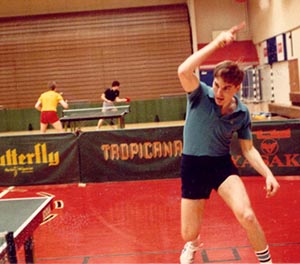
 Photo by Donna Sakai

This is an evolving website and Table Tennis Community. Your suggestions are welcome.

Want a daily injection of Table Tennis? Come read the Larry Hodges Blog! (Entries go up by 1PM, Mon-Fri; see link on left.) Feel free to comment!

Want to talk Table Tennis? Come join us on the forum. While the focus here is on coaching, the forum is open to any table tennis talk.

Want to Learn? Read the Tip of the Week, study videos, read articles, or find just about any other table tennis coaching site from the menu links. If you know of one, please let us know so we can add it.

Want to Learn more directly? There are two options. See the Video Coaching link for info on having your game analyzed via video. See the Clinics link for info on arranging a clinic in your area, or finding ones that are already scheduled.

If you have any questions, feel free to email, post a note on the forum, or comment on my blog entries.

-Larry Hodges, Director, TableTennisCoaching.com

Member, USA Table Tennis Hall of Fame & USATT Certified National Coach
Professional Coach at the Maryland Table Tennis Center

Recent TableTennisCoaching.com blog posts

How to Play Practice Matches with a Weaker Player - an Example
It's always a bit disconcerting to go to the USATT News page and see a big picture of yourself! (And it'll stay there until another news item goes up.) Here's the direct link to my Tip of the Week (from yesterday) as a USATT News item.

Here's an interesting example of this. Back in the 1990s we had a junior at MDTTC, Sunny Li, who was dominating several age groups. At one point he won Under 14, 16, and 18 at the Junior Nationals. But as he moved up in level and faced even stronger players, a problem began to show up. He had among the best serves in the country, and easily the best serves among juniors, and often devastated opponents by serving long and watching them flail away at these big, breaking deceptive serves (with spinny-looking no-spin mixed in) - and if they returned them weakly, he'd pound the return, forehand or backhand. But against stronger players, you can't get away with serving long as often, and his short serves were merely good, not great like his long serves. He also hadn't really developed a good short game, and against short serves mostly flipped or pushed long.  

Tip of the Week
How to Play Practice Matches with a Weaker Player.  (As explained in my Dec. 28 blog in the Tip of the Week, I'm putting up extra Tips of the Week and post-dating them for earlier in December so I'll end up with 150 Tips for the period 2014-2016. So today's Tip of the Week is dated Dec. 30. There is one more to go, and then we can finally celebrate the New Year!)

Last-Second Changes of Direction when Blocking
In the Sunday training session I had them do a basic drill, but with a twist. One player would serve and backhand loop (or forehand loop - I gave them that option) to his partner's backhand (or forehand - another option). The partner would aim the ball crosscourt - but at the last second would change and block down the line. (For advanced players, they had the option of going both ways.)

It's much easier to change directions at the last second on a block (or push) then with any other stroke - and players should take advantage of this. But you can't effectively do in a match what you don't practice, and so this was their chance to practice it. (And so should you.)

On the backhand side, it's a simple matter of pulling the wrist back at the last second and jabbing the ball down the line. On the forehand, you often take the ball a little longer - with the opponent often reacting to when he thinks you are going to contact the ball, and moving to cover the crosscourt. By taking the ball a split second later, and by bringing the wrist back slightly, it's easy to block down the line with the forehand. Many players don't have a down-the-line forehand block, a big hole in their games for savvy opponents, who know where you are next shot will be going.

Schools are closed today (Professional Day), and as usual, when the schools are off, so am I! We're having a one-day camp at MDTTC. We have so many full-time coaches that I'm not really needed, but I might go over anyway. Or I'll work on some USATT or writing projects. Meanwhile, this might be a good time for you to rewatch the old Matrix Ping-Pong video - probably the most hilarious table tennis video ever made! And then you can watch some of the amateur parodies, of which I've included four.

USATT Teleconference
The USATT Board had a teleconference last night. It was schedule for 7:00-8:20PM, but I think went on until after 9:45PM. There were three main items on the agenda, which I list as separate items, designated with a "=>". There was also a fourth, sort of, "New Business."

=>SafeSport Policy
Here's the USATT page on this which actually went up a few years ago. (Click on the three "Attachments" at the bottom for more info.) Basically, it means that a huge number of people are going to have to get background checks, and do so every two years. These include (and I'm copying this from the USATT page):

  • USATT Certified Coaches
  • USATT Board Members
  • USATT Staff
  • USATT Committee Chairs and Committee members
  • Affiliated Club Owners and Operators
  • Referees and Umpires
  • Tournament Directors and Organizers
  • Anyone else who has access to minors within USATT sanctioned competition or club activity.

SafeSport is supposed to safeguard us from the following, which I'm copying directly from the "USA Table Tennis SafeSport Policies and Procedures" document that's linked from the above.

Alex's Blocking
Between coaching sessions at the club I was watching Alex Ruichao Chen, one of our top player/coaches (rated 2713) working with one of our top junior players. Alex is a lefty, and was blocking backhands while the player forehand looped crosscourt. The part that was interesting was not his blocking, but what he did between the blocks. Most players in a drill, and especially coaches who do this hour after hour just keep their racket out there in backhand or forehand block position. (I plead guilty.) But not Alex! Between each block he'd not only return to a ready position, but he almost went into a forehand ready position. (He's a very forehand-oriented player, with perhaps the strongest pure third-ball attack in the country - serve and forehand rip - though he's worked hard the past year or so on his backhand.)

I looked around and watched the other coaches, and verified that they also mostly kept their rackets in blocking position when blocking for students. Alex himself would sometimes do this, so perhaps he is in the transition from hard-working player to one of us lazy coaches?

This is key for all players. When you drill, why would you keep your racket out there for the next shot? You'd be practicing something you never do in a match. Instead, go to ready position after each shot. Not only will you develop good habits, but you'll be ready for mishits, as well as become better at the transition from ready position to the shot you are practicing. When you are ready to become a coach . . . then you can get lazy.

How I Beat Boris Becker, by Andre Agassi
Here's the video (2:40). His secret? He could tell where Boris was serving by how his tongue stuck out of his mouth!

I had a similar coaching experience for many years. A member of the U.S. National Team for many years telegraphed when he was serving long by sticking his tongue out as he was serving! I coached against him many times, and my players did very well against him because of this. The player liked to serve long, and never figured out why some opponents always seemed ready for it.

In table tennis there are similar things you can pick up on, often subtle, if you watch for them. I would estimate that over half of players (including top players) telegraph their long serves by changing their backswing. That's a no-no - you need to use the same backswing for short or long serves. Even if opponents don't consciously pick up on it, they often do so subconsciously, and can tell when you are serving long without being sure how they know. This happens to me all the time - I can tell if someone's serving long but have to think about it to figure out what specifically gives it away.

As a test of how players react to a player's swing before contact, I once experimented on using a reverse pendulum serve motion until after I started the forward swing on the serve, and then switching to my favored pendulum serve motion. The result was astounding - people misread it over and over, and it became one of my serving mainstays.

Podcasts from Expert Table Tennis
Here are two new podcasts by Matthew Pearson

Tip of the Week
What Are Your Main Weapons? (As explained in my Dec. 28 blog in the Tip of the Week, I'm putting up extra Tips of the Week and post-dating them for earlier in December so I'll end up with 150 Tips for the period 2014-2016. So today's Tip of the Week is dated Dec. 29. There are two more to go, and then we can finally celebrate the New Year!)

Non-Technique Problems with Juniors and Adults
Yesterday I coached in three different 90-minute group sessions - one for beginning juniors, one for advanced juniors (mostly ages 8-10), and one for adults. In the latter two I noticed some interesting parallels. Usually junior and adult players have different problems. Most well-trained juniors have pretty good technique, but don't have the hand-eye coordination or control yet to be consistent. Most adults, unless they started as well-trained juniors, have technical issues, but better hand-eye coordination and control. But sometimes the problems are the same. Here are two examples, both involving forehand looping.

In the advanced junior session, there was a player who had good forehand loop. However, while sometimes he'd let it go and it would be pretty nice, often you could see him holding back, trying to just guide the ball onto the table, with his racket slowing down at contact instead of accelerating. At the adult session that night, there was a player who had the exact same problem. In both cases, the problem is more mental than technical. You have to just let the shot go and accelerate into the shot. It doesn't mean you rip the ball, but if you try to guide the shot, you lose speed and spin, and end up with a weak shot.

Tim's History of U.S. Table Tennis, Volume 19
It's finally happened - after working nine straight 18-hour days, we're almost done - but to get the thing finished today (Thursday), I was up past 1:30AM, and was up again at 6AM working on the pages. If all goes well, we'll finish today, and then Tim can go home early Friday morning. (We do about 12 hours per day on the book - just reading that makes me tired. The rest is my own coaching and other work.) I plan to sleep 12 hours straight when this thing is done.

But the bad news - no blog today or tomorrow. (Tomorrow's a "holiday," and I'll be recovering from all this.) So see you on Monday! Meanwhile, here's a repeating image of a cat bouncing a ball up and down on a paddle. Let me know on Monday how many times he bounces it. 

USA Citizens Rankings
They went up recently in the USATT ratings database. Go to the pre-set lists on the left, and click "US Citizens Only" at the top. And Behold! This is one of the things I promised to get done when I ran for the USATT Board. While I didn't do anything directly on this, I've been sending out periodic emails on this, asking them to get this done . . . and finally, it's done! (If you have any questions on this, or see any problems, contact the USATT Ratings Coordinator.)

For several years circa late 1980s/early 1990s I was in charge of creating and maintaining the citizenship list for USATT. We had no such list at the start, so I was asked to create one. So I sent out a mass postal mailing to the top 100 men and women in the country (this was before email was widespread), and had them contact me if they were USA citizens, including one-time proof (birth or naturalization certificate). For many of the "obvious" ones, I pro-actively contacted them, hounding them until I got the needed info. Once on the list, you stayed there forever. We regularly published the list of top men and women citizens in the print magazine.

Tip of the Week
Coaching and Playing Under the New ITTF Coaching Rule. (As explained in my Dec. 28 blog in the Tip of the Week, I'm putting up extra Tips of the Week and post-dating them for earlier in December so I'll end up with 150 Tips for the period 2014-2016. So today's Tip of the Week is dated Dec. 28.)

Cleaning the Newgy Robot
Last night I spent nearly two hours testing and cleaning our two Newgy robots. We usually have one, and one as a backup. The one we were using had recently started to jam regularly. It was reaching the point where it would do so every minute or so, and then we'd have to turn the robot off, and push the balls up through the feeder tube to unjam the balls. But that wasn't even the worst of the problems - the oscillator broke a couple months ago, so you could only aim it in one direction. Still worse, the shooting head had become loose, and so no matter where you aimed it, within seconds it would drift toward the wide forehand side. (To fix this, I began taping it in different positions with duct tape. Yes, you can fix anything with duct tape.)

As if that weren't enough, someone this past week managed to break the clamp that holds the controller to the side of the table. I'd improvised, balancing it against the net so it was workable.

Of course, we had that backup robot - except it had gone into storage because it was jamming every shot, and so was unusable. So . . . what to do?

I opened up both robots, as I'd done before, and tried cleaning the insides. But when I put them back together again, they still jammed. I also tried cleaning the area inside the hole the balls shoot out of (the head), but there are a bunch of parts in there, and even with a toothbrush I couldn't get at much of it.