Welcome to TableTennisCoaching.com, your Worldwide Center for Table Tennis Coaching!

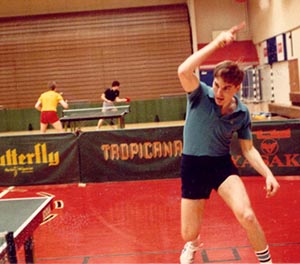
 Photo by Donna Sakai

This is an evolving website and Table Tennis Community. Your suggestions are welcome.

Want a daily injection of Table Tennis? Come read the Larry Hodges Blog! (Entries go up by 1PM, Mon-Fri; see link on left.) Feel free to comment!

Want to talk Table Tennis? Come join us on the forum. While the focus here is on coaching, the forum is open to any table tennis talk.

Want to Learn? Read the Tip of the Week, study videos, read articles, or find just about any other table tennis coaching site from the menu links. If you know of one, please let us know so we can add it.

Want to Learn more directly? There are two options. See the Video Coaching link for info on having your game analyzed via video. See the Clinics link for info on arranging a clinic in your area, or finding ones that are already scheduled.

If you have any questions, feel free to email, post a note on the forum, or comment on my blog entries.

-Larry Hodges, Director, TableTennisCoaching.com

Member, USA Table Tennis Hall of Fame & USATT Certified National Coach
Professional Coach at the Maryland Table Tennis Center

Recent TableTennisCoaching.com blog posts

Tip of the Week
Shot Awareness in Practice.

Chinese School Exhibition
On Saturday I did an exhibition/demonstration at a Chinese school at Rocky Hill Middle School. My partner for the exhibition was Lisa Lin, rated 1919, a member of the USA Hopes Team (top four under 12 at time of trials), who had just turned 12. I'd spoken to her briefly on Friday about what we'd do, since it was her first exhibition, and pointed out that between the two of us we'd done about 500 exhibitions. 

I gave my usual talk about table tennis being a game of strokes, footwork, and spin; how it was an Olympic sport; and emphasized how China dominates, since it was a Chinese school. We demonstrated forehands, backhands, footwork, and a multiball demonstration where Lisa did lots of footwork. I also explained spin, and demonstrated a backspin serve that bounced back into the net, and a sidespin serve where I served to the left, and the ball spun sideways and hit a conveniently placed paddle off to the right. 

Then I got into my "sad story" routine, where I explained how a terrible thing had happened, that after years of training, Lisa had gotten a "big head," had gotten conceited - and in fact had told me that very morning that she could beat me!!! So to settle it once and for all, we were going to have a challenge match, with the loser sweeping and mopping the gymnasium that night. 

Thursday Beginning Junior Class
We started a new seven-week session of the Thursday class, which is 6-7 PM – though in reality we tend to go an extra 20 or so minutes each time, since the kids are so enthusiastic and it's my last coaching of the day, so I'm free. The new session has a small group of just seven, including two returnees from last session, but it's already looking like one of the best groups to work with. It's also a somewhat older group than in the past, ranging from 11 to 15. But all seven are gung-ho about table tennis – not a slacker in the group!

When I say "slacker," that means two types of players that can really hurt a group session. One is the type who doesn't really want to play, doesn't want to be there, treats it like work, and keeps asking, "How much longer?" The other is the goof-off, who won't take anything serious, and refuses to try or learn – they just smack balls around however they want to. Both of these types can hurt the group as their behavior can spread to others.

But there are no slackers in this group!

Six of the seven have obviously played some before, and knew how it was supposed to be played – they all could hit decent forehands and backhands. One is more of a beginner, playing "basement" style where he mostly patted the ball back with his backhand; forehands were a novelty for him. But he's picking it up.

MDTTC Media Coverage and the Washington Post
Since 2012 I've been keeping careful track of MDTTC media coverage, with 54 different items. (We've been open since 1992, and I have a huge folder of media coverage from before 2012, but not online.) I send out regular press releases; every club should have someone sending out periodic press releases to generate media coverage. 

Even though we're an hour away, we get pretty good coverage from the Baltimore Sun, with twelve items, including five in the past two months. But the thing that jumps out to me is that lack of coverage by the Washington Post. The Maryland Table Tennis Center is in Gaithersburg, which is part of the DC Metropolitan Area – we're about 15 miles north of DC. And yet since 2012 we've only had four items in the Post, two in 2012, one in 2014, and one in 2015. What's wrong with them??? Don't they realize table tennis is [we'll get to this part].

On Tuesday night I wrote two press releases, one about the Hope Trials in Canada (MDTTC girls Tiffany Ke and Lisa Lin finished third and fourth), and about the MDTTC Open this past weekend. As usual, the Baltimore Sun did a feature on them. But the Post? Not a word. This is especially aggravating as I've been reading the Post since I was a kid, and I still get daily delivery.

So I wrote a third item, a letter I emailed to Washington Post Sports. Here is the letter. I'll let you know if there's a response.

Dear Washington Post Sports,

I’d like to call your attention to the lack of coverage of the sport of Table Tennis in the Washington Post. I understand the bulk of your coverage will go to sports like football, basketball, and baseball, but consider this:

USATT Teleconference
Last night we had a USATT board teleconference from 7-9PM. Here's a very rough synopsis of what we went over. Other than approval of minutes of past meetings (items #3 and 4), no votes were taken.

Energized vs. Non-Energized, Back Problems, and Todo List
There are really two types of energy in table tennis – physical and mental. The mental often overpowers the physical. I sometimes think I'm tired (physically) roughly 90% of the time, but you simply have to overcome that mentally. But a lot of it depends on who you are coaching or hitting with, or what you are working on.

When coaching or playing an energized player who is trying hard, you get energized. When paired with an uninterested player, you lose energy. When working with a kid who has no interest and is constantly asking "How much longer?", or who simply goofs off constantly, you have absolutely no energy, and feel like a black hole of lethargy. (All coaches have faced that.)

When working on something that I'm really interested in – in particular coaching or writing projects – I tend to be more energized. When working on projects like setting up the Maryland State Championships – well, it's exciting to have one, but the actual work in setting it up is a bit non-energizing. Sometimes when I find myself working on something that's "important," but will take up a lot of hours that few if anyone will ever know happened, it's a bit non-energizing. (That describes most USATT work!) Maybe that's why I sometimes put my todo list in my blog (see below)? There's also the problem of helping out thankless people, where you spend a lot of time helping someone out, and they just take it for granted. (I could go into a rant on that, but won't.)

Tip of the Week
How to Do Demonstrations.

MDTTC April Open
I ran the tournament this past weekend at the Maryland Table Tennis Center. Here are complete results. Now, can I go back to bed?!!! (I'll put up photos later on.)

I've run about 150 USATT sanctioned tournaments, dating back to the early 1980s. However, except for two that I ran back in 2012, I hadn't run any in about a decade. But as noted in past blogs, Charlene Liu, who had been running our tournaments, is now running her own full-time club in Washington DC, and so we needed a new director. So who did they ask/recruit/enslave? (But I do get paid.)

So I had to relearn the process all over again. I used Omnipong for the tournament, just as I did in 2012, and it worked great. Wen Hsu and Lixin Lang helped out tremendously, and were the difference for me between exhaustion, and complete, utter, annihilating exhaustion.

What Programs Should a Club Have?
There's an obvious difference between what a full-time club and a part-time club may have. I'm going to write about some of the programs my club has, a full-time one (MDTTC). Most full-time clubs have similar programs; part-time programs should pick and choose which ones they may be able to sustain - or more importantly, ones that will help sustain and grow the club. These programs bring in new players, keep current ones, and bring in revenue for the club. If you are interested in learning about any of these programs, or how you can run one, email me. (With the tournament I'm running this weekend, and other commitments, I might need a few days to get back to you.)

Table Tennis Players Who Are Very Good in Other Sports
There are a number of table tennis players who also excel in other sports. What follows is NOT a comprehensive list – it's a list of ones that I know of and remember this morning. To do a more comprehensive listing would take some real investigative work, and I'll leave that to the real investigators – you, the readers – so comment below your own nominations. (I know I'm leaving out some obvious ones.) Probably the three best all-around athletes in USATT's modern history were Dan Seemiller, Brian Pace, and Brian Masters.

World Table Tennis Day and Local Table Tennis People
Yep, it's today. Here's the World Table Tennis Day Facebook page, with lots of postings about various activities around the globe. (Including this rather interesting picture!)

Here's the ITTF press release on Table Tennis for NepALL - Inauguration Ceremony, which is being held today – it says, "Kathmandu has the honour to be the capital of the World Table Tennis Day," and "Kathmandu hosts the main event of World Table Tennis Day and promotes Table Tennis among people with a disability in Nepal"

Some are taking this very seriously (good!). Here's the Pongathon schedule for Mayrhofen, Austria.

Now celebrating World Table Tennis Day is a good thing. I've had people ask, even demand to know what I or others are doing this day. You know what? Some of us are doing "World Table Tennis Day" stuff every day. Perhaps as part of this World Table Tennis Day you should look around and celebrate the people who are doing these things, day in and day out, always trying to make our sport better. Some are volunteers; some are paid; but if they are making the sport better, it's the same thing. Why not make a list of those in your area who are making a difference in our sport?

Monday Coaching
It was another busy day. It started with the afterschool program – but with two kids away, I mostly worked one-on-one for an hour with 7-year-old Qiyu, who is starting to master the strokes when he's able to pay attention. (If you've worked with 7-year-olds, you know what I mean!)

Then I had a session with 11-year-old Daniel, where we did lots and lots of counterlooping. We also did a lot of forehand attack drills, such as he serves backspin, I push, he loops, and then play out the point. We also had a long drill where he just attacked into my backhand ("The Great Wall of China" I call it after a good rally) with his forehand and backhand.

Then I had an hour with Navin, "The Bionic Man." Here's a write-up and video he did of the first two minutes of forehand to forehand. As I wrote in a comment there, the best part of the session was when we did a drill where Navin served to my backhand, I'd roll it back to his forehand, and he'd smash. We didn't play out the point as we wanted to focus on that first smash. After a time we switched the drill to where I'd roll the ball back anywhere on the table, and we'd rally until I went to his forehand, and then he'd smash. I also served to him for nearly 15 minutes so he could work on low, angled returns against varied serves.