
Welcome to TableTennisCoaching.com, your Worldwide Center for Table Tennis Coaching!

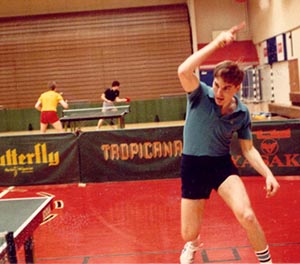
 Photo by Donna Sakai

This is an evolving website and Table Tennis Community. Your suggestions are welcome.

Want a daily injection of Table Tennis? Come read the Larry Hodges Blog! (Entries go up by 1PM, Mon-Fri; see link on left.) Feel free to comment!

Want to talk Table Tennis? Come join us on the forum. While the focus here is on coaching, the forum is open to any table tennis talk.

Want to Learn? Read the Tip of the Week, study videos, read articles, or find just about any other table tennis coaching site from the menu links. If you know of one, please let us know so we can add it.

Want to Learn more directly? There are two options. See the Video Coaching link for info on having your game analyzed via video. See the Clinics link for info on arranging a clinic in your area, or finding ones that are already scheduled.

If you have any questions, feel free to email, post a note on the forum, or comment on my blog entries.

-Larry Hodges, Director, TableTennisCoaching.com

Member, USA Table Tennis Hall of Fame & USATT Certified National Coach
Professional Coach at the Maryland Table Tennis Center

Recent TableTennisCoaching.com blog posts

Tip of the Week
Remember the Feel of the Good Shots.

Backspin/No-Spin Serves
We did some practice on this in my adult training session yesterday, 6:30-8:00 PM. Most of the players there could serve good backspin serves, but that becomes passé at a certain level – it needs variation. If you switch to sidespin or topspin, it's rather easy to attack. But a very low no-spin serve is hard to do much of anything with – and if it looks like backspin, it can be devastating.

When you serve backspin, at most levels you will most likely receive a long push return, and so you likely set up to loop, forehand or backhand. For some, that's enough. But why not get some "free" points as well? A low, heavy, short backspin serve is difficult to attack, and that's why it's usually pushed back. But it's also easy for the receiver to push it back low and heavy, and so while you get to loop, you don't get a really easy ball to go after. That's where no-spin comes in.

When you serve no-spin, there's a higher chance the receiver, if he reads it properly, will attack it. But most likely, if you've set him up by serving backspin previously, will push it back. And if he doesn't adjust by chopping down, the ball will tend to pop up, giving you an easy ball to put away. It'll also have less backspin, as there's no incoming backspin to rebound with backspin.

Ping-Pong for Quitters – My New Book!
Are you gutless under pressure? Unwilling to fight? If so, I have written the book for you!
Ping Pong for Quitters is my 12th book, my eighth on table tennis. (Here are all of my books.)
Realizing that most players are not as serious and hard-working as most high-level players,
I decided to write one for you, the normal player, the ones who don't always try their best,
like to goof off, and would rather quit than fight hard and put in all the hard work needed
for those who want to be the best. Some players will fight to the end in every game, but
others just don't have that warrior instinct. It is for those players that I dedicate this book.
Of course, few players will admit to being of the lazy, quitting sort, but no one has to know!
Like most of us, you can just have fun with the sport, and leave the sweat and tears to the
Stars (who buy this book instead) – and this book tells you how. On sale soon at Amazon!

A Simple Side-to-Side Drill
Sometimes the best comes from the simplest. Yesterday I was working with Navin on his forehand-to-backhand transition, feeding multiball side to side as he hit forehands and backhands. After a bit I said now let's do it randomly, where he had to react to where the ball goes. But he hesitated. I asked why, and he said he was now hitting the forehand so well that he wanted to do the simple side-to-side drill longer, to really ingrain it. We'd been working a lot on his forehand, and more and more it's beginning to click. So we continued doing the drill for a while longer.

This brought back a memory from 1979, when I was an up-and-coming 19-year-old. From 1979-1981 I lived and trained in Wilson, NC, at the Butterfly TTC. I was training regularly with Bowie Martin Sr. (co-founder of Martin-Kilpatrick, more commonly known as Butterfly North America). He's a lefty, and I often drilled into his backhand. I remember doing the very same side-to-side forehand-backhand drill with him, over and over, with him backhand blocking side to side, often doing the drill more than once per session. Why? Because I was making the transition from forehand hitting to forehand looping. The drill allowed me to not only ingrain the stroke, but do it faster and quicker, often almost right off the bounce. By doing the drill constantly, I became very fast at moving to my wide forehand, good at taking the ball close to the table, and the stroke itself became very ingrained and consistent. I still fall back on this drill when I need to quickly get back into practice.

Systematic Drills
I've never understood why more players don't focus like a laser beam on exactly what they need to do to improve, and do specific drills that allow them to systematically develop those techniques. The key phrase here might be "systematically." For example, many rallies begin with an opponent looping against a push. This means you will face a loop off a push a lot - and so should practice systematically against it. To many, this means perhaps playing games or doing drills where the point starts with a player looping off a push - and that's a start. But suppose you do that, while your twin does a drill where he faces these loops against backspin five times as often, who's going to improve against it faster?

So instead of playing out points, why not have one player serve and loop against a push, and while the other player reacts to the loop (probably by blocking, smashing, or counterlooping), the other player is reaching for another ball from a box of balls to serve and loop again. Result? One player gets systematic practice looping against a push; the other gets systematic practice against a loop off a push, perhaps working on his counterloop, which is different against a loop off backspin then a loop in a topspin rally. Both players dramatically improve. 

The same logic applies to other situations. Have trouble with a specific serve - say, a big breaking serve into the backhand? Then have a coach systematically give you that serve, without playing out the point. Or have a practice partner give you that serve and perhaps he plays one shot off your return, and then reach for another ball. Result? He systematically practices his serve and attack, while you systematically practice your receive off the serve that gives you trouble. 

Tip of the Week
Stroke Technique vs. Consistency, Serve, and Receive.

USATT Training Camp
USATT will be running a two-week "Super Camp" for USA team members immediately after the July 4-9 USA Nationals. With July 10 a travel date, the camp will run July 11-24. The location will be finalized soon, probably this next week. (We already have at least one very good option.) Organizing it is the new USATT High Performance Director Cory Eider, with assistance from Sean O'Neill, Han Xiao, and myself. I'm the volunteer, unpaid camp manager and one of the coaches. Sean and Han will also be there one week each as coaches. Other coaches will be named later, including a head coach for each week. (On a side note, I got the okay from Cory to go public with all this. I don't want to upstage USATT on their camp, but he wanted everything to be transparent and said to go ahead and blog about it.)

We had a 2.5 hour Google hangout meeting yesterday (Cory, Sean, Han, and myself, from 3-5:30PM), where we discussed and planned the camp. A big emphasis is going to be physical training. As I blogged last Wednesday (see item #3 of the items where I discuss my thoughts on the HPD position), we have to focus on the weaknesses of USA players, and we were all in agreement that physical training was a top priority. That and receive seem to be the biggest weakness relative to our overseas competitors.

Off Until Tuesday
As usual, when there's a holiday and the kids are off school, I'm off too, and they are off Friday (Good Friday) and Monday (Easter). Spring Break actually begins today – no school locally today, tomorrow, or all of next week, with schools reopening on Monday, April 4 – but I'm only taking the two "official" holidays off. I'm not really taking Friday off – I'm declaring it a "USATT day," where I spend the day working on USATT issues. (This weekend and Monday, on the other hand, I may do a "House of Cards" marathon!) I'm also coaching at the two-day mini-camp at MDTTC later this morning and tomorrow, probably only the morning sessions.

In Memoriam
Here are some of the people I've known well from table tennis who have died. The list isn't comprehensive; there are many more, but these are the ones who were influential to me, in alphabetical order, with apologies to those missed. (Feel free to post your own comments below on any of them.) 

Cory Eider Named USA Table Tennis High Performance Director
Here's the USATT article. "Eider will be responsible developing and directing all of USATT’s Olympic and National Team programs (Senior, Junior, Cadet, Mini Cadet, and Para), National Team coaches, as well as creating a National Team Development Program."

This could be a landmark for USA Table Tennis. Here is the "High Performance Director Wanted" notice, where it covers in detail what the HPD would be responsible for. I strongly urge you read the section under "Responsibilities and Requirements."

However, it's not just what he's responsible for – it's what he's expected to do. And that's to develop a year-round program where training centers, top players, top juniors, top coaches, and parents around the country work together to develop a national team that'll put the rest of the world on notice that USA, after sixty years of napping, is back.

Tip of the Week
Visualize Your Serves and Make Them Do Tricks.

The Brain, Visual Skills, and Ping Pong
Here's the video (5:13). The video from a year ago focuses on the two major visual skills needed in table tennis. (Here's the ITTF article on this.) The subjects are William Henzell and Trevor Brown, two Australian Olympic table tennis players. Brown, who is studying to be a neuroscientist, was asked, "What's the key to being a good table tennis player?" He answered, "It's being able to process info as quickly as possible."

The narrator says, "They have honed two visual skills to near perfection." The two keys are:

Off Until Tuesday
I'm leaving very early Friday morning for Lunacon, a science fiction convention in Rye Brook, NY, March. 18-20. I'm there to promote my SF novel Campaign 2100: Game of Scorpions – I'm on six panels, doing a reading, and will be in two autograph sessions. (Here's my bio and schedule. My reading is 4-4:30PM on Saturday. And remember, as I've blogged, the novel has lots of table tennis!) I'll be returning very late on Sunday night/Monday morning, so no blog on Monday. See you on Tuesday! (Coincidentally, the convention is about 15 min away from the 4-star Westchester Open held this weekend, but I don't know if I'll have time to stop by.)

2016 State Championships (so far)
There are currently 15 State Championships sanctioned for 2016 – but it's still early in the year. There'll be plenty more – for example, I'm running the Maryland State Championships later this year, but haven't sanctioned it yet. I know there'll also be a DC championships, and based on the listing for 2015 State Championships, there are plenty more to come. Here's the original USATT news item on this, with info on how you can run one. (Here's the USATT news item from earlier this week, on Regional Team Leagues and State Championships.)