
Blogs

Larry Hodges' Blog and Tip of the Week will normally go up on Mondays by 2:00 PM USA Eastern time. Larry is a member of the U.S. Table Tennis Hall of Fame, a USATT Certified National Coach, a professional coach at the Maryland Table Tennis Center (USA), and author of ten books and over 2100 articles on table tennis, plus over 1900 blogs and over 600 tips. Here is his bio. (Larry was awarded the USATT Lifetime Achievement Award in July, 2018.)

Make sure to order your copy of Larry's best-selling book, Table Tennis Tactics for Thinkers!
Finally, a tactics book on this most tactical of sports!!!

Also out - Table Tennis TipsMore Table Tennis Tips, Still More Table Tennis Tips, and Yet Still More Table Tennis Tips, which cover, in logical progression, his Tips of the Week from 2011-2023, with 150 Tips in each!

Or, for a combination of Tales of our sport and Technique articles, try Table Tennis Tales & Techniques. If you are in the mood for inspirational fiction, The Spirit of Pong is also out - a fantasy story about an American who goes to China to learn the secrets of table tennis, trains with the spirits of past champions, and faces betrayal and great peril as he battles for glory but faces utter defeat. Read the First Two Chapters for free!

USA Nationals Dates
As announced yesterday in USATT Insider, the USA Nationals this year will be July 1-7 in Las Vegas. For most of us, those are probably fine dates. However, for the large number of U.S. players attending the World Veterans Championships, June 18-24, also in Las Vegas, it poses a dilemma, since there's a week between the two. Do you attend both? If so, do you fly home and back in between, or stick around for a week?

Ideally, the two would have been back to back, with perhaps one day rest between. That's what USATT would have liked, but it was not to be, for several reasons. The main problem is that the World Veterans Championships has built into the contract that no other major tournaments can be run locally at the same time or the week before or after, since that could draw away entries from them. This makes sense, as it is a large undertaking, and the last thing they want is a competing local tournament. There was some discussion of making an exception, but apparently they didn't agree. (I wasn't in on the discussions.)

Another reason not to run them back to back was the hotel cost. Apparently the July 4 week is one of the worst weeks in Las Vegas for tourists, and so around July 1 the hotel costs plummet to something like one-fourth what they normally charge. The hotels don't really need high hotel rates to make money; their primary source of income is from their casinos, and so they do whatever is needed to bring in customers during slow periods so they can get those customers to give them money gamble. (This also happened at the U.S. Open in December, where the hotel costs were about $30/night for most of the tournament, then right at the end went up to about $120. This was in addition to the infamous "resort fee.") So by not having the tournaments back to back, you'll likely save something like $90/night in hotel fees. That should make up for your air costs if you have to fly home and back.

Another reason brought up not to run them back to back was staff issues. It's not easy spending 10-12 hours/day running a tournament for a week – and to do it for two weeks straight is mind-bogglingly difficult! However, this was less important to me as we'd have had a day in between for rest, and likely given staff a few extra days off afterwards, and perhaps schedule other breaks as well. But it was a concern.

Personally, my plan is to attend the World Veterans (June 18-24), where I'll be doing daily coverage for USATT and ITTF, as well as playing in the 55-59 age event. Then I'll attend two days of USATT Board Meetings (June 25-26). Then I plan on taking a reading and writing vacation (June 27-30) – paradise to me is sitting in a hot tub reading a great science fiction novel. And then I'll be coaching and perhaps playing in the USA Nationals (July 1-7).

Of course, none of this answers the age-old question (or at least since 1976, when we first had a USA Nationals in addition to a U.S. Open): Why do we generally call it the USA Nationals, while the other is the U.S. Open?

Hungarian Open
Here's the ITTF page for the event, Jan. 18-21 in Budapest, with draws, results, articles, photos, and video. Fan Zhendong (CHN, world #2) and Chen Meng (CHN, world #1) lead the men's and women's draws.

USATT 2018 Team Selection Procedures Pave Way for Unified National Team
Here's the USATT article.

Who Should Use Thin Sponge Rubber?
Here's the article by Coach Jon.

Portland Hosts Second Successful Course, Ideal Premises in Oregon
Here's the ITTF article on the ITTF coaching course taught by Christian Lillieroos.

Table Tennis Teen from West Hempstead Hopes to Make U.S. History
Here's the article featuring junior star Estee Ackerman. She's also the feature picture on the cover this morning.

Jörgen Persson to Address Sports Science Conference
Here's the ITTF article.

National Collegiate Table Tennis Newsletter
Here's the new January issue.

Not a Game for Boys
Here's the table tennis novel by Simon Block. (I just ordered a copy – at 104 pages, it'll be a quick read.) "Once a week, three cabbies seek respite from their lives in a local table tennis league, and tonight they must win, or face the unthinkable oblivion of relegation. Deeper rivalries and competitive obsessions emerge as the team try to survive the pressure, but the real game takes place anywhere but at the table." The novel is based on the play of the same title, also by Simon Block, from 1994. Here's a review of the play, which was apparently was running last summer in Dublin, Ireland.

Sun Yingsha Best Points 2017
Here's the highlights video (8:32) of the world #1 junior girl from China. (Here's the ITTF Under 18 Girls ranking list.)

Sunny Bunnies in Kung Fu Ping Pong
Here's the cartoon video (3 min 11 sec). The link should take you to 15:09, and the table tennis cartoon goes until 18:20.

***
Send us your own coaching news!

Ten Tips

  1. Shirt Longevity. Have you ever bought a nice table tennis shirt, and perhaps had your name and/or club lettered on it – only to see it wear away after a year or so? There's a simple way to avoid this. Always turn your shirts inside out before putting in the laundry. A washing machine pretty much pounds with water the outside of a shirt, so put that lettering and other shirt designs on the inside.
  2. USATT Clothing. Buy some USATT clothing, brand table tennis clothing, or some sort of table tennis outfit, and look like a real pro!
  3. Shoes in a Bag. Keep your playing shoes in a plastic bag or shoe bag in your playing bag. You don't want to wear them to and from the club unless you want to get the soles dirty (thereby losing traction), track dirt into your club, wear the shoes down, and put extra pressure on your legs and knees (since table tennis shoes aren't designed for extensive walking – little support).
  4. Dedicated Shoes for Slippery Floors. Do you sometimes play on good floors, other times on slippery floors? Have two pairs of table tennis shoes. One pair should be new and dedicated to slippery floors, since new shoes grab on the floor better. When it begins to wear out, it becomes your regular pair, and you get a new one for the slipper floors. Since some types of shoes grab the floor better than others, you might even buy a special pair of "grabby" shoes for slippery floors.
  5. Keep a Towel. Keep a towel in your bag when the weather gets hot and humid. In fact, if you sweat a lot, have two of them – one for you, and one for your racket and ball. (Hitchhiker's Guide to the Galaxy was right.)
  6. Drink. Always have plenty to drink while playing. Just keep sipping a little at a time the whole session. Perhaps have a few snacks available as well.
  7. Keep your Racket Clean. Normally wash it with water after or before every session. Occasionally use special rubber cleaners to really clean it off.
  8. Long Pips. Learn to play against long pips. If you have trouble playing long pips, then find someone who uses long pips, and ask, plead, or beg them to play you, and keep playing them until you figure out how to play them. Then you will never lose to anyone with long pips ever again. (Unless they are better than you.)
  9. Read this Blog. Mon-Fri. Why, of course.
  10. Have Fun. This is ping-pong, not real life.

US National Ranking Tournament Coming to Arnold Challenge
Here's the USATT article by High Performance Director Jörg Bitzigeio.

3 Years On: Have We Finally Adopted the Plastic Ball?
Here's the USATT article by Ray Huang.

Back Pain? 12 Tips for a Healthier Back!
Here's the video (4:24) by Samson Dubina, who turns out struggled with this for years.

Table Tennis Prodigy Determined to Live Up to Favorite Tag
Here's the article on Kanak Jha as he prepares for the Buenos Aires 2018 Youth Olympic Games.

My Favorite Haitians/Table Tennis From Haiti
Here's the article and video (6:20) from Coach Jon.

New Videos from EmRatThich

Penhold Play of Su Zhi
Here's the video (2:01) from the 2017 Amateur China Open.

Ping Pong Girl
Here's the video (60 sec) as she does trick shots!

FanDuel - Christian Laettner Ping Pong
Here's the video (37 sec) as the basketball star "motivates" workers through ping pong!

***
Send us your own coaching news!

Tip of the Week
Best Way to Learn – Watch, Mimic, Practice.

Board Teleconference – Executive Session
Last night we had a USATT Teleconference from 7PM to 8:40PM. Unfortunately, most of the meeting was in executive session, where we discussed confidential matters (personnel, legal, and/or certain financial issues). So I'm limited in what I can talk about.

We did come out of executive session to approve the 2018 USATT budget. It should be published on the USATT site sometime soon. We went over this previously, and went over it again during the teleconference. We also went over the dates of the USA Nationals this summer in Las Vegas – and the official dates should come out very soon. (There were scheduling complications in regard to the World Veterans Championships, June 18-24, also in Las Vegas, which I may blog about later.)

I've been pretty busy with USATT meetings recently. In December we had two days of meetings at the U.S. Open, plus the USATT Assembly. I flew out to Colorado Springs for a meeting on USATT Coaching Education and Certification on Monday, Jan. 8. There was the teleconference last night. And next Monday I'm on another teleconference regarding USOC online coaching resources that we may use or adapt. Mondays are becoming USATT Mondays.

USATT CEO Gordon Kaye returned Sunday from Vacation in Hawaii. Yes, he was there during the mistaken reporting of an incoming missile strike, and for 40 minutes or so thought his life was in danger!!!

Shoulder Injury
I was out for a month with a shoulder injury. I was having shoulder problems all through November and December, and at the U.S. Open in December I injured it pretty badly. I was forced to cancel all private coaching until this past Saturday, when I started up again. The shoulder is perhaps 80% healed, but I have a feeling this is one of those injuries that won't completely go away for a long time. I'm doing various exercises with a long rubber band.

I do have another injury. On Thursday last week, while getting the newspaper outside (yes, I still get one), while reaching down for it I released the screen door, which slammed into my heel, tearing an injury four inches long. It was pretty bad, and I really should have gone to the hospital. Instead, I cleaned it with soap and Neosporin, bandaged it up, and I've been limping ever since. But it doesn't really affect my table tennis, though it does hurt some moving as it puts pressure on the scab. It didn't get infected, and it's healing up.

The No. 1 Brain Sport
Here's the article by Mark Dekeyser in The Active Senior's Digest. "How do we stay mentally sharp as we age? Some try computer programs such as Lumosity (www.lumosity.com) or Fitbrains (www.fitbrains.com), others may prefer puzzles such as Sudoku and crosswords. We may be surprised to learn that physical activity is also good for our brains. Any type of physical activity can be valuable. The top physical activity for the brain is table tennis, say some experts."

2018 Team World Cup – China Team
Here's the article and pictures from EmRatThich.

How China Develops Their Players
Here's the video (1:57).

Training With Ma Long and Lin Gaoyuan at World Cup 2017
Here's the video (18:42) by Arnaud Scheen.

Sharon Alguetti (USA) vs. Artur Abusev (RUS) 2017 WJTTC
Here's the video (6:21).

The Future is…Ping-Pong? Omron Shows Off Incredible Table Tennis Robot
Here's the article and video (1:46). "Amid the buzz of drones, companion bots, and self-balancing rideable, an unlikely star shined on the first day of CES: ping-pong. Omron offered an incredible demonstration of its massive ‘Forpheus’ robot, which uses artificial intelligence to help improve your pong skills and set up the perfect volley."

Navin Kumar at Parkinson Association of Southwest Florida
Here's the video (6:01) of his motivational speech on Jan. 9 in Naples, FL at the Live Laugh and Learn Symposium for PASFI. (Here's a shorter 24-sec video of him bouncing a ball as he speaks.) The "Bionic Man," Navin Kumar has Parkinson’s and is a survivor of five open heart surgeries with mechanical heart, pacemaker and other artificial components.

Estee Ackerman to Appear on PIX 11 News
Here's video (9:20) of her playing with reporter Mr. "G" (Irv Gifoksky) in West Hempstead, NY. Estee won four gold medals at the recent U.S. Open in December. The story will come out in a few weeks.

History of USATT – Volume XX – Chapter 11
Here’s chapter 11 of Tim Boggan’s latest volume, which covers 1991-1992. Or you can buy it and previous volumes at www.timboggantabletennis.com.

Shot of the Day - Nandan Naresh
Here's video (11 sec) as Nandan pulls off a lunging, spinning backhand chop block that double bounces. Opponent is older brother Sid.

Ma Long in Smart Phone Commercial
Here's the video (30 sec).

Pongfinity – "Spin Serves" Episode 11
Here's the video (4:54). "In this episode Emil tries to flip a bottle with a ping pong shot, spin a coin with a ping pong serve, do various table tennis spin serves and eat a whole meal while keeping the ball in the air with his paddle."

***
Send us your own coaching news!

MLK Day
Today's MLK Day, so I'm off today - yes, it's Ma Long Karaoke Day! Here's the Chinese National Team members singing Karaoke (2:57) in 2010 – Ma Long, Wang Liqin, Ma Lin, and Wang Hao. The music starts about 15 seconds in. Ma Long sings 54 seconds in. (When they are standing at the stage at the start, L-R it's Wang Hao, Wang Liqin, Ma Lin, and Ma Long.) And just for fun, here's video (15 sec) of a trusting player blowing the ball up as Adam Bobrow smacks it out of the air. 

EmRatThich Table Tennis World Ranking System
Here’s the article and ranking list. This is not something he threw together – he goes over in detail the way his system works, which analyzes “43,735 table tennis matches played in 2017 (in official ITTF events) nearly 100 table tennis international tournaments during 2017.”

There have been many complaints about the new ITTF system, which rewards participation as well as level of play, leading to results that often don’t always correspond to actual playing levels. For example, it has Ma Long at #7 in the world, when he’s obviously #1 or #2. Here are the ITTF rankings. If you page down to “Official Documents,” there is info on how they are done. 

When doing such ranking systems, there is always the conflict between trying to set up the most accurate system, versus setting up a system that rewards and thereby increases participation. This is a classic case. USATT has the same problem - many players avoid playing to "protect" their rating. Using a system that rewards participation would likely increase participation, at the cost of accuracy. 

So let’s compare the two rankings, and you can judge for yourself.

EmRatThich System – Top 20 Men

  1. Fan Zhendong (CHN)
  2. Ma Long (CHN)
  3. Dimtrij Ovtcharov (GER)
  4. Timo Boll (GER)
  5. Lin Gaoyuan (CHN)
  6. Xu Xin (CHN)
  7. Tomokazu Harimoto (JPN)
  8. Jun Mizutani (JPN)
  9. Yan An (CHN)
  10. Fang Bo (CHN)
  11. Koki Niwa (JPN)
  12. Marcos Freitas (POR)
  13. Kenta Matsudaira (JPN)
  14. Lee Sangsu (KOR)
  15. Simon Gauzy (FRA)
  16. Vladimir Samsonov (BLR)
  17. Wong Chun Ting (HKG)
  18. Quadri Aruna (NGR)
  19. Ruwen Filus (GER)
  20. Hugo Calderano (BRA)

ITTF System – Top 20 Men

  1. Dimtrij Ovtcharov (GER)
  2. Fan Zhendong (CHN)
  3. Timo Boll (GER)
  4. Lin Gaoyuan (CHN)
  5. Xu Xin (CHN)
  6. Koki Niwa (JPN)
  7. Ma Long (CHN)
  8. Wong Chun Ting (HKG)
  9. Simon Gauzy (FRA)
  10. Kenta Matsudaira (JPN)
  11. Tomokazu Harimoto (JPN)
  12. Marcos Freitas (POR)
  13. Jun Mizutani (JPN)
  14. Lee Sangsu (KOR)
  15. Chuang Chih-Yuang (TPE)
  16. Omar Assar (EGY)
  17. Hugo Calderano (BRA)
  18. Ruwen Filus (GER)
  19. Yuva Oshima (JPN)
  20. Quadri Aruna (NGR)

Table Tennis with a Robot
Here’s the video (3:08) as they play with a robot that can rally live, not just shoot balls out at you. I’m wondering when these things will be on the market? However, they obviously can’t yet compete with a top player. From what I see, I don’t think it can react to aggressive shots to the corners, or to spins. However, I think they are missing the real future for this robot – put on a sheet of long pips, no sponge, and turn it into a pushblocker!!!

Throughout history people have made predictions about the future of such technology wonders that have proven false, so it’s risky making predictions here. However, I’m fairly certain that for the foreseeable future, these robots won’t challenge the top players. Perhaps many years from now.

US National Team - Year in Review 2017
Here’s the video (2:10). Live out the year with our National Team!

Dream Come True for Kanak Jha, Rankings Breakthrough for USA Star
Here’s the ITTF article.

30 Day Challenge to Improve Your Weakest Stroke
Here’s the article from Tom Lodziak.

Table Tennis Tidbits #16
Here’s ’16 Asian Olympic Trials:  Zhu “Helps” Ching Lose, by Robert Ho

Qualities Coaches Look For in Their Students
Here’s the chart. (Here’s the non-Facebook version.)

A Little Side to Side Footwork
Here’s the video (31 sec) with Lily Zhang, 4-time and current U.S. Women’s Singles Champion. Are you awake now?

Ma Long Serve Technique - Begin of the Attack
Here’s the video (7:18).

USATT Insider
Here’s the latest issue, which came out Wednesday.

Reliving the Memories of Riva del Garda, Truls Moregard Reflects on Stunning Campaign
Here’s the ITTF article. The next great Swede?

Adult Table Tennis and Coaching in England
Here’s the article by Eli Baraty about problems with table tennis in England.

Westchester TTC December 2017 Open Singles Final
Here’s the video (15:38), Tomislav Pucar vs. Kai Zhang.

Camping Pong
Here’s the cartoon.

Trick Shot Lob
Here’s the video (14 sec) as A.J. Carney puts together three trick shots in one routine. (That’s my U.S. Open Hardbat Doubles Champion partner!)

Christmas Ping Pong Trick Shots
Here’s the video (7:17) from Pongfinity

***
Send us your own coaching news!
Tip of the Week
Systematically Practice Against What You Have Trouble With. (I normally do these on Mondays, but I was out of town Monday and Tuesday, and didn’t have time to do one on Wednesday.)

Spin Wheel
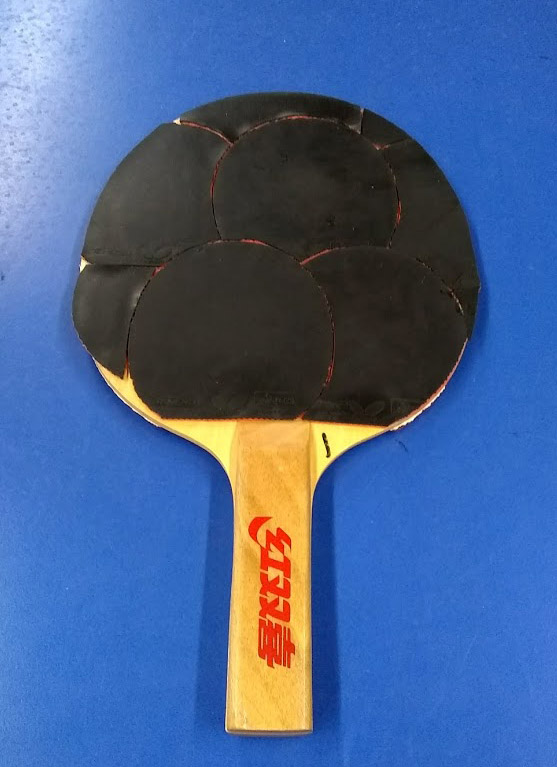
I had some fun in December with the new TSP Spin Wheel, which was sent to me by PingPongDepot. It’s basically a small tire attached to the table that allows you to practice looping by spinning the wheel. Included with it is a speedometer (technically, a tachometer) that tells you how fast you are spinning it! That’s half the fun – the kids at the club were battling to see who could make it spin the fastest. Here’s video (4:02) of the wheel in action. (This one is white, but the one I have is black.)

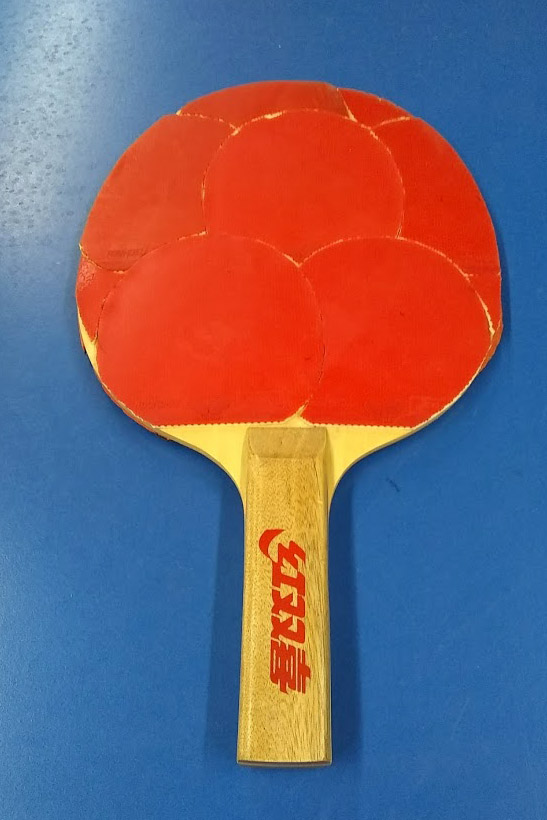
I didn’t want to hurt the sponge on my racket so I annexed an inexpensive sponge racket as the full-time racket to be used with the Spin Wheel – I recommend you do the same. The wheel will spin the same whether you use a $300 racket and sponge combo or a $15 one.

The key is to use your normal loop stroke (forehand or backhand) and do it over and over, focusing on proper technique each time as you build up the spin. Some might get careless and use just their arm, so focus on using the whole body, as you do with a loop, from the legs on up. Done properly, it could help in developing the stroke and the muscles used.

It wasn’t all fun for me when I found out what I’d suspected – that with age, I probably don’t get as much spin as before. I was able to hit an even 60 on the speedometer with my forehand (I’m not sure if that correlates directly to miles per hour, but it’s all relative), but then John Olsen went over and hit 72, dashing my hopes and dreams.

Here’s what it says on the Spin Wheel info page (see link above):

  • A useful device for learning and practicing spin variation and learning the difference between brushing the ball for spin instead of hitting the ball for speed.
  • Can be used in many different ways and at different angles, to improve spin on your stroke and on your service technique.
  • Has speedometer attached to measure the wheel's speed.
  • The faster the wheel rotates, the more spin you are likely to generate with that stroke.

ITTF Statistics Page Now Available
Here’s the ITTF article. Or go straight to the Statistics Page.

Progressing to Higher Levels, Learn from China
Here’s the ITTF article.

Simplifying An Overly Complicated Game
Here’s the article from Coach Jon.

Ma Long Chop Block Technique
Here’s the video (5:04). It’s in Chinese, but you can watch how he does it.

Waldner Videos!

Saive vs. the Little Girl
Here’s the video (46 sec) where Saive apparently is taking on challenges – and she smacks one in! Make sure to see Saive’s serve at the end.

When Accuracy Meets Table Tennis Fun!
Here’s the video (38 sec).

***
Send us your own coaching news!
USOC Meeting on Coaching Education and Certification
I returned yesterday afternoon from a whirlwind trip to the US Olympic Training Center in Colorado Springs, where I met with USATT and USOC people on creating a USATT Coaching Education and Certification Program. Those attending the meeting were:

  • Larry Hodges (Chair of USATT Coaching Committee and member of USATT Board)
  • Jörg Bitzigeio (USATT High Performance Director)
  • Mark Thompson (USATT Chief Operating Officer)
  • Denise Parker (USOC Vice President, National Governing Bodies Services and former CEO for USA Archery)
  • Chris Snyder (USOC Director of Coaching Education)
  • Avery Wilson (USOC Director of Strategic Planning)

The USOC people have extensive experience in developing education and certification programs for Olympic sports, and so we weren’t starting from scratch. They were very knowledgeable and extremely helpful. We spent probably the first half of the meeting going over where USATT currently stood – who the coaches were, where they coached, the current business model of USATT clubs where the coaches develop players, and current resources. We went over the current coaching certification program – USATT has two, both the badly outdated USATT certification program (much of it created by me in the early 1990s when our situation was very different) and the ITTF program, which we have adopted as part of our program.

How is our situation different now than in the early 1990s? Back then, we had one full-time training center (MDTTC, which I opened with Cheng Yinghua and Jack Huang in 1992); now there are 94. Back then we had dozens of certified coaches, few of them active; now we have 311, and twice that many before we had to trim the field due to the recent SafeSport compliance rules. Back then there were perhaps six full-time coaches in the U.S.; now there are about 300, though only about half are USATT certified. Back then we were desperate just to get anybody out there coaching; now we can focus on quality.

After a lot of discussion of the strengths and weakness of our current situation, we discussed how other sports did it – especially tennis and archery. Then we got into the real nitty gritty of what we could do, which included a lot of brainstorming. Many of the potential opportunities come from doing online programs, especially at the lower levels. They would focus on two aspects – the table tennis part (of which there already is a lot of material we might be able to use), and the non-table tennis part, i.e. how to teach, plus sports psychology, physical training, etc. (and here the USOC already had a lot of material we could use).

We spent a lot of time diagramming the way we could set up such a program, using large sheets of paper on an easel, which we would then tear off and tape to the wall. By the end of the meeting the walls were covered with such notes!  (We took pictures so they are not lost.) Anyway, we now have a rather strong vision and plans on how to develop a USATT Coaching Education and Certification program for the modern age.

After the meeting Mark took me to the USATT storage area, and I was stunned at all the boxes of vintage stuff – film reels of vintage players from the 1930s like Viktor Barna and Lezlo Bellak; boxes and boxes of VHS tapes from the 1980s, USATT Magazines, program booklets, and so on. It was way too much to go over in the short time I had there. I may discuss having a USATT history person do a visit and spend a day going over it all.

Perhaps the hardest part of the meeting for me was just getting there. I had a flight at 6:50AM to Chicago, where I’d transfer to another flight to Colorado Springs, arriving at 11:52PM. The meeting was scheduled 1-5PM. However, when I got up at 3:30AM to get ready for my flight, I had an email that said the flight had been cancelled, and that I’d automatically been put on a “Direct Flight” at 8:40AM. So I lounged about for a time, and then drove over to Dulles Airport in Virginia. It was there that I discovered that the direct flight was to Chicago, and that they had me on another flight to Colorado Springs, which would arrive there at 6PM – an hour after the meeting ended!!

So I spent some time with the agent, trying to find a way to get there on time, but there just didn’t seem to be a way. Then she said, “Well, there is this flight from National Airport, but I don’t think you can make it in time.” To make the flight I would have 55 minutes for the agent to book the new flight; I’d have to find a way to National Airport (about 30 minutes away if no traffic – but we were in the middle of rush hour); get through security; and make it to my gate. Not a chance, right? The cheapest way would have been to take a shuttle or Uber, but there just wasn’t time, so I ran outside and grabbed a taxi. It cost $80 ($68 plus tip), but he drove like a maniac, and magically, there was little traffic. At National, there was almost no line in Security, and I was “TSA Pre,” and I went through that really fast, and lo and behold, I made it with five minutes to spare!

So I made it to Chicago in time for my original flight, though there was a rush there as well, with only 30 minutes between flights. So I rushed through the terminals to the gate - and then, just as I arrived, out of breath, they announced the flight had been delayed two hours, due to weather! This meant I’d arrive around 1:45PM, well after the 1PM meeting began. I let the USATT know I’d be late, they alerted the USOC, and they rescheduled the meeting for 2:30-5:30PM. Once at the Colorado Springs Airport I Ubered over, and arrived around 2:15PM.

I spent the night at the USOC, where I lived in the dormitories from 1985-1990, so it was nostalgia time. Then I caught an 8AM flight back to Maryland on Tuesday.

USATT Announces 2017 National Coaches of the Year Awards
Here’s the USATT article. I was on the selection committee for this, and the choices were not easy as we had to choose between such quality coaches. Congrats to:

  • Coach of the Year: Jörg Bitzigeio (Colorado Springs, CA)
  • Mark Nordby Developmental Coach of the Year: Pieke Franssen (Alameda, CA)
  • Paralympic Coach of the Year: Mitch Seidenfeld (Lakeville, MN)
  • Doc Counsilman Technology Coach of the Year: Samson Dubina (Akron, OH)

Nets and Edges: Learn 5 Key Elements to Returning Some of the Most Difficult Balls!
Here’s the article from Samson Dubina.

Reshuffling the World Rankings: Progressive or a Mistake?
Here’s the USATT article by Ray Huang.

New World Ranking System Launches Jha into Top 100
Here’s the article by Matt Hetherington.

Estee Ackerman, Long Island Table Tennis Phenom, Spreading the Word
Here’s the article and video (1:38) from Newsday. “You might say that Estee Ackerman is an ambassador of Ping-Pong Diplomacy.” (She and I won Hardbat Mixed Doubles at the U.S. Open a few weeks ago! We both normally use sponge.)

Tom’s Table Tennis Tips
Here’s the monthly newsletter from Tom Lodziak.

Relocation Leads Tom Feng's Charge Towards 2020
Here’s the USATT article by Richard Finn.

Best Year Ever, Now Simon Gauzy Looks Forward
Here’s the ITTF article.

Paddle Palace Club Leads Charge for Safesport Compliance
Here’s the article.

History of USATT – Volume XX – Chapter 10
Here’s chapter ten of Tim Boggan’s latest volume, which covers 1991-1992. Or you can buy it and previous volumes at www.timboggantabletennis.com.

Dimitrij Ovtcharov – The Road to the TOP
Here’s the ITTF video (6:18). “What a year of 2017 it was for Dimitrij Ovtcharov that led him to the TOP of the new ITTF World Ranking! Relive his sensational journey to become the new world number ONE!”

Nittaku ITTF Monthly Pongcast - December 2017
Here’s the video (8:29).

Ask a Pro Anything: Timo "the Bandana" Boll
Here’s the article and video (9:03) from Adam Bobrow. Great video – features a challenge match where the lefty Boll plays right-handed in a challenge match with Adam!

***
Send us your own coaching news!
Coaching Matters, and Away Mon & Tue
I’ll be away Monday and Tuesday, so next blog will be next Wednesday. I’ll be at the U.S. Olympic Training Center in Colorado Springs, meeting with USATT and USOC people about setting up a USATT coaching education and certification program. My flight leaves at 6:50AM from Dulles Airport on Monday, so I’ll be leaving for the airport very early. We have a detailed agenda to go over – I’ll likely go over here when I return. It’s actually formulated in the form of questions – 18 of them.

The USOC is in the business of winning medals for the U.S., and part of that business is setting up coaching programs that lead to these medals. They have a lot of experience working with the various sports organizations in doing this, and are willing to support us in this with money and other resources. There was a time when there simply weren’t enough training centers or potential coaches in the U.S. to make this worthwhile for table tennis, but these days we have lots of both. So now we can focus more and more on quality.

Meanwhile, I’m also involved in about a zillion other issues. I’m on the selection committee that’s currently debating the coach of the year awards – we have the nominations, and there are some very tough choices to be made from a number of highly qualified coaches. Picking and choosing among them is perhaps the least favorite part of my volunteer work. The coaching committee is also debating the grandfathering of a top coach, and along with it various requirements in general, such as English skills needed, the value of full-time versus part-time coaches, and the potential problems of being a high-level coach while still competing as a player.

I’m sort of lucky that I hurt my shoulder recently as it’s given me more time to attack that infamous todo list that sits on my desk. Yesterday I was able to finish scanning all the Hall of Fame Inductions program booklets (see segment below), which we’ll put online soon. I also mostly caught up on a huge amount of email that had been piling up. I also did a bunch of planning and preparation for new junior classes starting up this Sunday and on Thursdays, as well as the adult training program which starts up again this Sunday after a one-month break. (I’m still doing group sessions, but had to cancel private coaching due to shoulder injury.)

Other issues for today – ordering trophies for our 2018 tournaments (always a time-consuming, tedious hassle); updating two online info articles; figuring out how to FTP to some of my older table tennis pages (a huge irritation – they discontinued WS_FTP); finalizing the rosters for three upcoming group sessions; some accounting and billing for some of my table tennis books sold; and arm rehab. Tomorrow is set aside to prepare for the USOC meeting so that I’m ready to answer those 18 questions from the agenda. Sunday I’ll be coaching much of the day – three consecutive 90-minute group sessions.

Wanted – the 1989 Hall of Fame Banquet Program Booklet
[NOTE – I ran a version of this yesterday, but thought I’d give it one more try.]
There have been 34 USATT Hall of Fame Induction Banquets, from 1979 to 2017, and 34 Hall of Fame Program Booklets. I’m putting all of them online. But there’s a problem – I’m missing the one from the Ninth Hall of Fame Induction, in 1989, when George Brathwaite and John Read were inducted at the USA Nationals. I’ve checked with George, but he doesn’t have one, and John died years ago. So . . . do any of you have a copy? If so, please contact me or comment below!!!

Do Not Buy Table Tennis Tactics for Thinkers!
Table Tennis Tactics for Thinkers is so full of lies that the White House has sent a cease and desist order. They do not want you to read this book. Do not under any circumstances buy this book to find out what it is they don't want you to read. In fact, do not buy any of my highly subversive books.

Volunteer at the National College TT Championships
Here’s info on the event held April 18-22 in Round Rock, Texas. They need volunteers for umpiring, scorekeeping, registration, transportation, results processing, venue set-up and takedown, hospitality, information desk, production and announcing, media, video, photography

US Open Ratings
They are up. Memorize them – you will be tested.

Rocky and Pong Road: Episode 06
Here’s the new episode (16:50). You can find the first five episodes at Pong Road. The episodes feature the trials and tribulations of table tennis star Rocky Wang.

Rocky Music
In the 1980s we learned that you train much harder after listening to Rocky music – so why not give it a try?

Rocky Bullwinkle Table Tennis Set
While we’re into Rocky, here’s a Rocky Bullwinkle table tennis set.

In-Out Multiball Training
Here’s the video (25 sec), with a short ball, then a random deep backspin.

Top Table Tennis Mistakes
Here’s the article from Pong Boss.

Bottle Top Pong Challenge
Here’s the video (27 sec) from Eli Baraty.

Top Ten Craziest Shots of 2017
Here’s the video (3:11).

Ping Pong Table Buying Guide
Here’s the article from Table Tennis Spot.

Tom’s Table Tennis Quiz 2017
Here’s the quiz from Coach Tom Lodziak.

The Best Table Tennis Funny Compilation 2015-2017
Here’s the video (23:11)!

North Korea – USA Nuke Pong
Here’s the cartoon!

***
Send us your own coaching news!
That article on "Why not many people play defender table tennis" is really poor. I mean, almost unreadable. Looks like machine translation and main purpose seems to be to sell you something through ads on the page.

Very unusual, most of articles you link to are of much higher quality.

Books I Read in 2017: "I have no life, and I must read."
Today’s blog is only partly related to table tennis – skip ahead if you have no interests in my book-reading proclivities. Below is a listing of the 58 books I read in 2017, which includes three books on table tennis, and another on coaching. It includes 21 novels by Mike Resnick; I’ve now read 43 of his books, 41 of them science fiction novels, the other two books on writing. I also read biographies of the first ten U.S. presidents (partly in preparation for a SF novel I might write), and lots of other stuff.

NON-FICTION (21)

  1. How to Coach Table Tennis, by David Hewitt (1990)
  2. History of U.S. Table Tennis: Vol. 19, 1991-92, by Tim Boggan
  3. History of U.S. Table Tennis: Vol. 20, 1992-93, by Tim Boggan
  4. Successful Coaching, by Rainer Martens
  5. Zen in the Art of Writing, by Ray Bradbury
  6. Astrophysics for People in a Hurry, by Neil De Grasse Tyson
  7. How to Build a Time Machine, by Paul Davies
  8. The Third Chimpanzee: The Evolution and Future of the Human Animal, by Jared Diamond
  9. A Concise History of China, by J.A.G. Roberts
  10. On Tyranny, by Timothy Snyder
  11. The Indisputable Existence of Santa Claus: The Mathematics of Christmas, by Dr. Hannah Fry and Dr. Thomas Evans
  12. Encyclopedia of Presidents: George Washington, by Brendan January
  13. Encyclopedia of Presidents: John Adams, by Barbara Feinberg
  14. Encyclopedia of Presidents: Thomas Jefferson, by Jim Hargrove
  15. Encyclopedia of Presidents: James Madison, by Brendan January
  16. Encyclopedia of Presidents: James Monroe, by Andrew Santella
  17. Encyclopedia of Presidents: John Quincy Adams, by Sean McCollum
  18. Encyclopedia of Presidents: Andrew Jackson, by Kieran Doherty
  19. Encyclopedia of Presidents: Martin Van Buren, by Lesli J. Favor
  20. Encyclopedia of Presidents: William Henry Harrison, by Steven Otfinoski
  21. Encyclopedia of Presidents: John Tyler, by Dee Lillegard

FICTION not by Mike Resnick (16)

  1. Buying Time, by Joe Haldeman
  2. The Count of Monte Cristo, by Alexandre Dumas
  3. Brave New World, by Aldous Huxley
  4. Murder on the Orient Express, by Agatha Christie   
  5. Harry Potter and the Cursed Child, by J.K. Rowling
  6. The Ice Dragon, by George R.R. Martin
  7. Wonder, by R.J. Palacio
  8. Barry’s Deal, by Lawrence Schoen
  9. The Genius Plague, by David Walton
  10. Supersymmetry, by David Walton
  11. All the Birds in the Sky, by Charlie Jane Anders
  12. Staked, by Kevin Hearne
  13. Zombies and Calculus, by Colin Adams
  14. H.G. Wells, Secret Agent, by Alex Shvartsman
  15. Funny Horror, edited by Alex Shvartsman
  16. Alternative Truths, edited by Bob Brown

FICTION by Mike Resnick (21)

  1. Gods of Sagittarius, by Mike Resnick and Eric Flint
  2. Soothsayer, by Mike Resnick
  3. Oracle, by Mike Resnick
  4. Prophet, by Mike Resnick
  5. Kilimanjaro, by Mike Resnick
  6. The Castle in Cassiopeia, by Mike Resnick
  7. Stalking the Unicorn by Mike Resnick
  8. Resnick’s Menagerie by Mike Resnick
  9. Sideshow, Galactic Midway #1, by Mike Resnick
  10. The Three-Legged Hootch Dancer, Galactic Midway #2, by Mike Resnick
  11. The Wild Alien Tamer, Galactic Midway #3, by Mike Resnick
  12. The Best Rootin'Shootin' Gunslinger, Galactic Midway #4, by Mike Resnick
  13. The Buntline Special (A Weird West Tale, Volume 1) by Mike Resnick
  14. The Doctor and the Kid (A Weird West Tale, Volume 2) by Mike Resnick
  15. The Doctor and the Rough Rider (A Weird West Tale, Volume 3) by Mike Resnick
  16. The Doctor and the Dinosaurs (A Weird West Tale, Volume 4) by Mike Resnick
  17. Walpurgis III, by Mike Resnick
  18. The Return of Santiago, by Mike Resnick
  19. The Other Teddy Roosevelts, by Mike Resnick
  20. Sideshow, by Mike Resnick
  21. Masters of the Galaxy, by Mike Resnick

Wanted – the 1989 Hall of Fame Banquet Program Booklet
There have been 34 USATT Hall of Fame Induction Banquets, from 1979 to 2017, and 34 Hall of Fame Program Booklets. (Here are the Hall of Fame Profiles.) I’m putting all of them online, scanning all the old ones. But there’s a problem – I’m missing the one from the Ninth Hall of Fame Induction, in 1989, when George Brathwaite and John Read were inducted at the USA Nationals. I’ve checked with George, but he doesn’t have one, and John died years ago. So . . . do any of you have a copy? If so, please contact me or comment below!!! (I was actually at the induction, but somehow misplaced my copy of the program, and nobody I’ve checked with seems to have a copy.)

Sidespin Serve – Tips and Tactics
Here’s the article and video (8:24) by Tom Lodziak.

How Can Having Targets on a Table Can Uplift Your Game
Here’s the article by Eli Baraty.

How to Do the Reverse Pendulum Serve
Here’s the article (lots of pictures) from EmRatThich.

The Complete List of Table Tennis Resolutions for 2018
Here’s the article by Coach Jon.

2018 Projects Ovtcharov to World Number 1
Here’s the USATT article by Ray Huang.

The Best Points of Lin Gaoyuan
Here’s the video (4:22).

Smart Phone Chopping
Here’s the video (22 sec) of Rory Scott – personally, I’m rooting for Hodges!!! (No relation.)

***
Send us your own coaching news!

North American Youth Olympic Games Qualification – Boys’ Final
Here’s the match, Kanak Jha vs. Jeremy Hazin (17:35, missing first game). This was one of the few top matches I got to see at the US Open, since I was so busy in meetings, coaching, and playing. But it was a great tactical match – basically, Kanak, age 16 but already over 2700 and #90 in the world, gave a clinic in receive and ball placement.

The match epitomizes something I’ve been quoted saying many times: “Tactics isn’t about finding complex strategies to defeat an opponent. It’s about sifting through all the zillions of possible tactics and finding a few simple ones that work.” In this case, Kanak used disarming receives to take away Jeremy’s serve advantage, and then used one seemingly simple tactic that completely dominated the match – attack the middle and wide forehand.

It seems simple, but the execution is far more difficult than it appears. If you just keep going after someone’s middle or forehand, they can anticipate it, and jump on that shot, so you have to be ready to switch back and forth. If you attack too aggressively, you make mistakes; if not aggressive enough, opponent has time to react.

Watch the rallies, and you’ll see over and over that when Kanak attacks the middle, Jeremy would struggle to react, either going for erratic counterloops (ones he’d likely made if the attack were to a corner) or awkward blocks. If Jeremy hedged over to cover the middle, usually with his forehand, Kanak immediate attacked the opened forehand corner.

For example, see the point at 3-1 in game two (0:28), where Kanak attacks a corner, than the middle, then the open corner. At 5-2 he spins a serve back to the middle, catching Jeremy, who appears to be guarding the wide forehand and so is slow to cover the shot. (Note how irritated he is after the point, since he should have been jumped on it quicker.) Often in this game Kanak finds openings to the wide forehand as Jeremy seems to be covering the middle, perhaps in reaction to Kanak’s attacks there in the first game, which isn’t seen here, but which I watched, and where Kanak went after the middle even more.

On receive, Kanak focused on consistency and variation. I’m not going to rewatch the whole video, but I don’t remember him outright missing a single serve. But more important, watch the variation – a mixture of flips, and short and long pushes, with last-second changes of direction that kept Jeremy from following up his serve effectively. (Ironically, Kanak’s first receive in the video is one of his weakest.)

Watch the first point of game three at 4:55. Kanak fakes a backhand flip but instead drops the serve short, then flips the next ball to the middle, setting up an easy winner. On the next point, Kanak quick-pushes to the wide forehand for a winner. Watch closely and you’ll see Jeremy start to move to his backhand the split second before Kanak contacts the ball – and Kanak instantly picks up on that. On the next point, Jeremy again leaves the forehand a bit open as he’s covering the middle, Kanak again jumps on the wide forehand. Jeremy is reacting to receives before Kanak has committed, and so Kanak is able to catch him off guard by changing his receive at the last second.

Another interesting thing you’ll notice about the match is the seemingly lack of pure counterlooping rallies. Normally when you see two top players go at it, there's a lot of counterlooping, and both of these players are great at counterlooping. But this is a big strength for Jeremy, who would love to turn the match into a pure counterlooping duel. While that might have been interesting to watch, Kanak shut that down almost completely, rarely letting Jeremy to get into a straight counterlooping battle. Kanak might have won such a counterlooping battle, but why should he play into the opponent's strength?

These tactics are seemingly simple. On paper, many could execute them. But in practice, they are very difficult - but Kanak made them look easy. As to Jeremy, he knows what he has to do next time out against Kanak – if he’s smart, he’ll be doing lots of drills where his partners vary their shots to the middle and wide forehand. He also probably needs to be less reactive to the opponent’s receive – most players telegraph their receive too early, and Jeremy was used to reacting to that. Against Kanak and other players his level, he’ll have to lose that instinct since he often seemed to react to Kanak’s receive before Kanak had committed, and so was caught off guard. Two seemingly simple things, and yet they made all the difference in this match. Take them away, and unless Kanak comes up with another simple yet effective tactic, we have an even match.

Kanak Jha to Top 100
The new ITTF ranking system definitely has shaken things up, since it gives an advantage to those who are more active. This helped our top two USA players. In the new rankings, Kanak Jha jumped from #200 to #90, while Lily Zhang went from #92 to #60. It’s been a while since USA had men in the top 100 – we had several in the 1990s - Cheng Yinghua, David Zhuang, Jim Butler, and Sean O’Neill. Since then the only other USA man in the top 100 I know of was Ilija Lupulesku in the 2000’s.

Decoding Jun Mizutani's serve
Here’s the video (12:25).

10 Stages of Footwork Summary
Here’s the video (4:46) by Samson Dubina.

New from EmRatThich
He has lots of new material up. Here are his two pages:

Table Tennis Tidbits #15
Here’s the article by Robert Ho, “Qatar Open ’16:  Genes and Memes—the Cream Rises to the Top.”

Irregular Drills, Positioning, and Anticipation – Problems of the Intermediate Player
Here’s the article from Epic Table Tennis.

Equipment – How Important Is It to the Sport?
Here’s the article by Eli Baraty.

Top 10 Best of 2017
Here’s the ITTF video (6:38).

History of USATT - Volume XX - Chapter 9
Here’s chapter nine of Tim Boggan’s latest volume, which covers 1991-1992. Or you can buy it and previous volumes at www.timboggantabletennis.com.

Samson Dubina in the Movies?
Samson gets a lot of coverage in my blog (and here’s his news page, with lots of coverage of his recent MegaCamp), but that’s because he creates a lot of great articles and videos. But now the truth is out – he’s secretly a movie star!!! Don’t believe it? Here’s video (38 sec) of a Regal Theaters Coca-Cola ad that they’ve been showing before movies the last month or two. When you see the character behind the counter selling the drinks and popcorn – tell me that isn’t Samson Dubina!!! (For comparison, see “10 Stages of Footwork Summary” segment above.) So . . . which of you is the guy in the glasses?

Colorful Beach Table
Here’s the picture. (Here’s the non-Facebook version.)

Dimitrij “Santa” Ovtcharov
Here’s the picture! (Here’s the non-Facebook version.)

Santa Ninja Table Tennis Cross Training
Here’s the video (90 sec) – table tennis is only in the first six seconds.

***
Send us your own coaching news!