If You Want to Compete, You Have to Cheat
This headline isn't technically accurate - there are a few top players who serve legally, and are still able to compete. Vladimir Samsonov is perhaps the best example. But the gist of the statement is correct - at the higher levels, since players are allowed to illegally hide their serves, players who do not cheat are at a substantial disadvantage. (The other major cheating problem in table tennis is boosting, which I discuss and give my solution to in this blog, which I will submit later as a rules proposal.)
I've been torn about whether to post pictures of all the USA cadets hiding their serves to show the extent of the problem. They're only kids. But the videos are public, and so anyone who isn't blind can see them. And I don't really blame the cadets who hide their serve in response to an opponent who does so and gets away with it - they are doing what they need to do to compete, and what they are coached to do, because the rules aren't being enforced or fixed. (I often look to see who does it first in a match– that's the one I do blame. You definitely shouldn't be hiding your serve unless the opponent does so far and gets away with it.)
How bad is the problem? At the 2014 U.S. Open there was only one top cadet regularly hiding his serve. He made it to the final of Under 14 Boys, where he met up with a strict umpire. After getting warned on the second serve of the match (and I think faulted later on), he served legally and lost.
But since that time, in tournament after tournament, umpires did not enforce the rule, despite regular complaints from opponents. The result? It became obvious that illegal hidden serves were allowed, and that those who used them had a large advantage. And so, one by one, the other top cadets began to illegally hide their serves.
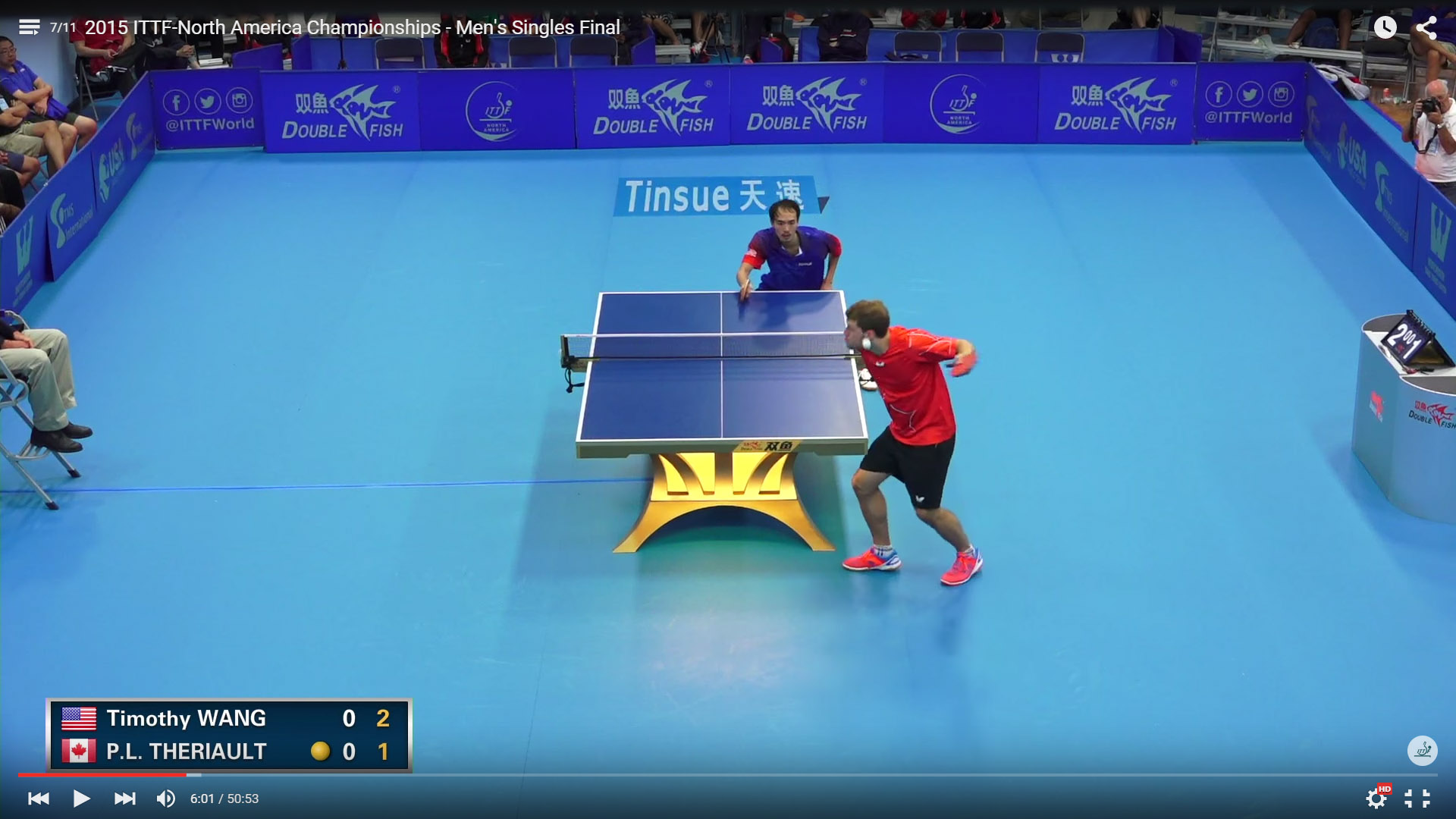
And the result? At the 2015 North American Championships (Sept. 5-7), there are online videos of seven of the eight quarterfinalists in Cadet Boys' Singles, and all eight Men's Singles quarterfinalists. Every single one of them illegally hid their serves. Not one of them was faulted for this. (Very rarely, one would be faulted for something else, such as hand over the table or throwing the ball back too much.) Here's the North American Video Page. (If you spend time watching the serves, make sure to freeze during the serve as the ball goes behind the head. The best way to do this is to freeze the screen just before the ball reaches the head, and then use the space bar to rapidly start/stop the video.)
We've taught our top cadets that if you want to compete, you have to cheat.
I'm all about finding solutions. It's become obvious that few umpires will enforce the serving rule as it is written, in particular the part that says that if an umpire isn't satisfied a serve is legal, he must either warn (the first time) or fault. The problem is that players are able to serve so umpires aren't sure if the serve is hidden or not, and so they let it go. And so the cheaters are honored and we cheat the honorable ones.
I blogged about how to solve this a number of time, such as here. I have a proposal that addresses this, with the rule change explained in that blog. The actual rule change, which I call the "Net Visibility Rule," would be as follows:
Current Rule:
02.06.04: From the start of service until it is struck, the ball shall be above the level of the playing surface and behind the server's end line, and it shall not be hidden from the receiver by the server or his or her doubles partner or by anything they wear or carry.
Proposed Rule (additions bracketed in bold):
02.06.04: From the start of service until it is struck, the ball shall be above the level of the playing surface and behind the server's end line, and it shall not be hidden from the receiver[, or any part of the net assembly and its upward extension,] by the server or his or her doubles partner or by anything they wear or carry.
Here's a good example of the serve that nearly everyone is now using and getting away with. As you can see, the ball is clearly hidden from the receiver, as will the contact a split second later. From the umpires' perspective from the side, they're not sure if it's hidden from the receiver or not, and so they do not call it. (They should, of course, since if the umpire isn't sure about the legality of a service he is supposed to warn or fault.) However, even from the umpires' perspective, it's obvious the ball is hidden from the right-hand net post, and so he'd likely call it. (In the proposal, I have pictures from the umpire's perspective that show this, from both sides.)
The proposal is eight pages long, with a number of photos showing how players hide their serve, and how and why they would be called illegal under the proposal. It includes pictures of both USA players and international ones hiding their serve, including Men's World Champion Ma Long. The pictures are from both the receiver's and umpire's point of view.
There's also a seven-page addendum which is a gallery showing all of the players hiding their serves at the North American Championships – all eight Men's Singles quarterfinalists and seven of the eight Cadet Boys' Singles quarterfinalists (one of them wasn't videoed).
There isn't any perfect way to fix the serving rule, but I believe this comes pretty close. Here's what I wrote in the proposal near the end:
There is often no perfect rule, and it's quite possible that in some cases, umpires would fail to call a hidden serve under the proposal. But that's also true of other rules, such as the six-inch toss rule, as mentioned earlier. But let's emphasize this: while an umpire might not always call a five-inch toss serve, he would almost always call a serve where the ball is thrown out of the hand, as that would obviously not be a six-inch toss. Similarly, under this proposal, while an umpire might not always call a serve that's hidden from part of the net or net posts, he would almost always call ones that are hidden from the receiver, as they would obviously be hidden from the net posts. And even if umpires don't call all of them, servers aren't going to hide their serve if they are frequently getting faulted.
I'll submit the proposal soon. I'll also likely put it online at some point – but I'm still hesitant about the reaction of posting all those photos of our top cadets hiding their serves, i.e. cheating. Since half the Men's Singles Quarterfinalists were cadets (!), posting those has the same problem. (I also don't want to post it until after it's been finalized and submitted.)
But there's a reason I'm featuring pictures of so many of our top cadets hiding their serves in the proposal – it gives quite an impact when we show what our lack of enforcing or fixing the serving rule has led to – teaching our kids that if they want to compete, they have to cheat!
Busy Friday
Meanwhile, when I wasn't collaborating with several people on the Net Visibility Rule Proposal (above), I was:
- One hour teaching the first session of a new junior class (six new kids), and saying 30 minutes late hitting with some of them. Crisis of the day – the robot broke down halfway through the class, causing problems since it was one of the three stations in the class rotation. Normally I'd resolve this by turning it into a serving station, but one problem – it was day one for these kids, and they didn't yet know how to serve. So I changed the class plans and taught them serves so they could practice them.
- One hour private coaching (slow day).
- Editing/proofing the draft of the USA Nationals entry form.
- Going over outlines for several upcoming USATT ventures, mostly involving regional leagues and associations.
- Tutoring one of our kids for 90 minutes on writing. He's eight, so we're working on punctuation, grammar, and above all, handwriting. It's my third session with him. I also have him spend 30 minutes of each session writing a new story, where we work on these things. Most of his stories involve me getting hit by meteors or exploding stars, or being forced to eat variations of fish ice cream.
- Dealing with (and finally resolving) various problems with my new smart phone.
- Answering 463,246 emails. I conscientiously spent at least five minutes on each. You do the math.
Beltway Plaza Table Tennis Challenge
Here's the article on the exhibition and competition to be held tomorrow (Saturday, Sept. 19), from 1-4PM, at Beltway Plaza in Maryland with Navin Kumar. Navin is one of my students, but alas, I have to miss it due to coaching commitments.
Executing Table Tennis Shots
#3 in this new series by Brett Clarke just came out.
Practicing the Short Push
Here's the video (26 sec), which makes use of a mini-hula hoop.
The Aces in Table Tennis
Here's a video (2:09) that shows players serving down-the-line aces. It's in French, but you can learn by watching, plus it's fun to see! Here's my Tip of the Week from 2011, "How to Ace an Opponent." If I were to grade and rank every single technique I did during my playing prime, my down-the-line ace serve was likely the single best thing I did. It's rusty these days, but I can usually bring it back after ten minutes practice.
Dimitrij Ovtcharov Multiball
Here's 17 seconds of intense multiball training with the German star.
Looking for Some Good Table Tennis Videos?
Here's the ITTF Channel, with lots of links to big matches from the recent Austrian and Belgium Opens. (Am I the only one to notice from the ITTF schedule that they have, consecutively, from Aug. 5 to Sept. 27, the China, Bulgarian, Czech, Austrian, Belgium, Argentina, and Chile Opens? They certainly are sticking to their ABCs!
USATT Insider
Here's the new issue, which came out Wednesday. You can have this emailed to you every Wednesday morning by going here. Or you can wait for the online version, which I generally link to every Friday.
Hard Work Pays Off
Here's the podcast (27:34) with Adam Gittings, from Expert Table Tennis. "Adam Gittings is 18 years old, lives in Doncaster, and has Asperger syndrome, dyspraxia, and type 1 diabetes. Three years ago he was invited to a South Yorkshire disabled sports trial day at the English Institute of Sport in Sheffield, where he was given to opportunity to try out a load of different sports and see if he had the potential to join any of the regional squads. Little did he know at the time, but that day would change his life forever."
International Table Tennis
Here's my periodic note (usually every Friday) that you can great international coverage at TableTennista (which especially covers the elite players well) and at the ITTF home page (which does great regional coverage). Butterfly also has a great news page.
More Mike Mezyan Pictures
NOTE - If you are unable to see these pictures, all you have to do is join the Table Tennis Group - it's easy! Here are all the past, present, and (soon) future pictures he's collected. (I pick out his best ones for here - he has more.)
Table Tennis Fight Club
There really is a Table Tennis Fight Club in London – and when you go there, it automatically plays the Table Tennis Fight Club video (28 sec)! (Here's the youtube version.) Make sure to check out their Rules section! There's also the Table Tennis Fight Club Open Arena (also in London), which automatically plays another great video when you go there. (It's scenes from the movie "Balls of Fury.")
***
Send us your own coaching news!












Re: September 22, 2015
You should read RatingCentral's method for rating. It is much more accurate and takes the time since last played into account which IMO makes it much more accurate-- especially for Jr players.
Re: September 22, 2015
In reply to Re: September 22, 2015 by despreston
Does it have rating adjustments to avoid deflation? (I was familiar with the system many years ago, but it's been a while, plus there might have been changes.) There were pluses and minuses to that system. If I start getting into that, there'll like be a huge debate. We've been through that many times, and I don't have time or interest in going through that again.
Re: September 22, 2015
In reply to Re: September 22, 2015 by Larry Hodges
There is no need for adjustments. There is a second value assigned to the player that tracks how long it has been since they played. The higher this value, the less certain we are of the accuracy of the rating assigned to that player. The second value is what helps determine how many points you win/lose from a match.
Re: September 22, 2015
In reply to Re: September 22, 2015 by despreston
The number you refer to has nothing to do with rating deflation or inflation. Having a number that tells you how accurate the rating is relative to others in the system is not the same thing.
Re: September 22, 2015
In reply to Re: September 22, 2015 by Larry Hodges
Sure it does. It allows us to go about rating players without having to rely on pumping points into the system. The reason (at least from what I see) for adjustments is because players are so underrated that it would be unfair to other players to NOT adjust their rating. Reasons players appear in tournaments highly unrated: kids that learn quickly; coaches that hold players out of tournaments until they are significantly underrated; players that go a long time without playing a US tournament (busy training in China, etc). Most of this is based on the time between recorded tournaments. Its the standard deviation that helps determine how many points you should lose and how many points should be given. There are further solutions that could be taken with this system as well-- giving juniors a higher standard deviation is one of them.
Re: September 22, 2015
In reply to Re: September 22, 2015 by despreston
Adjustments are done specifically for the reasons given in my blog and the linked article - to stop rating deflation. They tend to go to under-rated players, but that's actually arbitrary to what's needed to stop deflation, which is to pump points into the system to keep it stable. If you could calculate how much a system deflates in a year, you could get the same result by simply adding that many points to everyone's rating each year. (My guess is it's never been more than 5 points a year, and it's less if anything now, but that adds up over time. See the link to my earlier blog on this above.)
Keeping track of the time between tournaments only gives an indication that the rating may be less accurate, and so the SD goes up. While this could affect the rate of deflation, it works both ways. You assume players who don't play for a time are under-rated, when it's probably just as likely that players stop playing for a time, and when they come back, might be out of practice. But either way, at most it would change the rate of deflation. (Coaches holding players out of tournaments so they can be under-rated is generally rare, though I've heard of the accusations against a specific club in California. Any good coach knows you need regular tournaments to maximize improvement. It's an isolated case out of a large country.)
The system can stay internally accurate while deflating as a whole. Players will still tend to improve, and so be under-rated. They'll then, on average, beat players and get a more accurate rating, while other players he play will go down more than they should, due to his being under-rated. This leads inevitably to deflation, unless there is a mechanism to stop this. I'm tempted to cite data and findings from long ago, but just don't have time and interest to get involved in another long ratings debate - too many other priorities.
point adjustments
By adjustments, do you mean the points that are injected into the system when a player stands to gain more than 50 rating points in a tournament? It would seem hard to analyze the overall effect of this because players who gradually improve would not inject points, whereas sudden improvements would add points.
Or are there some other kinds of adjustments?
Re: point adjustments
In reply to point adjustments by dhill
correct, the rating adjustments in the USATT rating system are for players who gain more than 50 points. It does make analysis tricky.
Re: September 22, 2015
I second the Ratings Central system, it appears to be much more accurate than USATT ratings from what we see in the leagues out here in Portland, OR.
It is not a zero-sum system like elo, so it is not 'naturally' deflationary in the same way that that system is.
The benefits of it are that:
Players who have not played in a while have high deviations and therefore don't affect the ratings of players with lower deviations as much if there is an upset in either direction.
Ratings += are not fixed values, they move based on relative ratings and deviations of both players.
The ratings get more accurate the more that a person plays (if they play a variety of other players).
The downside is that if players have not played in a while, their ratings will vary wildly for a few matches, and if only take wins or losses over those few matches, their rating can move by hundreds of points.
Here is their page on how the system works:
http://www.ratingscentral.com/HowItWorks.php
I highly recommend that you try it out for your Capital Area League. We input the data for our matches in leagues and tournaments out here every week and it makes it super fun. Players get emails when the events are posted, and those ratings are used for placement in the weekly tournaments and leagues that we have. I've never heard anyone complain about the accuracy of the system in the many years it's been used.