

We're going to try an experiment today. I went to bed last night with a nasty cold, and got up this morning with a nastier one. And according to the federal government, today is the new year holiday, and if I don't take the day off, the terrorists win. So I'm going to go back to bed without a blog entry today (except for this), and postpone the Tip of the Week until tomorrow. If the universe explodes, it's my fault. Sorry. (Happy New Year!)
Welcome to TableTennisCoaching.com, your Worldwide Center for Table Tennis Coaching!
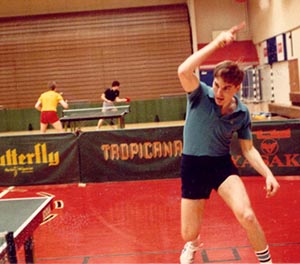 Photo by Donna Sakai
This is an evolving website and Table Tennis Community. Your suggestions are welcome.
Want a daily injection of Table Tennis? Come read the Larry Hodges Blog! (Entries go up by 1PM, Mon-Fri; see link on left.) Feel free to comment!
Want to talk Table Tennis? Come join us on the forum. While the focus here is on coaching, the forum is open to any table tennis talk.
Want to Learn? Read the Tip of the Week, study videos, read articles, or find just about any other table tennis coaching site from the menu links. If you know of one, please let us know so we can add it.
Want to Learn more directly? There are two options. See the Video Coaching link for info on having your game analyzed via video. See the Clinics link for info on arranging a clinic in your area, or finding ones that are already scheduled.
If you have any questions, feel free to email, post a note on the forum, or comment on my blog entries.
-Larry Hodges, Director, TableTennisCoaching.com
Member, USA Table Tennis Hall of Fame & USATT Certified National Coach
Professional Coach at the Maryland Table Tennis Center
Recent TableTennisCoaching.com blog posts
MDTTC Christmas Camp
Yesterday at the MDTTC Christmas Camp the focus was on backhand attack. That meant lots of backhand smashes, backhand drives and flips against backspin, and backhand loops. I was amazed at how fast some of the "beginner" kids picked up the backhand loop. The old paradigm that you have to be relatively advanced before you can backhand loop has been wrong for many years, and yet it still plagues many junior players whose old-fashioned coaches hold back on teaching this shot, thereby handicapping their games. My general rule of thumb is as soon as the kid can hit 100 forehands and 100 backhands with a good stroke he's ready to learn to loop.
This reminds me of a Junior Olympics many years ago where a full-time professional coach from another region was admiring the level of play of the Maryland juniors. She was amazed at how well some of our kids in the 10-year-old range could loop, and commented, "None of my students that age are good enough to learn to loop yet." As she explained, she thought it was assumed a kid needed to be at least 1500 before he should be taught to loop. Yikes!!!
Once again I gave out lots and lots of chocolates in a game where the players had to hit a bottle to win one. My chocolate supply is making me very popular.
Entries at USA Nationals
We now have the entry totals for the USA Nationals - and it ain't particularly pretty. (The ratings for both the North American Teams and the USA Nationals were processed last night.)
Falling backwards when forehand looping against backspin
This is a common problem with a rather easy fix. Many players go off balance and fall backwards when looping against backspin with their forehand. Why? It's almost always because they are standing too far from the table. And so they have to reach forward to contact the ball. This throws their weight slightly forward; to compensate, you have to lean backwards. You lose control, power, and are off-balance for the next shot.
How do you fix this? Stand closer to the table, and rotate more sideways when you loop. The contact point should be the same as before, but relative to your body, it's farther back in your hitting zone, often in front of the back leg. This allows you to rotate in a circle as you loop, creating torque and maintaining your balance even during your most powerful loops.
Yesterday, during the Christmas Camp at the Maryland Table Tennis Center, I found at least five players who were doing this. (I also had another chocolate candy "giveaway" - hit the bottle on the table, and get a delicious truffle! I gave out about 50 of them. I think we're the most popular table tennis camp in American right now.)
Table Tennis Training Stage IV: Putting It All Together
Here is Stage 4 of Samson Dubina's articles on training for the Olympic Trials. And in case you missed them, here is Stage 1, Stage 2, and Stage 3.
Ping-Pong Diplomacy
MDTTC Christmas Camp
We're in the middle of the Christmas Camp at the Maryland Table Tennis Center. It's our 21st consecutive year we've had a Christmas Camp, along with about 150 other camps, mostly during the summer. (All camps are five days/30 hours long.) I basically run the morning sessions, where I give short lectures and then go into groups where the players rotate, doing multiball with the coaches. Coaches Cheng Yinghua, Jack Huang, and Jeffrey Zeng Xun are the other coaches. Cheng and Jack run the afternoon sessions. Coach Jack Hsu is also coming in during the morning sessions to assist and put in the hours needed toward his ITTF coaching certification.
We have about 30 players this year, including a number of "luminaries," such as 2011 and 2012 National Cadet Team member Tong Tong Gong, 10 & Under Boys' Finalist at the Open and Nationals Derek Nie, U.S. Under 10 and Under 12 #1 Girl Crystal Huang (she's 9 and rated 2150!), 15-year-old Nathan Hsu (2277), and a bunch of others that range from beginner to 2200, including players from California, New Jersey, Pennsylvania, Washington DC., and of course Maryland.
Yesterday I brought in a box of chocolates - 48 in all - and during break I put them on the table near the edge. (They were individually wrapped.) Nearly the entire camp joined in as I fed multiball - two shots each, a forehand from the backhand side, and one from the forehand side - where if they knocked one off, they got the chocolate. It took about 20 minutes for them to knock off all 48, thereby saving me the trouble of having to eat them all and gain 20 pounds.
After two weeks at the Nationals and Christmas, I hadn't fed multiball in a while. After two days of feeding multiball, my out-of-shape arm is sore. Soon I'll be off for another day, with today's focus on forehand looping. Plus I have another box of chocolates.
Coaching Seminar at the USA Nationals
Tip of the Week
Back from break
I've mostly been away the last two weeks, coaching at the USA Nationals in Virginia Beach and at Christmas with family in Santa Barbara, CA. I'm pretty much setting a policy that when I'm out of town, I take a vacation from blogging. But now I'm back, and so expect new blogs to go up every morning, Mon-Fri, normally by 9 or 10 AM. It won't be easy this week - I'm coaching at the Maryland Table Tennis Center Christmas Camp, and so have to get it all done before I leave each morning. (It's our 21st consecutive Christmas Camp - every year starting in 1991 - and roughly our 150th five-day camp overall.)
Coaching Seminar at the USA Nationals
At the recent USA Nationals Stefan Feth and Richard McAfee held a coaching seminar on behalf of the USATT coaching committee. I attended as did about twenty others. USA Men's Coach Stefan Feth went first, with a presentation on "Modern Trends in the Serve and Serve Return Game." Unfortunately, you had to be there to see the demos to really understand these techniques, but I'll cover them briefly.
Serve:
- Ways to serve forehand backspin but fake topspin with an upward elbow follow-through.
- Importance of focusing on one or two service motions.
- Nine spots to serve to - short, half-long, and long to the forehand, middle, and backhand.
- Inside-out hook serves
Receive - Banana and Strawberry flips. I'm not making this up!
Tip of the Week
Christmas Sabbatical
As noted last week, I'll be away for Christmas, so my next blog entry will be right after Christmas. Then I'll return to blogging every morning, Mon-Fri.
USA Nationals
I had a great time last week at the USA Nationals in Virginia Beach. Here are the results. (Make sure to set the tournament field to "2011 US Nationals.") Ty Hoff and I won Hardbat Doubles (my 12th time at the Nationals or Open, eight of them with Ty, the other four with Steve Berger). However, I was mostly there to coach. Below are a number of segments about the Nationals.
USA Cadet Trials
Tong Tong started out poorly, losing numerous close games and matches the first three days, Tues-Thur, Dec. 13-15. However, the BIG event for him was the Cadet Trials, which were on days four and five. Last year he had gone in seeded #9 in the ratings, but made the team (top four) by pulling off four upsets to grab the fourth spot. This year he went in seeded #10 in the ratings, but made the team (finishing third) by pulling off five consecutive upsets! So he made the team two straight years by pulling off nine upsets without losing to anyone below him - not bad. If he had lost any of those nine matches or to anyone below him, he wouldn't have made the team that year. He's the only one to make the team both years. Key to his turnabout in the Trials - stronger mental focus and more two-winged attack. (He'd been playing too much forehand.) We also came very prepared tactically.
Tip of the Week
The USA Nationals, Christmas Vacation, and a Sabbatical
After today, I'm taking a short sabbatical from blogging. My next blog will be next Monday, Dec. 19 (right after I return from the USA Nationals), and my next one after that will be when I resume blogging regularly (Mon-Fri) on Dec. 27.
I'm leaving for the USA Nationals this morning, returning next Saturday. Then on Monday I leave for Santa Barbara, CA, for Christmas with family, returning on a red-eye flight on Christmas night that lands back in Maryland about 8AM on Dec. 26, in time for the MDTTC Christmas camp I coach at that starts that afternoon.
Yes, I know, the Nationals is exactly the time I should have lots to blog about, but I'm going to be extremely busy there, coaching, playing, and attending meetings, and expect to be leaving for the playing site early each morning and returning late.
I'm primarily going to the Nationals to coach, but I'm also entered in three hardbat events: Hardbat Singles (which I've won twice at the Open or Nationals), Over 40 Hardbat (I'm four-time and defending champion) and Hardbat Doubles (I'm 11-time and current champion, and playing with Ty Hoff - we've won it seven times).
Hidden Service Rules
From the just-received Nov/Dec 2011 issue of USATT Magazine, page 62, from the An Official's View article by International Umpire Joseph C. H. Lee:
[He quotes a service rule.] "From the start of service until it is struck, the ball ... shall not be hidden from the receiver by the server or his or her doubles partner or by anything they wear or carry."
[He quotes another service rule.] "It is the responsibility of the player to serve so that the umpire or the assistant umpire can be satisfied that he or she complies with the requirements of the Laws, and either may decide that a service is incorrect."
"From the umpire’s angle, sometimes it is difficult to determine whether or not the serve is hidden from the receiver. It is the server’s responsibility, however, to demonstrate to the umpire or the assistant umpire that the serve conforms to all aspects of the service rules."
He concludes with this:
"...the server must make sure the umpire can observe the entire motion of the serve, including the moment when the racket strikes the ball. If the umpire is unable to observe the serve, he/she will give a warning and the server had better comply in subsequent serves."
Bingo. Why is it so many umpires refuse to enforce the hidden serve rule? As International Umpire Joseph Lee writes above, if the umpire can't see that the serve is visible, then he gives a warning, and if it happens again, it's a fault. It's not complicated.
I've blogged about this a number of times. Will it be enforced at the Nationals next week? I sure hope so. If not, then umpires are allowing players to win by cheating, and penalizing the ones who do not cheat. If not enforced, it likely will be the difference between a player winning a championship or making a USA Team or going home frustrated because he was cheated out of these things.
Backup plans
On Monday I blogged about always having a backup attack plan if your main tactic doesn't work. In my case, I wrote about switching from forehand looping to forehand hitting because my opponent was blocking too quick and fast for me to keep looping aggressively. Someone asked me what I would have done if my forehand smash was missing - good question! But there are always options, though not all options work. (In fact, most do not, and the goal is to find the ones that do.) Here were my main rallying options against this quick-hitting penholder, roughly in order of preference.
- Aggressive forehand looping, steady backhand countering
- Aggressive forehand hitting, steady backhand countering
- Steady forehand looping and backhand countering
- Steady forehand and backhand counter-hitting
- Steady forehand counter-hitting and an aggressive backhand
- Quick-blocking and hitting from both sides with varied pace
- Chopping, fishing, lobbing, and pick-hitting
Spinny serves
USATT Coaching Newsletter
The fourth USATT Coaching Newsletter just came out, produced by coaching chair Richard McAfee. And here are the first three.
Short side-top serves to the forehand
I'll never figure out why so few players develop this serve. Sure, it gives the opponent an angle into your forehand. (Is your forehand that weak?) Sure, it's easier to flip short sidespin and topspin serves than backspin ones. (But it almost goes to your forehand - isn't that what most players want?) Sure, it takes some practice to learn to serve sidespin-topspin serves and keep them short, especially down the line to the opponent's forehand side, where you have less table. (Okay, this is probably what stops most players from developing these serves - they'd have to practice.) But it's such an effective serve in setting up a third-ball attack, and a great variation from the constant serves most players do into the backhand. Learn it!