

Blogs

Larry Hodges' Blog and Tip of the Week will normally go up on Mondays by 2:00 PM USA Eastern time. Larry is a member of the U.S. Table Tennis Hall of Fame, a USATT Certified National Coach, a professional coach at the Maryland Table Tennis Center (USA), and author of ten books and over 2100 articles on table tennis, plus over 1900 blogs and over 600 tips. Here is his bio. (Larry was awarded the USATT Lifetime Achievement Award in July, 2018.)

Make sure to order your copy of Larry's best-selling book, Table Tennis Tactics for Thinkers!
Finally, a tactics book on this most tactical of sports!!!

Also out - Table Tennis TipsMore Table Tennis Tips, Still More Table Tennis Tips, and Yet Still More Table Tennis Tips, which cover, in logical progression, his Tips of the Week from 2011-2023, with 150 Tips in each!

Or, for a combination of Tales of our sport and Technique articles, try Table Tennis Tales & Techniques. If you are in the mood for inspirational fiction, The Spirit of Pong is also out - a fantasy story about an American who goes to China to learn the secrets of table tennis, trains with the spirits of past champions, and faces betrayal and great peril as he battles for glory but faces utter defeat. Read the First Two Chapters for free!

Tip of the Week
Eleven Points for Developing a Modern Advanced Style.

A Review and an Interview
My fantasy table tennis novel “The Spirit of Pong” was just reviewed for a Topeka Book Club, and I was interviewed about my writing by Jeff Cates – with lots of table tennis. (Here are all my books - buy some!) Here is the review and interview:

Across the Net: A Story of Ping Pong and Friendship
(NOTE – I added this late, on Monday night. I will include it in next week’s blog as well.)
Here’s the video (12 min) - CGTN America did a feature on my co-coach Cheng Yinghua at the Maryland Table Tennis Center. Cheng was a member of the Chinese National Team, and then 4-time US Men’s Singles Champion, 2-time US Open Men’s Singles Champion, and a member of the 2000 US Olympic Team. (I’m interviewed multiple times in the video. Over half of the pictures of Cheng they used were also from my files. CGTN America is China Global Television Network America.)

Weekend Coaching and Hating to Lose
Due to a writing seminar I attended on Sunday, I only coached two group sessions this past weekend, both on Saturday. In the Intermediate group, much of the focus of my multiball group was the same as last week – transition from looping backspin to looping or hitting topspin, on both forehand and backhand. In the more advanced group, much of the focus (as always) was on footwork. Most players get this, but some still don’t always quite get the idea that 1) you don’t wait to see if you have to move; you assume you have to move, and prepare with a light bounce on your feet as your opponent is hitting the ball, and 2) you move to the ball with your feet even if you could do so by just reaching for the ball.

When they got to games, I could often tell which players were affected by not wanting to lose – all of them! But there were three ways players responded to this. Some got passive, especially when it was close, and were scared to attack. Others stayed aggressive, but shots they’d make in practice they’d miss because they were worried about losing, and so couldn’t play free. Others had learned to mostly clear their minds and played mostly free, even under pressure. That’s what you need to strive for.

John Olsen had written me that, “Players that excel, I have found that it's not so much that they love to win, but they hate to lose.” And there’s a lot of truth to this. In theory, you’d think wanting to win would be more important than hating to lose. Sometimes that’s true. But often it’s hating to lose that motivates players, as well as wanting to win.

Top players (all sports) hate losing far more than the average person. They are competitive by nature. However, it is this very hatred of losing that, counter-intuitively, keeps their hatred of losing from affecting their play. They know that if they worry about losing while playing, it will affect their play and they are be more likely to lose. And so, from years of mental training and learning to focus in matches, they’ve learned to clear their mind when it’s time to play, all so they won’t lose. Result? Players who really, Really, REALLY hate to lose are often at their best in big matches and during big points. On the other hand, players who don’t like losing but not as much as top players are more likely to let his fear of losing affect him, and thereby lose because of it.

Top players often have a history of being bad losers as juniors – it’s a motivating factor. Those that overcome it become top players. The key is to use it for the first, but put it aside in matches so you can play free. Many players get passive under pressure because they are afraid to lose, and so never learn to play well under pressure. You have to overcome your fears and play your normal game under pressure. Ideally, you train not to avoid losing, but so you can improve and win! (And “win” means different things to different players – it could mean winning against your friends at a club or in the basement, in a league, a rating event, a club or state title, or national or international events.)

Major League Table Tennis

New from NCTTA – National Collegiate Championships

Butterfly Training Tips

New from Pingispågarna

Learn the Hook Serve
Here’s the video (3:26) with Dutch National Table Tennis Team Member Milo De Boer, from Acceleraq.

New from the Table Tennis Teaching Channel

New from PingSkills
Ask the Coach.

55th Anniversary of a Ping Pong Diplomacy That Changed the World (1971–2026)
Here’s the USATT article by Joshua Dyke.

New from Steve Hopkins/Butterfly

New from the ITTF

Panda Pong
Here’s the video (15 sec)!

I Played a 2x Olympic Champion
Here’s the video (8:25) from Adam Bobrow! He takes on Chen Meng, World #1 for 76 weeks in-a-row and 2x consecutive Olympic Singles Champion.

***
Send us your own coaching news!

Tip of the Week
Try to Stay Within Arm’s Length of the Table.

Spring Break Camp, Weekend Coaching, Multi-ball Backspin, and Placement
I coached Tue-Fri last week in our MDTTC Spring Break Camp, plus two group sessions on Sunday. I spent over half the sessions feeding multiball, and the rest either as a walk-around coach or practice partner. If there was a theme to the multiball, it was looping against backspin, both forehand and backhand. Most kids learn this pretty easily. The harder part is when I do drills that combine looping backspin and then looping or hitting against a topspin ball that roughly mimics a quick block of their loop. The key is the playing shoulder. You drop it against backspin. After doing that a lot, it’s somewhat natural to drop it at least a little against topspin – and the instant you do that, you’re going off the end. So, I did drills where I’d have them do the one-two of looping against backspin and then a quick topspin.

One other key thing was I didn’t want them to fall into the bad habit of just looping and hitting everything crosscourt. Once they could do this one-two drill pretty well, against backspin and then topspin, I had a new rule. Every shot had to go to one of the “three spots” (wide forehand, wide backhand, and “middle,” the opponent’s transition spot between forehand and backhand), but they couldn’t hit to the same spot twice in a row. So, they had three options for the first shot, and then the second shot had to go to one of the other two spots. This roughly mimics what you should mostly do in a match. There are times you do want to go twice in a row to the same spot in a match, but most players do that out of habit rather than tactical reasons.

When should you go to the same spot twice? You can often do this to the opponent’s middle over and over effectively. (I once coached a 1200-rated kid against a 1700 player. He was down 0-2, and every rally was a bang-bang fast topspin rally. I told him to attack every ball at the opponent’s elbow, and he relentlessly did just that, especially with his backhand – and he didn’t just win the next three games and the match, he completely dominated all three games.) Or, if you go to a wide corner – most often the forehand –  you can often catch the opponent off guard by going there again as he moves away and back into position. However, far too many players just go to the same spot twice because that’s what they do in practice

Upcoming Travel
I’ve got a busy travel schedule this Summer, including lots of table tennis and science fiction. Here’s the rundown. The BIG one is I’ll be spending 25 days sightseeing in eight northern European countries in August!

Class of 2026 Inductees & Lifetime Achievement Award
Here’s the announcement from the US Table Tennis Hall of Fame, with info on each recipient. The new Hall of Famers are Mark Hazinski, Juan Liu, and Noga Nir-Kistler, with Lily Yip getting the Lifetime Achievement Award. “The Class of 2026 will be formally honored at the U.S. Table Tennis Hall of Fame induction ceremony as part of the Patty and Si Wasserman Junior and Open Championships in October 2026 in New Jersey. Additional details will be announced soon.”

Major League Table Tennis

Butterfly Training Tips

Designing Points Around YOUR Strengths
Here’s the video (11:19) from Seth Pech on “How I Practice.”

The Service Training Method I Wish I Knew Earlier
Here’s the video (11:42) from Andreas Levenko.

New from the Table Tennis Teaching Channel

Fast Long Serves with Milo DeBoer
Here’s the video (3:01) from Acceleraq.

New from PingSunday
19 new videos this past week!

We Challenged World's Best Anti Spin Player!
Here’s the video (9:58) featuring Sabine Winter (world #9 from Germany), from Table Tennis Daily.

Membership Rating Features Enhanced on JustGo
Here’s the USATT news item.

The Philosophical Adventure of Ping-Pong
Here’s the article from El Mundo America.

New from Steve Hopkins/Butterfly

New from NCTTA

New from ITTF

Panda vs. Cat
Here’s the video (21 sec)!

World's Most Dangerous Racket
Here’s the video (15:17) from Pongfinity! That first “game” where they smack each other in the head with ping-pong balls – yikes!

Non-Table Tennis – New Short Story Sales
I sold two more short stories this past week. “Blueberry Pie” was my 200th original short story sale. (I’ve sold 257, but the other 57 were resales.) The two new sales were:

  • The Eye in the Sky of the Blueberry Pie” (1000 words) to Third Flatiron’s Food for Thought anthology. When a planetary-sized blueberry pie comes plummeting down on Earth, scientists and religious folk debate who sent it while normal people prepare to get smooshed.
  • Thirty-Five Genie Heads on a Wall” (8400 words) to Critical Blast’s Fantastic Journeys anthology. While being bullied at the beach, teenager Robbie is sucked into a Coke bottle. So begins his life as a genie, including classes at Genie University. His owner is a brutish king on a planet far from Earth – and the squirming, tormented heads of the king’s previous 35 genies are on display on a wall. (This was a resale.)

***
Send us your own coaching news!

Tip of the Week
Develop Your Game Around Overpowering Strengths.

Antarctica Classic Table Tennis Championships, April 1-5, 2026 at Esperanza Base
Antarctica! Today I fly to the Antarctica Classic TT Champs., starting Wed, Apr. 1. I’m
playing in the Over 60 Hardbat and Icebat events. Icebat is tricky. Players have to wear
rubber gloves or the racket melts too quickly. The surface is slick like antispin rubber.
It's also rather expensive as a typical racket melts about twice every game, so I'll need
lots of them, plus a portable freezer. (The Antarctica TTA offers discounts on these.)

Fortunately, I'm seeded #2 in both events. Surprise entry Jan-Ove Waldner is the number
one seed. He’s taken a recent interest in these events. I've studied his game and think I’m
only a slight underdog if I attack his wide forehand. Other Americans competing include
Lily Zhang and Kanak Jha, and my doubles partner, Danny Seemiller. I hope I can win the
singles, and for Danny & me to sweep hardbat & icebat doubles! Maybe we'll play penguins.

Weekend Coaching
Last week I had my second bout of flu this year, and wasn’t even sure I could coach this weekend. But it cleared up Friday, and so I coached on Saturday. My emphasis that day was SPEED! I fed a lot of multiball, going faster than usual, pushing the kids to their limit. The key was teaching them efficient movement and balance. A player who moves efficiently can get around faster than someone who’s quicker but not so efficient. Plus, as good coaches hammer into their players, balance is a must or you can’t quickly recover from one shot and move to the next. I had to remind some students that if their free hand hangs down like a dead snake, they won’t be too balanced when they move.

Dan Seemiller Classic
Besides the 15 regular events (including a Giant RR, three doubles events, and $4,000 in prize money) at the 3-star Butterfly Dan Seemiller Classic 3, and besides a trivia contest at the tournament, it also includes a Dan Seemiller clinic on Friday night, 6-8:30 PM. It all takes place in West Liberty, Kentucky, Apri. 24-26. I’m told it’s a great venue! You can enter by going to Kentucky in Omnipong.

Major League Table Tennis

Butterfly Training Tips

Learn How to do a Simple No Spin Serve
Here’s the video (2:55) from Matt Hetherington.

3 Hidden Mistakes SABOTAGING Your Table Tennis
Here’s the video (3:02) from Andrea Levenko.

This Simple Change Improved My Table Tennis Instantly
Here’s the video (2:59) from Pingispågarna.

New from Acceleraq

Should Adults Train the Same Way as Children When Starting Table Tennis?
Here’s the article by Bob Chen.

Tentative Play is the Worst … Here’s How to Fix
Here’s the article from Tom Lodziak.

New from PingSunday/EmRatThich
Note – there are a number of other “Members Only” videos.

New from the Table Tennis Teaching Channel

Interview with Sid Naresh
Here’s the video (5:46). It includes Introduction, How Sid got started in table tennis, Sid's journey to compete in LA, Advice for young athlete, People Sid wants to thank, and Where to find Sid.

New from Steve Hopkins/Butterfly

New from the NCTTA

Southeast Regional Table Tennis Championships Return to Florida
Here’s the USATT article by Joshua Dyke

New from ITTF
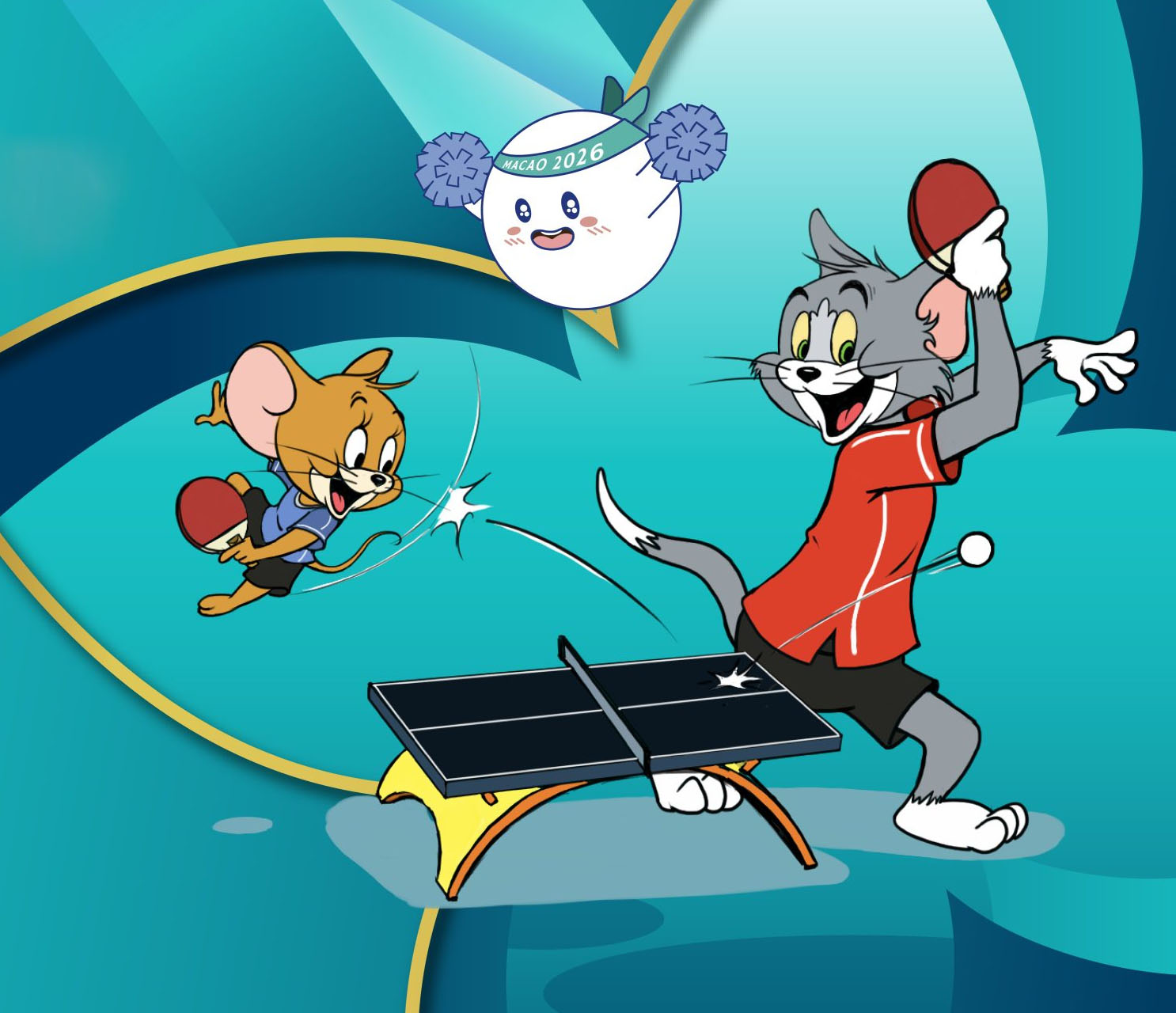
Note the Tom and Jerry item near the end, which includes a nice graphic of the two playing.

Comparative Effects of High-Intensity Interval Training Modalities on Physical Performance and Physiological Responses in Competitive Table Tennis Players
Here’s the research article from Research Square.

Tom and Jerry Table Tennis

80 Years Old, Still Returning Everything Life Serves at Him
Here’s where you can buy this birthday card!

Why I Lose at Ping Pong
Here’s where you can buy the shirt at Amazon!

Marty Supreme - Was He Actually Paid To Lose?
Here’s the cartoon video (21:05).

New from Table Tennis Daily

Ranking the Best Table Tennis Fails
Here’s the video (32 sec)!

Explosive Pong
Here’s the video (2 sec)!

How Long Can a Trickblock Take?
Here’s the video (15 sec) from Pingpongmaestros!

Cat Pong
Here’s the video (12 sec)! It’s AI, but done decently well, unlike others I’ve seen.

Adam vs. The Women of Thailand
Here’s the video (16:10) from Adam Bobrow!

Non-Table Tennis – Science Fiction & Fantasy Publications
I have two new stories out, and sold two others. I’ve sold 255 short stories – 199 original and 56 resales. I hope to sell my 200th original story soon! (I also have four novels. Here are all 25 of my books, over half on table tennis.)

  • Forgive the Fortune Teller” came out in Black Cat Weekly. A fortune teller tells people their future, but by doing this, it changes their future actions and thereby dramatically changes their future. And then the teenaged future savior of the world, who will go down as the greatest person in human history, comes in and she tells him his fortune, changing everything. (To read it you’ll have to buy the issue.)
  • Twin Lives” came out in Abyss & Apex on Wednesday, April 1 (no April Fools!). You can read this one online. Twin brothers choose different paths in life. One becomes a famous astronaut who leads an expedition to a nearby star. He’s adored by millions. The other is a failed athlete who lives an ordinary life. Because of time dilation, the latter is extremely old and about to die while his famous brother is still in his prime. Who had the better life?
  • I sold “The Oysters of Pinctada” to the War in the Stars anthology. (They bought it a month ago but I was sworn to secrecy until they made the official announcement two days ago.) It’ll come out in August. The people of Pinctada--who are genetically part oyster--use the deadliest secret code imaginable to save their king from space pirates who've kidnapped him! (This is the third time I’ve sold this story.)
  • I sold “The Trojan Alien” to 100-Foot Crow magazine. It’s a very short story about what happens when aliens show up and put a huge horse statue in orbit. Does that sound suspicious?

***
Send us your own coaching news!

Tip of the Week
Reverse Serves.

Weekend Coaching and Other Toothy Issues
Just a short blog today – I have a three-hour dental appointment this morning to fix the tooth that broke a few weeks ago during my South America tour.

On Saturday I spent an hour working with two kids, both seven years old. One was mostly a beginner, the other a little more advanced. Both had decent forehand strokes, even the beginner. But both had problems with consistency – the first because he was a beginner, the second because he liked to smack every ball too hard. So, how to fix this problem?

Two things. First, I had them take turns hitting with me (live, not multiball) where as soon as they missed twice, they sat down and the next player played. This gave them incentive to keep the ball going. The beginner, who didn’t have a long attention span, became much more focused, while the other player finally slowed down to keep the ball in play. Second, as we rallied, I said, “Bump-bump, bump-bump, bump-bump, bump-bump,” timing the “bumps” to when the ball hit the table and racket. This greatly helps their timing. It’s one of those little things that really helps when working with beginners. Both managed to get 50 in a row. As I regularly explain, when you can hit the ball consistently with a good stroke at a slow pace, hitting at a faster pace becomes much easier. Hitting at a fast pace where you miss a lot is a good way to practice missing a lot.

On a side note, I have a science fiction story called “The Unbeatable Teleporting Alien Table Tennis Foe . . . and Elephants” that’s a finalist at the Odyssey New Myths “Driven” contest. They are looking for stories about people who are “driven” to do something – and my hero is driven to be the Galactic Table Tennis Champion! But in the final he plays a teleporting alien. No matter where and how fast he hits the ball, the alien instantly teleports there and smacks a forehand. How can he beat this incredible player? He gets killed the first two games in this best of five – and then he discovers something that makes things even worse! (I can’t give that big plot twist away.) I’ll post when/if the story gets published. So, what does the “elephants” in the title mean? That’s another twist near the end – and again, I can’t give it away!

Ping-Pong Paddles Can’t Talk!
I’ve been actively working with the illustrator on my upcoming children’s picture book. The cover should be finalized in the next week or so. The book comes out in June. Here’s the text from the back cover. First comes the rhyming part (for the kids). Then comes a short paragraph (for the parents).

He practiced his ping-pong, he’s fully prepared!
But at his first tournament, poor Kevin is scared.
He has to play Li, a formidable foe.
She smiles and laughs—but plays like a pro!

He’ll be so embarrassed! To quit would be wise.
He stares at his paddle . . . and it opens its eyes!
It smiles and then opens its mouth wide to say—
Oh, come on! No paddle can talk . . . can they???

🏓 🏓 🏓 🏓 🏓

“Ping-Pong Paddles Can't Talk!” is about a nervous boy and his (talking?) paddle in their first tournament, where he plays a friendly girl who is really good. They have an adventurous match, and along the way he learns not only about the sport, but also about facing his fears, working toward a goal, honesty, and friendship.

Coaching Opportunity – PongPlanet Table Tennis Club (San Francisco Bay Area, California)
Here’s the info page.

Forehand and Backhand Tips from Fan Zhendong
Here’s the video (2:03) from China’s Fan Zhendong, Men’s Singles Gold Medalist at the 2021 & 2023 Worlds and 2024 Olympics.

4 Mental Tips for Better Table Tennis Performance
Here’s the large cartoon graphic!

Interview with Kanak Jha
Here’s the video (2:36) with US #1 Kanak Jha.

Coaching and News from All Over
Since I’m off to the dentist soon, here are links to table tennis sites that have new items. Have fun!

Table Tennis Shirts from PrintBlur
Here they are!

Proof It’s You and Not Your Racket
Here’s the video (12 sec) from Pingpongmaestros!

***
Send us your own coaching news!

Tip of the Week
The Five Attacking Placements.

Marty Supreme Goes Oh For Nine
Timothée Chalamet didn’t win for Best Actor for Marty Supreme, despite most considering him the slight favorite. Earlier in the year he’d been considered the strong favorite, winning at all of the following (from IMDB):

Golden Globes, Critics Choice Awards, Chicago Film Critics Assoc., Satellite Awards, Las Vegas Film Critics Society, London Critics Circle, Online Film Critics, Palm Springs International Film Festival, Vancouver Film Critics Circle, Austin Film Critics Assoc., North Texas Film Critics Assoc., Indiana Film Journalists Assoc., Denver Film Critics Assoc., Georgia Film Critics Assoc., Online Film & Television Assoc., Phoenix Critics Circle, Gold Derby Awards, AACTA International Awards, Hawaii Critics Society, Greater Western New York Film Critics Assoc., Discussing Film Critics Award, North Dakota Film Society, Portland Critics Assoc., Critics Assoc. of Central Florida, Minnesota Film Critics Alliance, Astra Film Awards, New Jersey Film Critics Circle.

I bet you didn’t know there were that many acting awards – and that was just the ones he won! He won about 2/3 of the available awards, with Michael B. Jordan  (“Sinners”) winning most of the rest, including the Actors Awards (formerly the Screen Actor Guild awards, SAG). Some thought Chalamet lost because of a recent sarcastic and disparaging comment about ballet and opera, where he said, “I don’t want to be working in ballet, or opera, or things where it’s like, ‘Hey, keep this thing alive, even though like no one cares about this anymore.’” However, that took place after the Oscar voting was already closed. But others thought he lost because of arrogance during his campaign to win the award. Here’s CNN’s How Timothée Chalamet’s Oscar campaign may have cost him Best Actor (2:54) which explains this.

However, getting NINE nominations is incredible for a table tennis movie – Best Movie, Director, Actor, Casting, Cinematography, Original Screenplay, Production Design, Costume Design, and Editing. In the numerous organizations giving awards, it had 43 wins and 287 nominations – here’s the IMDB listing. That edges out Balls of Fury (2007), which somehow had zero nominations. (You’d think they could have gotten something for special effects or editing!) Here are some other table tennis films at IMDB – but they leave out a few.

I saw all ten of the movies nominated for Best Picture, and didn’t really have a favorite other than, of course, Marty Supreme. Here’s my Jan. 5 blog where I wrote about the movie, and in particular all the inaccuracies. I think if they’d given him the real personality of Marty Reisman – a narcissist but not in the malignant way of our president, a great showman, full of quips, and friendly to those who are friendly to him – he might have won.

Major League Table Tennis

MDTTC Open
Here are the results of the MDTTC Open held this weekend at my club, the Maryland Table Tennis Center.

Incredible Rally!
Here’s the video (72 sec)! This’ll wake you up for the day.

New from Butterfly

New from Table Tennis Teaching Channel

Table Tennis Racket Angle Adjustments for Topspin
Here’s the video (3:17) from Matt Hetherington/JOOLA.

Stop Losing Easy Points in Table Tennis
Here’s the video (3:12) from Pingispågarna.

Backhand Basic Techniques
Here’s the video (3:15) with Milo DeBoer, from Acceleraq.

Seth Pech vs Jesper Hedlund Sweden Div 1 2026
Here’s the video (10:41) with Seth’s usual play-by-play analysis.

New from PingSunday
Lots of new videos this past week – though now about half of them are “members only.”

I Was a Teenage Table Tennis Champion — It Was Intense
Here’s the article featuring EY Zhao, author of the table tennis novel Underspin. (Here’s my review of it.) “The film Marty Supreme has shone a spotlight on the world of competitive table tennis. The author EY Zhao writes about how playing the sport shaped her youth.”

Can You Name One Woman Who Changed the Sport?
Here’s the video (30 sec) about four women who changed the sport of table tennis, from Aga Pingpong.

New from Steve Hopkins/Butterfly

New from ITTF

Bench Pong
Here’s the video (11 sec)!

TT Serves Level 100
Here’s the video (4 serves in 7 sec) from Ping Pong Maestros!

Shots Table Tennis Cartoons
Here’s another week of table tennis cartoons!

Jimmy Faces Off Against Joshua Topolsky's Beer Pong Robot
Here’s the video (1:48) from the Tonight Show with Jimmy Fallon! “It's man versus machine as Jimmy attempts to defeat tech expert Joshua Topolsky's robot arm in a game of beer pong.”

***
Send us your own coaching news!

Tip of the Week
Return to Ready Position Even When Blocking in Drills or Warmup.

Weekend Coaching and Giving Kids a Reason to Want to Be Good
One of the toughest things for good coaches when working with younger kids is finding that balance between disciplined training, and keeping it fun so they’ll want to keep coming back. As I blogged about on February 23, you have to give them a reason to want to get good. This past weekend I had an interesting experience regarding this in one of our group sessions.

I was doing multiball with four kids. I was taking them three at a time where they’d rotate in a circle, doing 3-4 shots each, then the next one, with the fourth player on ball pickup. For example, one would do backhand, forehand from backhand side, then forehand from forehand side, then circle around while the next player was up. If you do this fast, the players are drilling or moving almost continuously. I was also putting targets on the table for them to hit. Toward the end, I put a round box on the table, and challenged the players to knock it off the table. To do so takes a number of hits, with each hit knocking the box from a quarter to a full inch at a time.

The four in my group, ages roughly 7-10, got a bit exuberant and loud. I had to stop a few times to get them to quiet down and play more “serious.” And yet . . . I couldn’t help but notice that they were getting great practice. They were loud, but they were also focused on hitting that box. They were practicing their footwork, their strokes, and their accuracy. And they were having fun. As much as I’d prefer they quiet down a bit, I liked the enthusiasm. And guess what it reminded me of? The same type of loud enthusiasm from many of our past star juniors when they were starting out, such as Stanley Hsu, Ryan Lin, Mu Du, and so many others. It also reminded me of the many stories about great players from the past, such as Waldner and Appelgren, who were deemed “uncoachable” as juniors because they also seemingly “goofed off” when training, i.e., were loud and exuberant rather than quiet and focused.

As they get older, kids do take it more seriously and are more quiet and focused as they train. But when they’re younger, that’s almost counter-productive, in the long term. 

China Global TV Network
On Tuesday, March 3rd, I spent three hours with the China Global TV Network, along with Coach Cheng Yinghua. They broadcast in English. They are doing a special on the 55th Anniversary of 1971’s Ping-Pong Diplomacy. Cheng and I were interviewed extensively, and they filmed us hitting for a long time at MDTTC. They also took us out to a Chinese restaurant for lunch and filmed more interviews there. I’ll post when the show is online.

Knee and Long Pips
Due to my ongoing right knee problems, I’m toying with going to long pips (no sponge) on my backhand. (I’d still normally use inverted on both sides when I’m hitting with players as a coach.) I tried it out for the first time this weekend for a few minutes – and I felt really comfortable with it. On the backhand I’m a control player who mostly blocks, and so this fits in with my game, where I generally attack all-out with my forehand. I’ll likely try it out a few more times in the coming weeks – though I have to be careful about my knee. One thing I realized – part of the reason I re-injured my knee last week was I’d gone to a less-tight knee brace that didn’t give much protection. I’m back to a firmer, bigger, more expensive one and will stick with it. (The injury isn’t that bad, since I stopped before aggravating it more, but still worrisome.) One side issue – should I play doubles at the Nationals I July? I could be an unreliable partner if I reinjure my knee, or my side, shoulder, or foot (which have also given me problems the last two years). Even with long pips, I am still better if I can get my attacking forehand into play, especially in doubles.

Major League Table Tennis

Table Tennis: The Ultimate Brain Sport
Here’s the video (5:17) from PingPiPi.

Fethomania!
New drills from Stefan Feth and Larry Thoman, care of Butterfly.

New from Matt Hetherington/JOOLA

The Secret to Backhand Power
Here’s the video (26 sec) from Ultimate Table Tennis with Germany’s Dimitrij Ovtcharov, former world #1 and 2017 World Cup Men’s Singles Champion.

Forehand Basics with Milo DeBoer Table Tennis Techniques
Here’s the video (3:28) from Acceleraq (formerly PongSpace).

This One Finger Mistake Ruins Your Grip
Here’s the video (26 sec) from Pingdom.

The FIRST Table Tennis Serve Every Beginner Should Learn
Here’s the video (8:04) from Andreas Levenko – forehand pendulum backspin and no-spin serves, which many intermediate players should learn as well!

World’s Fastest Server Strikes Again
Here’s the video (20 sec) from Matt Hetherington, featuring Japan's Asuka Sakai.

Day in the life of a Table Tennis Coach
Here’s the video (14:02) from Vlad Totkalo.

New from PingSunday
19 new videos in the past week!

New from PingSkills
Ask the Coach.

Why Defensive Table Tennis Is Disappearing?
Here’s the video (6:33) from SeriousSportsScienceStories.

The Olympic Final That Shocked China
Here’s the video (4:38) from Beyond the Podium, featuring Ryu Seung-min, the 2004 Men’s Singles Olympic Gold Medalist.

New from Steve Hopkins/Butterfly

New from ITTF

How to Win at Table Tennis in 1939 Camel Cigarette Ad
Here it is – I just bought it on Ebay for $20. But they may have other copies.

Highly Animated Ball and Paddle Talking in Spanish
Here’s the video (11 sec) and a highly exuberant table tennis discussion – but I have no idea what they are saying! If you know Spanish and can do a translation, email me, and I’ll post it here and attribute you!

Shots Table Tennis Cartoons
Here’s another week of table tennis cartoons.

Magical Forehand Combos
Here’s the video (11 sec) from Pingpongmaestros!

Theocracy vs. Autocracy
Here’s the cartoon – with Iran the ball. It pretty much sums things up.

***
Send us your own coaching news!

Tip of the Week
Play the Inner Forehand Against Backhand Players.

Weekend Coaching and Playing
We have a glut of coaches at MDTTC, so I only coached one junior group session this weekend. I did a lot of multiball the first half. I generally start with four simple multiball drills, and then go on to others, often personalized for the player. The four are: forehand-forehand footwork; backhand-backhand footwork; forehand-backhand footwork; and backhand-forehand-forehand drill, also known as the 2-1 dill or Falkenberg drill, which incorporates the three most common moves in table tennis. (The sequence is backhand from backhand side; forehand from backhand side; forehand from forehand side, then repeat.) After that, I worked in individualized shots, such as looping or smashing, and some pushing as well. The second half I had the players in my group hit among themselves, seeing how many they could hit in a row at a slow pace. The hardest part for younger kids is the “slow” part. They are used to going faster with a coach, and when they hit with another kid and the balls start spraying around they end up with very short rallies. As I explain and demonstrate to them, once you can stroke the ball consistently with a good stroke, then hitting hard is easy.

Meanwhile, I decided to play in the MDTTC Elite League on Sunday. Due to injuries, I hadn’t played a sponge match since October last year, and played less than ten all of last year. I had been training a couple of times a week for the last few months with Lidney Castro (when I was in town and uninjured), with both sponge and hardbat, and in practice was playing pretty well. I’m hoping to win medals in senior and hardbat events at the US Nationals coming up in July.

To prepare for the Sunday Elite League, I first played in the MDTTC Friday Night League. (I founded it in 1992!) I’ve only played in it once in the last decade or two. I immediately discovered that the ball moved way too fast for me. I wasn’t “match-tough,” and so struggled, going five games with a 1600 player and losing to a 1900 player. At that point I realized I had a long way to go to get back in shape.

But then, almost by magic, when I played in the Elite League two days later on Sunday, everything suddenly clicked. After a so-so first match against a 2300 player, I played really well the next two, playing at close to a 2200 level. I was looping and smashing forehands from all parts of the table, my backhand was a wall, my receives were consistent, everyone struggled with my serves, and I moved like an oiled cheetah. I was back!

Except . . . late in the second “good” match I was forced off the table. My opponent ripped a forehand to my wide forehand. I had almost no time to react, and yet reacted, counterlooping a winner. But as I put my weight on my right leg, I felt a stab of pain in my right knee. And then, as I followed through, another stab of pain from my right side. Those are the two injuries I’d battled with all last year.

It wasn’t debilitating, and I finished and won the match. But while the side was only a twinge and probably okay, the right knee definitely was a problem. I played one more match, trying to protect the knee, but it was only getting worse, and I had to default out after that.

So, I’ll likely take the next month off, and then see how the knee is. I’ll still coach, of course, and act as a practice partner when needed, but will have to go easy on moving.

One thing I’m strongly considering is long pips on the backhand (no sponge), so I can play a bit more when the knee becomes a problem. My backhand is mostly just a steady blocking shot anyway; I mostly attack with my forehand, where I like to attack from all parts of the table, especially when I serve. (When I’m “on,” I attack almost any long serve with my forehand. Yeah, at 66 I can still step around against long serves to my backhand! But for tactical reasons, I’ll sometimes just topspin them back with my backhand to force a backhand-backhand rally.)

I recently tried out short pips on my backhand for a short time. I’m really good with them in drills. But when we get to game-type rallies, I run into a problem. With short pips, you have to stroke the ball more, and in fast rallies I’ve never been quick enough at the table to do that on the backhand side. I get away with this with inverted where I basically rebound the ball back, but with short pips I can’t. But using short pips is a great way to force yourself to play the backhand more aggressively, and after using it for a short time, my backhand is better. If you play inverted on the backhand but aren’t aggressive enough in backhand rallies (when counter-hitting, not looping), I suggest trying short pips for a short time as well, even just a few drills – it’ll force you to stroke the ball more, giving you a more aggressive backhand when you go back to inverted.

From this point on, I will be hesitant to enter doubles events at major tournaments like the US Nationals. If injured, I can drop out of singles. But I’d be letting my partner down in doubles, and so would feel obligated to play – and would then get injured worse as well as not being able to play well.

Major League Table Tennis

New Coaching Videos from Butterfly

New from Matt Hetherington

5 Table Tennis Mistakes Holding You Back
Here’s the video (2:52) from Pingispågarna.

Push and Loop with a Robot
Here’s the video (1:22) from PongSpace with Yang Xiaoxin.

5 Minutes. 12 Rallies.
Here’s the video (5:02) from Street TT.

New from PingSkills
Ask the Coach

New from Steve Hopkins/Butterfly

Tulane Traveler Treks to Table Tennis Tournament
Here’s the NCTTA article, featuring Fiona Hu from Tulane University Table Tennis.

Kou and Okamoto Claim Singles Titles at 2026 USATT Pacific Regional Championships
Here’s the USATT article.

WA Table Tennis Club’s Players Serve Smashes and a Bit of ‘Marty Supreme’ Style
Here’s the article from the Seattle Times, featuring the Seattle Pacific Table Tennis Club.

New from ITTF

It Ain’t Over Until It’s Over
Here’s the video (18 sec)!

Shots Table Tennis, the Comic Strip
Here’s their Facebook page – lots of TT comics!

***
Send us your own coaching news!

Tips of the Week

Digging Holes and Table Tennis Junior Group Training
Imagine you’re a kid, perhaps 6-8 years old, and your parents sign you up for a class on . . . digging holes. At the first session, the coach goes on and on about how if you work hard, you can become really good at digging holes. He then has you dig holes, and keeps working on your hole-digging technique, and you gradually get better at digging holes. It’s hard work, but the coach keeps assuring you that with all this work, you’ll become a great hole digger. You keep improving at hole-digging. But after a while, you get tired of all this hole-digging and begin to lose focus. You still do what the coach asks and you still slowly improve, but your heart isn’t really in it as you don’t find hole-digging fun and you’re just not that interested in getting good at it. And so you never reach your potential in hole-digging nor do you enjoy it and want to continue as a hole-digger.

Do you see the problem here?

The coach has set up a dynamic where he’s focused on teaching the player how to become an expert in digging holes, and expertly teaches the student how to do so. But he hasn’t given the student a reason to want to dig holes or become good at doing so. And that is a primary reason why many junior programs fail to produce many top players while others do so regularly.

Many coaches are good at teaching kids proper technique. That’s the easy part. The hard part is teaching them to love the sport by showing them it’s both fun and something they want to get good at. And that’s what many coaches forget. Finding the right mix of serious and keeping it fun may be the most important aspect of a coach’s job, especially when dealing with younger, newer players.

It’s easy to send a group of kids under age ten out to the tables and call out drills for 90 minutes and work on each player’s technique. It looks like a serious table tennis program that’ll develop players. But until you’ve shown them that table tennis is fun and given the kids a reason to want to get good, it rarely produces great results. You end up with kids going through the motions because they are expected to, and they get pretty good. But they aren’t self-motivated and so their practice is sub-par, even if they are putting in the work, and so “pretty good” is their upper limit.

Now imagine the coach who shows them table tennis is fun and something they want to get good at, as well as teaching proper technique. He gives them regular breaks so they are mentally fresh throughout the session. In that 90-minute session, the last 30 minutes are games, designed for the age and level of the players. For younger beginner kids, it’s target practice games, where the coaches feed multiball and the kids aim for targets on the table – water bottles, cups, etc. They develop their stroking skills and accuracy while having fun – and they want to come back and get better!

As the players get older and better, they play more regular games, often with improvised rules to encourage them to develop aspects of their game, such as serve and attack. (The rule here would be you lose the point if you don’t serve and attack, where you might also require the receiver to push back against short backspin serves.) The varying improvised rules not only improves their game, but makes it more interesting. When a player shows interest in one aspect of the game – say, learning a certain serve, or flipping, or backhand loop – instead of going with the “schedule,” the coach stops and teaches the student what he’s shown an interest in. He also punctuates sessions with humor and table tennis flamboyance – demonstrating trick shots that shows the kids the “fun” side of the game and hooks them into becoming serious players.

When the players want to get better, the coach’s work is mostly done. Then he can do the easy part and teach technique. He explains the purpose of each drill so they understand how that drill will improve their game, and the now-hooked players work much harder at the drill then they would have if they were just doing it because they are expected to do so. As the hooked players get older, they gradually transition into more and more serious training – but now they are working hard on their own because they really want to improve, and so will reach their potential, and are likely lifelong players.

Ping-Pong Paddles Can’t Talk!
I had a long Zoom meeting last night with the illustrator for my upcoming children’s picture book, “Ping-Pong Paddles Can’t Talk!” She’s done rough illustrations for each page, as well as several cover options, and had a number of questions. We went over the pages, one by one. I hope to have a final cover in the next couple of weeks. The book should be out in April. It’s a humorous Seussian-like rhyming book for children. It introduces kids, roughly 7-10, to table tennis. It features a nervous boy and his talking paddle in their first tournament, where he meets and plays a girl who is really good, and they have an adventurous match. Along the way, kids learn about the sport, with themes on facing your fears, working toward a goal, honesty, and friendship. It’s about 3,000 words, 77 four-line stanzas and a few other miscellaneous lines.

If you’re a dealer and would like to sell this – or any of my other bookscontact me and I’ll send you a wholesale price list.

2026 Classic Table Tennis World Cup
Here are some more links. I blogged about this last week.

Major League Table Tennis

New from Butterfly

New from MH Table Tennis

New from Pingispågarna

New from PongSpace

How Many Hours Should You Train for Improvement in Table Tennis?
Here’s the article from Tom Lodziak.

New from PingSunday
Here’s their video page – 16 new videos in the last two days!

Backhand Secrets 95% of Players Miss
Here’s the video (8:51) from Andreas Levenko

How 15 Days at Ti Long Club Changed Me – Indian State Champion Speaks
Here’s the video (4:32)

Seth Pech Sweden Division One 2026
Here’s the video (9:02) from Seth with tactical commentary.

Forehand and Backhand Push Roadmap
Here’s the video (26:10) from Drupe Pong.

Two GOATs. One Rule: Only Attacks Ma Long vs Fan Zhendong
Here’s the video (1:17) from Street TT.

Ma Lin: The Champion Who Wouldn’t Let Go
Here’s the video (5:01) from Beyond the Podium.

New from PingSkills
Ask the Coach

New from NCTTA

New from Steve Hopkins/Butterfly

USA Table Tennis Returns to Las Vegas for 2026 and 2027 U.S. Open Championships
Here’s the USATT news item.

ITTF News

Waking Up a Ping-Pong Player
Here’s the video (11 sec)!

Table Tennis on Ice
Here’s the video (12 sec)!

We Challenged The WORLD'S ULTIMATE TRICKSTER!
Here’s the video (13:07) from Table Tennis Daily, as they take on Romain Ruiz of France.

Non-Table Tennis
I just sold two science fiction stories. "Teeth: Just When You Thought It Was Safe to Go Into the Garden Again" (2,000 words), a darkly humorous story, sold to the Perilous Plants anthology from WonderBird Press. Humans accidentally commit speciocide by genetically creating intelligent carrots, and in the ultimate clash of species, vegetable brains won out over meat. With humans gone, carrots rule the world . . . until a rabbit escapes the zoo and terrorizes a local school. The main characters are Aei and Ua, a teacher and child who happen to be carrots. The other sale went to one of the big “pro” markets – but, alas, I’m sworn to secrecy about it until sometime in March.

***
Send us your own coaching news!
Tips of the Week
Here are the Tips of the Week that went up every Monday during the month I was gone in South America.

A Month in South America
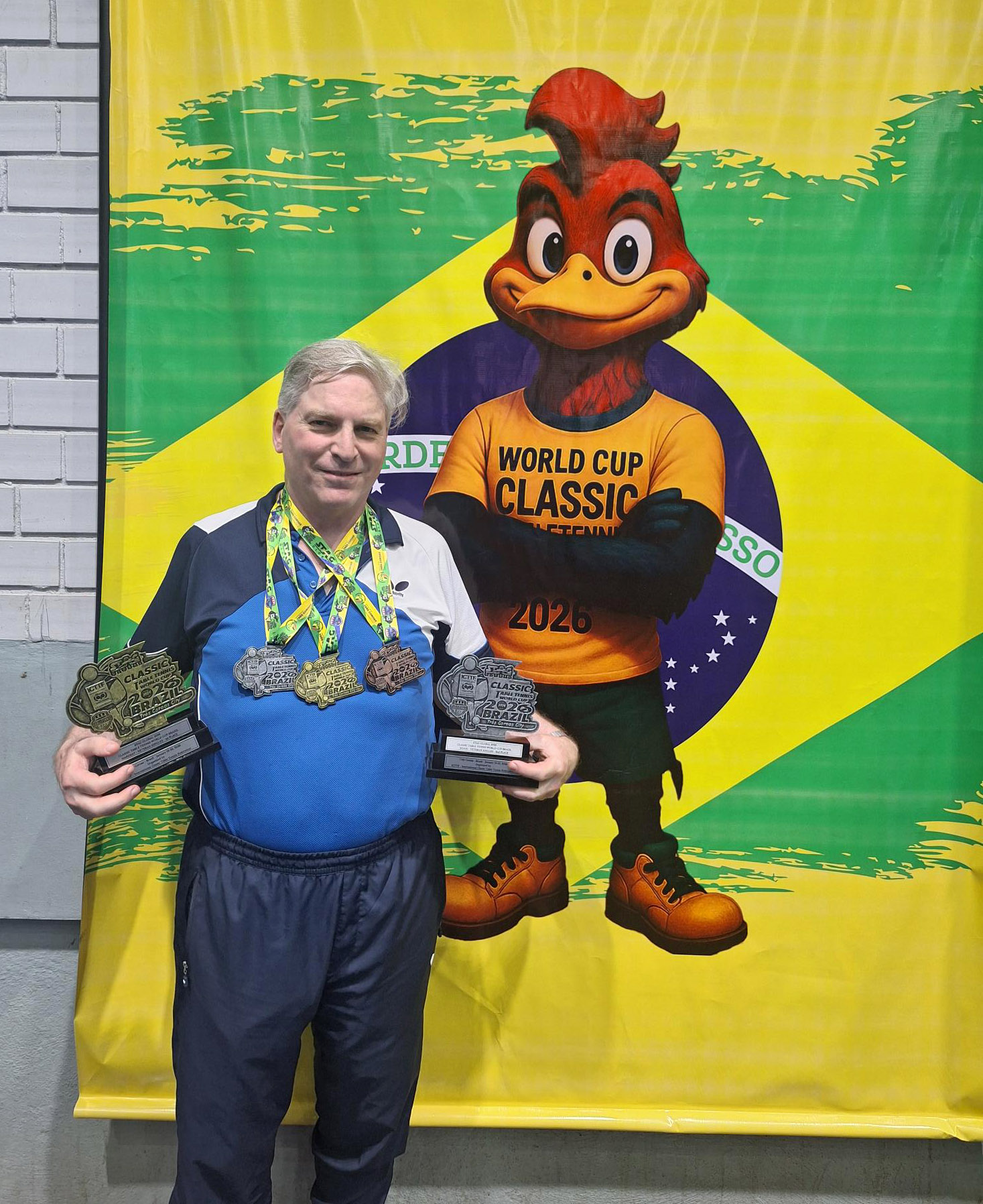
I just spent a month in South America, competing in the Classic Table Tennis World Cup in Três Coroas, Brazil, Jan. 18-25. I won gold in Over 60 Hardbat Singles and silver in Over 60 Woodbat singles, as well as quarterfinals in sandpaper. Here's me with my winnings! (There was also a nice cash prize. Note that I play both hardbat and sponge, and now wood and sandpaper!) All the training I've been doing with Lidney Castro paid off. Fortunately, I've gotten over the various ongoing injuries I've battled this past year, especially my shoulder, side, and knee, all on the right side. Afterwards I spent three weeks touring South America, returning Feb. 12. I posted long notes almost every night about my sightseeing on Facebook, including photos. If you want to read about my adventures, here's my Facebook Page. Page down to January 16, and go from there! Here are the places I visited and toured.

  • Três Coroas and Rio de Janeiro, Brazil
  • Buenos Aires, Argentina
  • Montevideo, Uruguay
  • Lima, Cusco, and Machu Picchu, Peru
  • Bogotá, Colombia

Who Brought the First-Ever World Championships to American Soil?
What Happened to Decades of USATT News Items?

Some of you may have read the USATT news item that came out a few days ago, Announcement To USATT Members from Board Chair Kelly Watson. It basically says that the USATT board has contracted current CEO Virginia Sun through the end of 2030. It gives a whole series of vague superlatives about what she’s done. I find some of them misleading. Let’s take just the first claim, “Virginia has helped elevate the sport of table tennis in the U.S. by bringing the first-ever World Championships to American soil.” This refers to the 2021 Worlds in Houston.

Sung had nothing to do with bringing the first-ever World Championships to American soil. I emailed her on this, and I’ll get to her response shortly.

It would be helpful if we could just refer to the USATT news item on this from 2019, but in another USATT scandal, all news links before May 16, 2019 have been lost from the USATT news page. (They were apparently lost when USATT switched to a new server during Sung’s tenure as CEO. No backups. Hundreds of those articles were by me from my days as co-webmaster. I'm not sure if I have copies of all of them. Most are gone for good; if you already know about a specific news item, and if you know enough about it to search, you can use the Internet Wayback Machine, but that's a rather awkward way of doing so, and the rest - the huge majority - are essentially lost.) That’s literally decades of history, now gone. In fact, the very first news item now is about Sung’s original hiring, Virginia Sung Appointed New CEO of USA Table Tennis, on May 16, 2019. (Is it coincidental that all news items before that were lost? I have no idea. It's as if nothing happened before Sung was hired as USATT's 16th CEO/ED.)

For those with time on their hands, feel free to do what I did, and go to the USATT News Page, page to the bottom, click on “Load More,” and repeat, page after Page after PAGE, until you get to May 16, 2019 (it takes a long, tedious time), and discover there are no more before that. It’s an incredibly clumsy way to organize a news page. (At least give links for each year.) I also did searches, but they only go back to that date.

I found the link to the USATT news item on USA getting the 2021 Worlds from several sources, including my blog. But it’s no longer valid, and just takes us to current USATT page. It’s by Matt Hetherington from when he worked for USATT, but he didn’t have a copy of the original. Here's the original address:
https://www.teamusa.org/USA-Table-Tennis/Features/2019/April/22/The-World-Table-Tennis-Championships-is-Coming-to-USA-for-the-First-Time-in-2021

I wasn't able to find it with the Internet Archive's Wayback Machine. However, my cousin, Jess Snyder, was able to do so! Here it is. Or see the rather long and awkward address:
https://web.archive.org/web/20200813034445/https://www.teamusa.org/USA-Table-Tennis/Features/2019/April/22/The-World-Table-Tennis-Championships-is-Coming-to-USA-for-the-First-Time-in-2021

So, here are four sources:

As noted in the Butterfly article, the four main contributors to the bid and presentation were Dragomir Cioroslan (USOC Director of International Strategies and Development), Janis Burke (Houston Sports Authority CEO), Anne Warner Cribbs (USATT Board Chair), and Lily Zhang (US Team member). Here’s the 13-minute presentation to the ITTF.

The original bid (initially for 2020, later changed to 2021) was sent to ITTF in October, 2017. (Note that I was on the USATT Board of Directors until the end of 2017.) Here is the Butterfly article on this, Table Tennis North America Submits Letter of Interest To Host 2020 ITTF World Team Table Tennis Championships. (I believe at the time we were working with Canada on this.) The presentation and awarding of the bid came on April 22, 2019. Sung was hired as CEO of USATT 24 days later, on May 16, 2019. Before that, she had no involvement in these issues. According to then-USATT Board Chair Anne Cribbs, "The bid was awarded well before Virginia was involved with USATT." (She also gave credit to former CEO Gordon Kaye and Dennis Davis for helping and supporting the bid.)

There was one small complication. Originally, USATT bid for the 2020 Worlds. South Korea also bid for that year. After negotiations, it was informally agreed that USATT would withdraw their bid for 2020 and bid for 2021, and both would support the other. (I think China was also involved in the discussions, as they were successfully bidding for 2022.) Here is the USATT announcement on Facebook, on May 1, 2018. (Note that the link to the news item with the withdrawal notice is no longer valid.) The bid was resent, leading to the winning bid for 2021, awarded on April 22, 2019.

At this point, it’s fairly obvious that Sung was not involved in “bringing the first-ever World Championships to American soil.” So, when I emailed her on this, what did she say?

She admitted that she was not involved in what she called the “initial bidding process,” as she was hired after that. However, it wasn’t an “initial” bidding process; it was “the” bidding process that brought the Worlds to the US. She also wrote that she was “involved in negotiating the initial financial terms with the ITTF.” That's likely correct, but that’s not "bringing the first-ever World Championships to American soil.” That's the job of a CEO who inherited a World Championships.

Her primary claim, however, was that due to Covid, the 2021 Worlds were cancelled. I’m not sure if they were actually cancelled, but I know it was considered. If Sung helped convince them to go on with the Worlds, then say, "She convinced the ITTF to continue with the 2021 Worlds rather than cancel because of Covid," and kudos to that. But that’s not the historic “bringing the first-ever World Championships to American soil.”

Making it worse is that it implies Sung did it alone rather than credit the ones who put the bid together and made the presentation that won the bid before she appeared on the scene. It says she "helped elevate the sport of table tennis in the U.S." and then says that she, Virginia, did so by "bringing the first-ever World Championships to American soil.” This is a huge disservice to the ones who actually and historically worked so hard to actually bring “the first-ever World Championships to American soil.” Perhaps the article could have just said, "As CEO, she helped organize and run the first-ever World Championships on American soil"? You know, be accurate? Then I wouldn't be writing this segment.

I’m not going to go through the rest of the news item. It’s just not worth it. And it would involve getting info from USATT that we would have to trust is accurate. Remember when former board member Thomas Hu, an MBA, said he found possible problems in the USATT financials and asked to see the more detailed version? They blocked him from seeing them. (See my July 1, 2024 blog on this, the segment "USATT Board Member Denied Access to USATT Financials," right after the segment about the illegal third term of the previous chair of the board.)

I am so flipping tired of USATT issues that I'd rather talk about flipping...

Flipping Change of Direction
Here's the video (25 sec). However, all you need to do is watch the first shot, the first three seconds – but watch it twice. First watch only the kid receiving. Watch closely (and perhaps more than once) and see how his forehand flip starts out aiming to the receiver's wide backhand, and then, at the last second, switches to a crosscourt ace. How was it an ace? Now watch the receiver. This is subtle, but watch his left foot. As the receiver is about to flip, you can see the receiver start to move to his left to cover the flip, as he sees the racket aiming there. And so he is unable to recover in time to even make an attempt to cover the flip to the forehand.

Reisman vs. Hodges Clip from 1997 US Nationals Hardbat Final
Here's a clip of me playing Marty Reisman (71 sec) in the hardbat final of the 1997 US Nationals (he won) that made the rounds on Facebook and elsewhere this past month in the aftermath of the movie Marty Supreme. The rally is about 13 seconds long, followed by Marty talking about hardbat vs sponge. (Here's a photo from the match of me smashing.) I wrote about this match in my blog on January 5, 2026. As noted in the blog, my racket was stolen before the match and I had to borrow one that played like a brick. When you watch the video, listen to the high-pitched "ping" sound when I hit the ball – that's not the sound of a good racket. (Compare it to the sound Marty's racket makes.)

Table Tennis Tactics for Thinkers and Tactiques de Tennis de Table pour Pongistes Penseurs
Yesterday someone put up this video (15:38) in French Portuguese about my Tactics book. I don't know French Portuguese, so have no idea what they're saying – I hope they liked it! (If you understand French and want to fill me in, email me.) The book comes in English and French (with a possible Chinese version coming soon). Here are the two versions:

Table Tennis Transfers
Here's the page. I have not looked into it closely myself, but it looks interesting. "Table Tennis Transfers is a global networking app and community that helps table tennis professionals connect, promote themselves, and find opportunities."

Coaching and News from All Over
Rather than post links to everything that happened since I last blogged on Jan. 12, here are links to some pages that had new content while I was gone that you might want to check.

The Scientific Case for Ping-Pong: Why Athletes — and You — Should Play More Table Tennis
Here's the article from the New York Times. (You might need a subscription.)

‘A Long Time Coming’: Table Tennis World Hails Marty Supreme-fueled Boom
Here's the article from The Guardian about the film's impact on table tennis.

Ensure Max Protein Nutrition Shake . . . and Lily Yip
Here's the ad (6 sec) starring US Table Tennis Hall of Famer Lily Yip!

Five-Table Pong
Here's the video (11 sec)!

Valentines Table for Two
Here's the table tennis cartoon! (Here's the non-Facebook version.)

Adam vs. Stina | No Mercy
Here's the video (9:25) from Adam Bobrow!

How Good Is a World Rank 17 Player Actually?
Here's the video 20:23) from Pongfinity!

***
Send us your own coaching news!
This week's Tip of the Week is up, Positioning Part 3 of 4: In the Rally. However, I'm postponing this week's blog until tomorrow because:

  1. I only got back from a month in South America on Thursday night, spent Friday resting, coached all day Saturday and Sunday, and now have a month's worth of things to take care of.
  2. I have a dental appointment this morning – about a week ago, while in Peru, either the cap of a tooth from a previous problem broke off or the tooth itself broke, I'm not sure which.
  3. It's President's Day!