

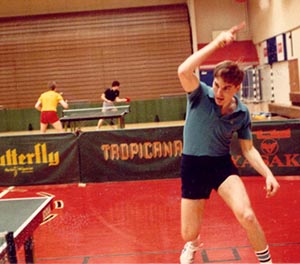
 Photo by Donna Sakai
Day One at the Writer's Retreat
Yesterday was the first day of the writer's retreat at the Writer's Center in Bethesda, MD, Mon-Fri, 9:30 AM - 5:00 PM. I'm working on my new book, "Table Tennis Tactics: A Thinker's Guide." Going into the retreat I'd done exactly 6222 words, and I was hoping to average 5000-6000 per day. On Day One, I did 8063, for a total of 14,285. That's actually a crazy pace, but it's only for five days. I'm guessing the book will total about 50,000 words, but we'll see - I'll probably keep writing well past that and end up with 100,000. I do have a publisher that's interested in the book, but whether I go that route or self-publish, it should be out next year, hopefully before the U.S. Open.
I spent much of today writing about conventional and non-conventional tactics (lots of examples of both), and on service tactics. For example, I gave ten ways to mess up your opponent with a short serve, and the thinking behind each. I'm also writing a lot about tactical (how to win the current match) versus strategic (how to develop your game) thinking. But the best part of the book is the chapter on Tactical Thinking, which I began last week, and finalized this morning. I put a lot into that chapter. Tomorrow I finish up service tactics, and move on to receive tactics. And there's a lot more coming after that.
I have a pretty extensive outline, and yet I'm barely using it. The book is basically written in my head, so I'm just transcribing it. I open the book with this: "The purpose of tactics is to mess up your opponent." The rest of the book is just elaborating. I've also got some ideas for the cover, but I won't go into that yet.
Finding Your Zone