Re: February 14, 2014

Fri, 02/14/2014 - 16:50
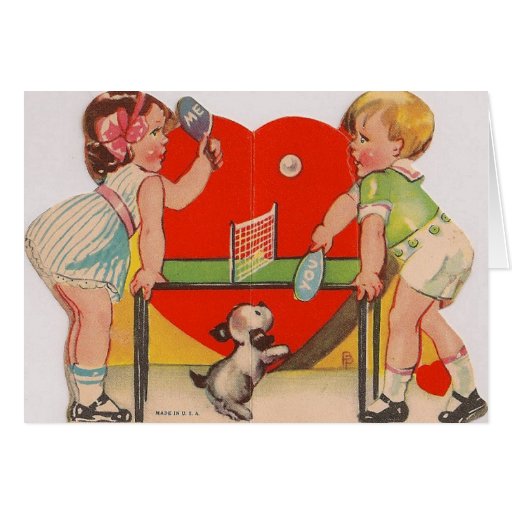
Here's another Valentine's Day table tennis picture, from Mike Mezyan. I added it to the listing above, as the "Valentine's Day Hearty Paddle."


Larry Hodges' Blog and Tip of the Week will normally go up on Mondays by 2:00 PM USA Eastern time. Larry is a member of the U.S. Table Tennis Hall of Fame, a USATT Certified National Coach, a professional coach at the Maryland Table Tennis Center (USA), and author of ten books and over 2100 articles on table tennis, plus over 1900 blogs and over 600 tips. Here is his bio. (Larry was awarded the USATT Lifetime Achievement Award in July, 2018.)
Also out - Table Tennis Tips, More Table Tennis Tips, Still More Table Tennis Tips, and Yet Still More Table Tennis Tips, which cover, in logical progression, his Tips of the Week from 2011-2023, with 150 Tips in each!
Or, for a combination of Tales of our sport and Technique articles, try Table Tennis Tales & Techniques. If you are in the mood for inspirational fiction, The Spirit of Pong is also out - a fantasy story about an American who goes to China to learn the secrets of table tennis, trains with the spirits of past champions, and faces betrayal and great peril as he battles for glory but faces utter defeat. Read the First Two Chapters for free!
Vision
I've previously blogged about some of the below, but I'm going to rehash some of it here so as to get to the point about vision.
Way back in December, 2006, I made a proposal to the USATT board for them to get involved in developing training centers and junior programs. The plan basically involved them recruiting and training coaches to set up these centers and programs. They'd use their web page and regular mailings to get prospective coaches into coaching seminars that USATT was already running. The seminars would cover not only how to coach, but the professional side as well - how to get students, set up and run programs, etc., with a major emphasis on developing full-time coaches who would set up full-time training centers and junior programs. I even wrote the manual for the program, which I've since had published, "Professional Table Tennis Coaches Handbook."
I ended the proposal by asking the USATT board what their vision was for table tennis in America, and gave them mine:
"Hundreds of professional clubs with coaches, junior training programs, classes, and leagues; thousands of recreational clubs with leagues or training programs; and hundreds of thousands playing in leagues or training programs."
At the time there were only about ten full-time centers in the U.S., and about that many serious junior programs. When I finished my proposal, thirteen board members looked back at me with seemingly little interest. Two of them spoke up, saying there weren't enough table tennis players in the U.S. to support training centers except in a few unique areas. I stared back in absolute disbelief. I was so disgusted that I told several people that very night I was resigning my position as editor of USATT Magazine, co-webmaster, and program director, which I officially did one month later.
That was just over seven years ago. Without USATT's involvement, there are now nearly 70 full-time training centers in the U.S., and nearly every one of them has a serious junior program. It happened because many others saw what I saw - there would be a demand for such centers, and where there's a demand, entrepreneurs step in. In this case, lots of table tennis coaches and top players filled the demand. The two board members were correct that there "weren't enough table tennis players in the U.S. to support training centers." What they and others without vision did not see is that you create this demand. With USATT's support, who knows how many more we would have.
Some would say we're better off without USATT getting involved, but as one who's out in the trenches, who's actually set up full-time centers and helps others doing so, I guarantee the lack of any national leadership is perhaps the biggest handicap here. Everyone who opens such a center has to practically re-invent the wheel. Other sports recruit and train coaches and promoters to do these things; we rely on them figuring it out on their own. There should be a partnership between USATT and those trying to set up such centers and junior programs, since both should have the same goals.
The result of all these new junior programs has been staggering. The level of play in the U.S. at the cadet and junior level is so far ahead of where it was just seven years ago it's not even comparable. Two years ago I blogged about this, and gave a comparison of the top juniors in 2011 to those in 2006, and it wasn't even close. In the last two years, the level has dramatically gone up again. Kids who are now battling to compete with the best of their age would often be the dominating #1 player just seven years ago. The top ten players in every age group are now doing things that at most one player their age might have been doing seven years ago. We have multiple 12-year-olds who could have been the U.S. Under 18 Champion in many past years.
Since USATT still has no interest in helping out in the recruiting and training of the coaches and promoters to set up training centers and junior programs, and also have shown no interest in setting up any sort of nationwide network of regional leagues, they either have some other vision, or no vision. Which is it?
While the staff does the day-to-day running of the sport, the board, with help from committees, sets policy. You can't set effective policy until you know where you are trying to go. Those who don't understand this do not have the vision needed to lead our sport to prosperity.
So here's my question to all USATT board members, as well as committee chairs and members, staff, and anyone else involved in the development of table tennis in the U.S. Think this over, take your time, and give a serious answer.
What is your vision for table tennis in the U.S.?
USATT Fundraising
In yesterday's blog I linked to the new minutes of two USATT board meetings and reports. I'll blog about them sometime soon. However, here's one really good thing that jumped out at me from the December meeting - the part about raising $5 million in four years in the amended motion #2. The good thing isn't about the proposed raising of $5 million. Here's the motion:
"MOVED to direct the CEO to develop a major fundraising plan that would raise $5,000,000 per quad, in addition to our current operations. The major concepts of the plan are to be presented to the Board at the Spring 2014 Board meeting."
It's good that they are trying to raise money, but there's nothing new about it. What jumps out is that they did one small, seemingly insignificant thing that USATT almost always forgets to do in the past - they put someone in charge of actually doing it - the USATT CEO. Voting to do something may make it look like something is being accomplished and may make the voters feel good about themselves, but it doesn't accomplish anything unless you put someone specifically in charge of actually getting it done. It's a lesson USATT should have learned long ago, but over and over has failed to do, and so rarely gets much done. (Anyone remember the People's Front of Judea in the movie "Life of Brian"? They kept voting to do hugely important things, then would adjourn without actually doing anything.) Perhaps this time it'll be different - I'm actually hopeful here, since I know raising funding is a top priority of board chair Mike Babuin, and now we have our CEO directly in charge of doing so. In the words of a famous captain, "Make it so!"
Crossword Puzzle
Late last night before going to bed I decided to do the crossword puzzle from that morning's Washington Post. Here was 62 across, eleven letters: "Olympic sport with the smallest ball." Let's see, what could that be? Spitballer? Peashooting? ProMarbling?
Poly Balls
Here's an article on the new poly balls, which are supposed to replace celluloid balls starting in July. The newer versions have apparently passed all eleven required laboratory tests. Will they pass the players' test? USATT has announced they will still use celluloid balls at the U.S. Open in July (they had already ordered the balls), but after that we'll see. I believe tournament directors will be able to choose which to use, but I'm not sure.
Richard McAfee's New Knee
Here's a picture of former USATT Coaching Chair and current ITTF roving coach Richard McAfee after having knee replacement surgery. He looks so comfortable, lying back and reading with all those tubes sticking out of him.
Westchester Open Singles Final
Here's the video (35:47), with Eugene Wang of Canada (U.S. Open Men's Singles Champion and North American #1 ranked player) defeating 16-year-old Kai Zhang, -11,10,3,8.
Crazy Rally
Here's an incredible rally (47 sec) posted this morning from the Swedish League.
Pong to the People
He's Having a Ball Playing Table Tennis
Headis - Soccer-style Table Tennis
Here's video (43 sec) of the fastest growing sport in America. While we're on the subject of soccer, here's video (5:11) of three members of the U.S. Soccer team playing table tennis (Brek Shea, Juan Agudelo, and Heath Pearce).
***
Send us your own coaching news!
Want to Improve? Compete with a Junior!
Here's a little tip for those who want to improve. Every club has some up-and-coming junior who practices regularly and keeps getting better. Well, why not grab his coattails (even if you are currently better), and try to stay with him? It gives incentive and can lead to great improvement. Make a friendly rivalry out of it, perhaps practice with and play the kid regularly. As he improves, he'll push you to improve.
It may be counter-intuitive, but even if you are better, and practicing with the kid seems to help him more than you (and thereby make it "harder" to stay with him), it works both ways. His improvement will push you to higher levels, either to stay ahead or to stay with him. He probably plays faster than you; his speed will push you to rally and react at a faster pace. As he gets better, he'll push you to find new ways to win points, and suddenly you'll be thinking more about the aspects where you should have an advantage due to experience: serve, receive, heavy spins (topspin and backspin), placement, or just plain consistency. You'll have incentive to develop these aspects in ways you might not do against other players who are not improving so much. The more he adjusts to you and improves, the more you'll adjust to him and improve. And you can ride his improvement as long as you can, right up to a pretty high level. And if he does finally pull away, with you metaphorically kicking and screaming all the way as you try to stay with him, you'll both have improved dramatically, and will be able to point at this star in the future and say, "I was his practice partner." He may even remember you someday during his USATT Hall of Fame induction speech!
Beginning/Intermediate Class
We had the second meeting of the new class yesterday. (Ten Mondays, 6:30-8:00 PM.) There are eleven in the class, ranging in age from their twenties to their sixties. We started with a forehand review and warm-up. I had most hit among themselves. Two players were complete beginners, so I put them with my assistant coach, John Hsu, who did mostly multiball with them.
Then I called everyone together and John and I did a backhand demo, and I lectured on the intricacies of the shot - foot stance, racket tip (sideways or 45 degrees), contact (flat or topspin), etc. Then they paired off for practice again (with the new players with John again). Later I called everyone together again to demo and explain down-the-line shots (on forehand, line up shoulders properly and take the ball later), and then they practiced down the line. Then I called them together again and did a review of serving with spin, which I taught last week. Then we went over service deception. (One key concept I explained is that even if you can't come close to doing it now, it's important to know what's possible so you can work toward it.) I went over the three main types of service deception - sheer spin, semi-circular motion, and spin/no-spin combos.
After serve practice we played a little game the last 5-7 minutes where we stacked ten paper cups in a pyramid, and everyone had ten shots (fed multiball) to see how many they could knock over. (We used two tables, so John and I both fed shots.)
Two players had missed last week session so I stayed 30 minutes afterwards to recap for them what had been covered the previous week - grip, ready stance, forehand, and serving with spin.
USATT Minutes and Reports
Lots of breaking news from USATT. Below are the minutes from the USATT's two-day board meeting at the USA Nationals and from their January teleconference, the news item on the new tournament sanctioning procedures (no more tournament protection, i.e. pure free market), and the 2014 budget. My last two blogs were mostly about an interview with the ITTF president and about the chair of the USATT board's report, so today I'm going to go back to blogging about the emphasis for this blog - coaching - and save my thoughts on the below for later.
Top Ten Shots at the 2014 Qatar Open
Here's the video (4:40).
Mini-Table Tennis
Here it is! Anyone know who Kosto and Zik are?
Exhibition Tricks from Scott Preiss
***
Send us your own coaching news!
Tip of the Week
Adham Sharara Interview - More Changes Are Coming!
Here's an interview with ITTF President Adham Sharara. Some of the things he says will make some players nervous or even downright scared. Three of the main things he talks about are ending Chinese domination, slowing down the game by using a ball with less spin and speed (bounce), and starting to restrict rackets with a bounce test. Here are excerpts, and my comments. (Note that I'm saving for last the most revolutionary item - the testing of rackets, i.e. a bounce test, and an apparently new racket approval process.)
When asked why he thinks it's necessary to end Chinese domination, he uses the example of USA basketball, and says, "Hence, we felt it’s necessary to take our sport to other nations and requested China to help others. Table tennis should be played everywhere. Otherwise, it’ll become very boring." I'm a bit leery of the whole idea of making it a goal to end a country's domination, though of course he might have a point about it being more interesting when more countries are competitive.
There does seem to be one difference, however: I believe that when the USA basketball teams dominated, the whole world watched when they played. With China dominating, the world doesn't seem to watch when they play. I think this has more to do with USA media, which is (of course) biased toward USA and tends to dominate or at least influence the rest of the world's media. I'd rather the focus be on China helping to spread table tennis by continuing to do what they are already doing, which is to send their coaches all over the world to train players in other countries. Then it's up to the rest of the world to catch up with China, with the help of these Chinese coaches. That's what we're doing in the U.S., for example. With the help of seemingly zillions of new Chinese coaches and practice partners, and many dozens of new training centers opened in the past 7-8 years, we have by far the best junior and cadet players in our history. In a few years they may be challenging anyone in the world . . . except maybe the Chinese. (USA top juniors and cadets: sic 'em!)
Then they get into balls and rackets. We'd been told that the change to the new poly balls was because celluloid balls are extremely flammable, and it was becoming very difficult to ship them around the reason for insurance reasons. But Sharara says:
"We’re also changing balls. FIFA made the balls lighter and faster, but we’re changing balls from celluloid to plastic for less spin and bounce. We want to slow down the game a little bit. It’ll come into effect from July 1, which, I think, is going to be a very big change in the sport."
We already switched from 38mm to 40mm balls to slow down the sport, and now the change to poly balls is for the same reason. While this might technically slow the ball down and reduce spin, it also will likely have two apparently unforeseen effects, which also happened when we increased the ball's size. First, with a slower ball, players have more time to get into position and throw their entire body into the shot, and so you favor big, power players who rip everything even more - and so the ball speeds are even faster. (On the other hand, a bigger ball does slow down faster due to air resistance, and so is easier to return, as we learned with 40mm balls. But will the new poly ball be slower due to a substantial size increase, or just slower off the racket? Apparently the latter, though the new balls may be slightly larger than the 40mm ball we've grown used to.) Second, with less spin, you make defensive chopping at the higher levels even more difficult as they rely on heavy backspin to succeed.
Finally, we get to the question on rackets. Sharara says:
"In the past, we’ve tried various ways to control the power of the racquet. But players are always ahead of us. They’ve tried other means, which made the action faster. Now we’ve decided to measure the racquet from the outside. The racquets will have a bounce limit as well. We’ll introduce this next year."
Rackets are already tested, mostly for continuity and any traces of illegal glue. This would be a new test, presumably measuring the actual speed of the blade and covering. (There aren't that many rules on blades, which is the racket without covering - they can be of any size, weight, or thickness. About the only rules about blades is that they must be flat and rigid, and at least 85% natural wood. Here are the current ITTF rules on rackets; most of it is about the coverings, not the blade itself.) How far would this new bounce test rule go? Would rackets need to pass a test to be approved, thereby making many older or homemade rackets illegal until tested? Would they be tested at tournaments? That's be another task for referees.
We'll just have to wait and see how these things transpire. Meanwhile, on Saturday one of the kids in our junior class asked me why one of the balls we were using was smaller than the others. It turned out a 38mm ball had been mixed in with the regular 40m ones - the second time this had happened recently. I have no idea where they are coming from; someone at the club must be bringing them in. Later that day I brought one out during a lesson and hit with it, and boy did it bring back some nostalgia! Those balls really react to topspin, curving down like a hawk diving for prey.
Larry's Trademarked Terms
From now on you have to pay me $1 anytime you use any of these terms I've invented. I'm pretty sure I've invented some others but can't remember them.
Lily Zhang Qualifies for Nanjing 2014 Youth Olympic Games
Here's the ITTF list of qualifiers (page down to Women's on page 4, and see the third item, "ITTF Under-18 World Ranking). So her world under 18 ranking qualified her for the Nanjing Youth Olympic Games.
Xu Xin Wins Qatar Open
Here's the ITTF home page for the event, with results, articles, pictures, and video. Here's another article on it from Table Tennista.
McConaughey vs. Harrelson
Here's an article on how Matthew McConaughey and Woody Harrelson turn table tennis into extreme sport.
Ping-Pong Trick Shots
Here's a new video (6:08) with an incredible compilation of trick shots. The first one might be the longest trick shot ever.
***
Send us your own coaching news!
USATT President's Blog
Here's USATT Board Chair Mike Babuin's new blog on "Changes for 2014." It's mostly good stuff. Many of the items he writes about we can't really judge until we know more about the programs, and see if they will actually be implemented. USATT historically doesn't have a high batting average in that regard. Here are my short comments on each.
Upcoming ITTF Coaching Courses in USA
There are two coming up, a Level 1 Course in Akron, OH (July 28-Aug. 1) and a Level 2 Course in Austin, TX (Aug. 25-30). For more info, see the USATT Coaching Courses Page.
2016 Olympic Rio Qualification System
Here are the rules for qualifying.
2014 Friendship Trophy
This is part of the ITTF's Women's Development Program, where they encourage you to "… find a way to celebrate women and girls in Table Tennis."
Chinese Retirement Ceremony
Here's an article with a link to a video trailer (4:49) where retiring Chinese team members give messages to their teammates (in Chinese, alas).
Mike Meier to Umpire at Worlds
Amazing Table Tennis Serves
Here's a video (4:03) where a player demonstrates his tricky spinny serves. I think the commentary is in Chinese. Note that the serve where the ball bounces back into the net is more for show, and is easy to return; in a real match, it's better to serve the ball so second bounce is near the end-line.
Orioles' David Lough and Table Tennis
Here's an interview with new Baltimore Orioles left fielder David Lough. See third item:
Hidden talent: I thought I was good at ping-pong until I saw some of these other guys playing in here. [Laughs]. I don't have anything else cool, I'm boring.
Adam Bobrow on Table Tennis, Comedy, Excessive Celebrations
Here's the video (20:49). Here's more about Actor, Comedian, and Table Tennis Player Adam Bobrow.
Qatar Open's 20th Birthday
Here's their 20th Birthday Cake. (Here's the home page for the Qatar Open in Doha, held Feb. 18-23 - yes, right now!)
***
Send us your own coaching news!
Warming Up
One of my junior students had a sort of bad experience yesterday. He came in a bit early while I was coaching another junior player, who was a friend of his. They wanted to play some, so at the end of the session with the first player I let them play some games - but I was bit worried since the second player had no warm-up. I was right to be worried.
The first player was all warmed up and playing really well, but the second player wasn't. He was rated a bit higher, but while the first player mostly kept the ball in play, the second was an attacker who couldn't attack because he hadn't warmed up. (Both were around 1500 level or so.) With just five minutes warm up he might have played okay. Instead, the second player played horribly, and after a while was reduced to swatting backhands from his forehand side since he had no confidence in his forehand anymore, which was normally his strength. He lost a series of games, and was pretty depressed.
When we started our session (15 minutes late, but I had told him I could go 15 minutes extra at the end), he couldn't play, mentally or physically. He couldn't get himself to care after the drubbing he'd just taken, and his shots were all messed up. It took about 15 minutes before he could play serious. But gradually he got back into it, and by the end of the one-hour session he was back in full form. The other kid was long gone, so no rematch.
I told him a story about my "best" tournament ever, from way back in the late 1980s or early 1990s. There's a reason "best" is in quotes. At the U.S. Team Championships in Detroit many years ago (it's now the North American Teams in Washington DC), after two days I had only one loss (to a 2600 player), and I had hordes of wins against 2250 players, a bunch of wins against 2350 players, and several 2400+ wins. I'd gone in rated 2272, and if I'd stopped after two days, I might have been adjusted to 2500. On the third and final day, my teammates didn't show up until the last minute. Back in those days I always needed a good warm-up, but didn't have anyone. Finally, about ten minutes before we had to play I found a 1700 player, a lefty with long pips who swatted shots all over the table, and left more messed up than I would have been if I'd simply played without a warm-up. So what happened? On that day I went 0-6, with all six matches upsets, including three against players rated over 100 points lower. Instead of that adjusted 2500 rating I came out . . . 2273, one point higher than I'd gone in.
So the lesson is to always warm up properly. It's important to practice against all styles, but warming up for a serious match is different. For that, you want someone who plays somewhat orthodox (or can in a warm-up), preferably someone you are used to playing. I encourage all my players to arrange in advance who they will warm up with at tournaments, and arrange when and where they will meet.
Fobbing
A lob is a high, defensive shot with topspin and sometimes sidespin. Fishing is a somewhat high defensive topspin. What about defensive topspin shots that aren't high enough to be lobs, but are too high to really be fishing? I hereby trademark the term "fobbing." I "invented" the shot yesterday while letting a student practice against lobs and fishes (he'd been having trouble in matches), and that's when I discovered and unleashed the power of the fob.
USATT Magazine
I'm wondering how I'm going to read it from now on, now that it's only going to be online. I do not like to read extensively at a computer; reading is something that should be done in a comfortable lounge chair or even in bed. More importantly, extensive reading on a computer screen hurts my eyes. So there's no way I'm going to read the magazine on a computer, other than perhaps selected articles. So I guess I'm going to have to either skip most of it, or print it out to read. (Addendum - I'm all for the online magazine; it's just not for me. As I've blogged, they should have added the online version - leading to increased advertising - but kept the print version.)
No Table Tennis at Junior Olympics
I just saw this. I immediately sent out queries. I just got this response from the Junior Olympics people (AAU):
"Unfortunately Table Tennis will not be a part of the 2014 AAU Junior Olympic Games in Des Moines, Iowa. Due to facility and staffing we are unable to hold the event this year. We hope to have it return in 2015 in Hampton Roads, VA. Stay tuned for more information regarding next year. Once again we apologize for any inconvenience this has caused."
Physical Training for Table Tennis
Here's a video (11 sec) of what 13-year-old Adriana Diaz of Puerto Rico doing some physical training. She's ranked #9 in the world in Under 15 Girls. (All but one of the eight ahead of her are from Asia - three from China, three from Japan, one from Korea, and one from Romania. Of course, these rankings only include those who play in ITTF events.)
Western Open
Here's a video (1:35) of highlights from the Western Open this past weekend. And here's a photo gallery. (I linked to the results on Tuesday.)
Anagrams of the Stars!
TOP MEN
Ma Long: Man Log, Am Long
Wang Hao: Ha Wagon, A Hag Now, A Hag Won, Own a Hag
Dimitrij Ovtcharov: Vivid Major Rich Tot, Vivid Major Rot Itch
Timo Boll: Mi Lob Lot
Chuang Chih-Yuan: China Guy Can Huh?
Vladimir Samsonov: Invalid Savors Mom
Waldner: Law Nerd
TOP WOMEN
Liu Shiwen: Uh - Lie Wins
Feng Tianwei: Wee Fainting, We Fine Giant, Negate If Win, A Fine Twinge, Win Eaten Fig, Win Fine Gate, We Gain Feint
Guo Yan: Nag You
TOP USA
Timothy Wang: I Won That Gym, I Own That gym, Win at Hot Gym, Hit a Town Gym, A Mighty Wont, Goat Myth Win, Into What Gym?, Not With A Gym, Got a Win Myth, Win Toga Myth, Why Man Got It
Corey Eider: I Eye Record
Dan Seemiller: Reels in Medal, Learned Smile
Michael Landers: Me Learn as Child, Handles Miracle, Lame Child Nears, Me Child Arsenal
Ariel Hsing: Irish Angel, Shinier Gal, A Shine Girl, A Relishing
Constantini: Instant Icon
Larry Hodges: Holy Regards, Godly Sharer, He's Gray Lord, Shy Lord Rage, Oh Sly Grader,
Hodges: He's God!
USA Table Tennis: Satan but Senile
***
Send us your own coaching news!
USATT Membership and Mass Mailing
USATT has about 8000 members. That's pretty weak in a country of 314 million.
A few days ago I received another brochure in the mail (regular mail, not email) from USTA (U.S. Tennis Association). For many years I played tennis on the side (and had a heck of a forehand!), and used to go to group training sessions twice a week for many years. I also played in their doubles leagues, and joined USTA to do so. Being a smart organization with 700,000 members, which are overwhelmingly league members, they have been trying to get me back ever since. Which is why I regularly receive both mail and email from them.
Is it cost effective? Of course it is; they are not idiots. I still get mail from many other organizations I used to belong to (and I bet you do as well), always encouraging me to rejoin or re-subscribe. Former members are probably the single best group of people to target when trying to increase membership. USATT should target this group.
USATT has a membership of around 8000 or so. (If you include life members who are no longer active or even alive, organizational memberships which were mostly given out for free, and club memberships, the number may shoot to something like 9000, but I don't have up-to-date figures, and USATT doesn't seem to publish them as they used to do.)
How many is 8000? Let's see:
So how do we fix this problem? For years I've argued the obvious, that we should do what nearly every successful table tennis country does and what other successful sports in the U.S. do - focus on leagues and training centers. Setting up a nationwide system of regional leagues is about as obvious as you can get, if you any knowledge of how table tennis and other sports develop, but we haven't even begun to do such things. I've blogged about setting up these nationwide regional leagues many times; I just did a search of my blog entries, and here's one example. Bowling in the U.S. has about two million annual paid members in their bowling leagues; can you imagine how fast that would drop if they did what USATT does, and only had tournaments? The same is true of tennis, which focuses on leagues. Take away those tennis leagues, and their membership wouldn't be much higher than table tennis - it too would become a "round-off" error.
As to setting up training centers, the key there is to promote, recruit, and train coaches to be professional coaches who will set up such training centers. That's why I wrote the Professional Table Tennis Coaches Handbook. We've gone from 10 to 70 of these in eight years, but it's happened because coaches saw it as a way to make a living. Many of them copied the success of my club, MDTTC, which pioneered such a training center when it opened in 1992, with me, Cheng Yinghua, and Jack Huang as the coaches. (We now have seven full-time coaches and a number of part-time ones, and other centers have similar success.) While the focus of training centers tends to be junior programs, it's for all ages and levels. Guess what happens? Coaching turns recreational players who come and go into serious players who stay.
But USATT is a bureaucracy, where doing the obvious things is often difficult. No one seems to have the vision or will to do these things. I think many are scared of trying because if they failed, they'd be blamed. (Perhaps they should read the "Man in the Arena" quote by Teddy Roosevelt. Many leaders think they are in the arena because they deal with the day-to-day issues, mostly putting out fires, doing reports, answering email, and doing the daily running of a status quo sport, instead of actually going into the arena and striving to build the sport.)
I'll continue to argue for these obvious things. But perhaps it's also time for a one-time fix to increase membership. Here's a suggestion to any board members or staff who want to take initiative.
USATT has something like 50,000+ former members of USATT on the computer. That's a lot of mailing addresses just sitting there gathering computer dust. Why not do a one-time mass mailing to them all? Sure, it'd cost money, but takes money to make money, and you'd come out way ahead overall. Have it written by someone who knows how to write - for the love of God, do not have it written by a staffer without a strong writing background! Then have the letter come from a prominent U.S. table tennis star - a Dan Seemiller, Sean O'Neill, Jim Butler, or a Sweeris, for example, and include a picture. Have them personally invite these former members to rejoin USATT. Give specific reasons to rejoin. It's unfortunate we can't really offer them leagues as tennis can, and that we no longer offer the print magazine (!!!), but we can offer them tournaments, including the U.S. Open and Nationals. We can point out all the new full-time centers that have popped up.
As a side benefit, maybe, just maybe, as they create or think about this invitational letter, USATT leaders will realize that maybe, just maybe, we do need to think about what USATT really has to offer, and realize that we do, in fact, need that nationwide network of leagues and to start recruiting coaches to be full-time professional running junior and other training programs. These are the incentives you can use to attract members, and that's what we're aiming for, right? If you are aiming for Olympic medals and top players, then we have the same goals. Guess where they come from? Junior training centers. Guess where the money comes for USATT to develop them? Large members that come from leagues.
Multiball Training
Here's 25 sec of Stefan Fegerl doing multiball at the Werner Schlager Academy in Austria.
Slow Motion Table Tennis
Here's a video (4 min) of slow motion play of the top players. Great to watch and you can learn a lot from watching it this way.
Chinese National Team Show Up at Park
What would you do if you were playing Table Tennis at your local park and the Chinese National Team turned up to play? Here's the video (1:32)!
Wide Stance
I've written about using a wider stance, but this is ridiculous!
Energizer Battery Table Tennis Commercial
Here's the video (31 sec) - this is hilarious! It just came out this past weekend.
***
Send us your own coaching news!
Adult vs. Junior Classes
Last night was the first session of the new beginning/intermediate class I'm teaching at MDTTC, Mondays from 6:30-8:00PM. (Here's the flyer.) The class is for beginners up to roughly 1500 level. We had eleven in the class, but one apparently dropped out and another had to miss the first session, but emailed that he'd be there next week. John Hsu, an ITTF certified coach, assisted.
There's a huge difference between teaching adults and teaching kids. Adults have more patience, and so you can lecture and demo a lot longer, and they have lots of questions. Do that with kids and you get a lot of impatient kids. Kids rarely ask questions other than ones like "Are you almost done?" or "When's break?" Working with kids is fun, and you can develop top players from them, but teaching adults is often more interesting because you can go more in depth on each topic. There were lots and lots of insightful questions. Let's face it, I could talk two hours non-stop on any table tennis topic, so I have to restrain myself!
We covered four things in the first session. First was the grip. I went over what a neutral grip is and why players should use it while developing their strokes. (I wrote about this in this Tip of the Week, Should You Use a Neutral Grip?) Then I went into proper ready position, as well as the relationship between the two. (I wrote about this in another Tip of the Week, Feet and Grip. A related Tip is Use a Wider Stance.)
Then we went into the forehand drive. John and I demoed it, and then I went over the basics of the shot. Then the players went out on the table and practiced.
The final thing covered was serving and spin. First I went over the rules. Then I showed and explained how to get great spin on a serve. Part of this included using soccer-colored balls so you can see the spin, and having the players toss the ball up and spin it off their racket and catch it so they could work on grazing the ball, making it spin, and controlling the direction of the ball when spinning it. (I explain all this in this blog entry - see second segment.) Then it was off to the tables again to practice.
At the end of the class I demoed some serves, and nobody wanted to go. So I spent an extra ten minutes letting them take turns trying to return my serves while I threw all sorts of variations at them.
Next week we do some more forehand practice, and then cover the backhand drive, side-to-side footwork, and deception on serves.
ITTF Level Three Coaching Course in Trinidad and Tobago
Here's the ITTF article on the course, to be taught by USATT coach Richard McAfee.
Western Open Results
Here they are. (Set dropdown menu for Western Open, held this past weekend in Berkeley, CA.) Here are photos of the winners of each event.
Elite Multiball Training
Here's video (25 sec) of some multiball training at the Lily Yip Center in New Jersey.
Ma Lin's Touch
Here's 16 seconds of Ma Lin alternating dropping balls short and backhand flipping.
Top Ten Shots from the Kuwait Open
Here's the video (4:08) from the Kuwait Open held this past weekend.
Eleven Curious Facts about Zhang Jike
Here they are! (Did you know he was a championships high jumper?)
Ten Reasons You Should Start Playing Table Tennis
Happiness is…
***
Send us your own coaching news!
Tip of the Week
Most Difficult Questions for Coaches and Players
For me, here are the seven most difficult judgment calls for each student. I could write entire blogs and Tips on each. Whether you're a coach or a player, you too should be thinking about these things. (Readers, let me know if there are any below you'd like me to elaborate on.)
One-Day Camp
Today we have a one-day camp at MDTTC. Schools are closed because of President's Day. Come join us, 10AM-6PM! (There's a two-hour lunch break, with Chinese food delivered to the club.) It'll be mostly kids, but adults are welcome as well. No lectures today; just training.
Beginning/Intermediate Class
I have a new 10-week beginning/intermediate class starting tonight, 6:30-8:00 PM. The class is for beginners up to roughly 1500. I've been playing around with the schedule a bit, and made some changes from past sessions. For session one, we're going to focus on the grip, stance, and forehand, but I'm also going to introduce them to spin serves, starting with some exercises where they learn to create spin, and working our way to Seriously Spinny Serves. (Do you have SSS?) It's going to be a long day, with the one-day camp (see above) and then the class.
Table Tennis Tips Status
My newest book is now at the proofing stage. Sometime this week I plan on taking all 208 pages (single spaced, with 86,000 words) to Ledos and spend a day proofing and eating pizza. Except for the cover, this one is all text. It's a compilation of all 150 Tips of the Week from 2011-2013, but now in one volume and in an orderly fashion, organized by topic instead of by the date it happened to go up. I'm also going to write an intro to some of the Tips. The cover is done; I'll post it sometime soon.
Snow
We ended up with 19 inches of snow at the Maryland Table Tennis Center. We closed for one day, while local schools closed for two. I didn't want to shovel snow since it'd inevitably lead to back problems. Here's the way I see it. The powerful forces of nature dropped snow on us, and the powerful forces of nature will eventually melt it away. Who is mankind to defy nature with their puny snow shovels? (However, the people I rent to downstairs shoveled the front area, solving the problem. But I did eventually shovel out my car so I could get to club to coach, and yes, I did feel twinges in my back, my knees, and my foot. But hopefully nothing serious.)
U.S. Open Entry Form
Here it is! And here's the U.S. Open page.
Stellan Documentary
Here's a documentary (5:12) on Sweden's 1971 World Men's Singles Champion and San Diego coach Stellan Bengtsson.
Robot Table Tennis
Last Tuesday I blogged about the upcoming "challenge" between Timo Boll and the table tennis robot Kuka. Who'll win? Duh!!! Timo will easily win. There's no way the robot will be able to react to his spins (looping, pushing, serving, etc.), and I doubt it it'll react to the speed of his shots either. Maybe someday in the future. While Kuka may be the best table tennis playing robot right now, I don't think he's going to be able to go from basic beginner to advanced in two years. Here's where robotic table tennis (3:06) was about two years ago.
Wang Hao's Son
Here he is - meet Wang Ruiting!
Michael Ealy vs. Soo Yeon Lee
Here's the video (3:43). The two squared off on the Arsenio Show. Guess who won between actor Ealy (the self-proclaimed master of table tennis) and pro player Lee?
Table Tennis Ballboy Tutorial
Here's the hilarious video (3:32). I especially like the training sequences starting at 2:07.
***
Send us your own coaching news!
Happy Valentine's Day!
Here are Happy Valentine's wishes from around the world (15 sec video), care of the ITTF. Here are some Valentine's Day table tennis pictures.
How to Practice When Snowed In
We're snowed in here in Maryland (and much of the east coast), with about 17 inches outside, and supposedly 1-2 more coming. All table tennis was cancelled yesterday and tomorrow, and the weekend is still iffy. So what does an ambitious table tennis player do when snowed in? Easy - he trains!!! But how can one train when stuck inside? Glad you asked. Here are five ways.
USATT Online Magazine
USATT CEO Mike Cavanaugh now has a report, "Transition of USA Table Tennis Magazine to a Digital Publication," that explains the transition from print to online that I blogged about on Tuesday. It's strange that they made the public announcement about the decision before putting up the explanation; they should have gone up at the same time. The decision was made a month ago, so they had plenty of time.
As a past advertiser, I received an email from the editor explaining the transition and advertising situation. The key phrase from the email was, "Ad rates will remain at the same level as they have been in the past." This is going to be problematic for them as online advertising rates are generally considerably cheaper than print advertising. They are trying to set a new paradigm here. If they do, then they've hit a home run.
As I wrote in a discussion on this at the about.com forum, they face two serious problems with this. First, while the print magazine went to dedicated table tennis players, going for hits from a web page may bring in more total people, but they are not the dedicated players advertisers are looking for. Second, with the magazine readers paged through it, and so saw the ads. With the online version, readers only zoom in on what they are interested in, and so are less likely to see the ads.
Advertisers are well aware of these problems. The reaction of advertisers to being asked to pay the same amount for an online only magazine is going to be interesting - as noted above, you generally pay a lot less for online advertising than print advertising.
Now, if they'd kept the print magazine but added the online version (which takes little extra work to do since both print and online versions come off the same PDF file), then they could have gone to advertisers and offered the added value of the web version - and with this added value, they could increase the ad rates and number of advertisers, and so greatly increase revenue without losing the print publication. That would have been my recommendation if I'd been in the room.
Past Magazines Now Online
One piece of good news. In my Tuesday blog, I pointed out that when you go to the new issue, just below it is a listing for "Related publications." USATT Magazine was the second one listed, sandwiched between two magazines with nude cover pictures. They fixed this in two ways. First, they somehow had the nude covers removed. But better still, the link now goes here, with past USATT Magazine covers below. When I clicked on the covers, those magazines are now online! Apparently they simply put the old PDF files into whatever converts them to the online version (Flash, I'm told), and so the last eight issues are now online.
Coaching Scam from England
There's a new coaching scam that's going around. I, along with at least four other coaches that I know of, have received various versions of the following email from some knucklehead (with typos left as sent):
How are you doing? I hope you are doing great, I am [VARIOUS NAMES] from United Kingdom,my son will be coming for 2weeks holiday in USA (Annandale,VA ) from February 20 2014 ,he's 15years old and i want him to use the period of his holiday to learn the fundamental of table tennis from you. He developed interest when he was very young before he lost his mother and i have assured him that i will make his table tennis dream come through. Please get back to me with your qualification,rate and location so we can start from there.
I've seen these scams before. One coach decided to test it out, and responded. After several back and forths, he received the following email:
Top of the morning to you, how are you today? i tried calling you but your number was not going through. My personal assistant has sent your payment and it will be delivered to you this morning by USPS with tracking number (a tracking number was given here that actually tracked a package sent from Montclair, California to Hilliard, Ohio - it was supposed to have been sent from England!) but my personal assistance made a mistake on the amount on the check he put ($2800) instead of ($480). And it has been authorized already, Please when you receive the check go ahead and cash it and send the excess payment to Owen travel Agent who is incharge of his visa procurement as soon as you can. Below is the information of his travel agent. You can send the excess payment to him through western union or money gram money transfer. Owen will be in your location by 18th of this month ahead the lesson for 20th of this month. I will give you a call later.
Of course, the supposed $2800 check would have bounced. This coach has already forwarded the emails to the FBI.
Three Things No One Tells You About How to Get Motivated
Here's the article from Table Tennis Master.
Why Michael Maze Still Has it
Here's the article from Table Tennis Master.
Federal Association of Sandpaper Table Tennis
Here's their latest release (#42), which covers the sandpaper events at the USA Nationals.
2014 Europe Cup Tribute
Here's a highlights reel (6:27) set to music from the 2014 Europe Cup.
Adidas Ping Pong Short
Here's the video (1:13) of some intense TT competition.
The Art of Ping Pong
Here's a 46-page online booklet on table tennis art.
Skeletal Pong
Here's the latest TT artwork from Mike Mezyan. (He also did the "Valentine's Day Hearty Paddle" at the top.)
So, Tell Me About Your Backhand
Here's the cartoon from the NY Times.
You Can Never Start Too Early
Here's video (26 sec) of a baby doing backhands and forehands.
Non-Table Tennis - "How Bad Are We" Article on the Baltimore Orioles
Here's the article. (It was originally titled "The Big Five Starters - Not So Bad?", but they changed the title. What makes this article interesting (at least to me!) is it's my 1499th published article. #1500 should be up soon!
***
Send us your own coaching news!
Here's another Valentine's Day table tennis picture, from Mike Mezyan. I added it to the listing above, as the "Valentine's Day Hearty Paddle."
Snowmageddon
We have 15 inches of snow here in Germantown, MD, and it's still coming down, though slower than before. A member of our club, Hubert Noah Essomba, has been building this giant sled and collecting two of every style - two loopers, two hitters, two blockers, two choppers, etc. (Noah is from Cameroon, and was ranked #697 in the ITTF world rankings before dropped off the list in September, 2012, presumably to build his mighty sled.) This morning they all sledded off, leaving the rest of us to freeze in the snow. Except, of course, we have heated houses and heated table tennis clubs, so perhaps we'll survive after all.
Since everyone else in the region is taking the day off, I'm taking the day off too, and plan to spend it reading in bed and fighting the urge to go outside and build a snowpingpongball. So no blog this morning, other than this biblical ping-pong account of snowmageddon.
***
Send us your own coaching news!