

I'm going to take today and tomorrow off - after all, today's Christmas Eve! More importantly, I'm still on west coast time (from the Nationals in Vegas), and when I tried to get up early this morning to do the blog, I was rewarded with a morning headache. So I'll return on a daily Mon-Fri basis on Thursday, Dec. 26 (day one of our Christmas Camp), where I'll blog about the hidden serve problems we had at the Nationals, including a mind-boggling argument over the definition of "satisfied," since the serving rules state, "It is the responsibility of the player to serve so that the umpire or the assistant umpire can be satisfied that s/he complies with the requirements of the law." (When two referees tried to redefine what it meant, I Princess Brideian told them, "I don't think that word means what you think it means." I finally wrote out the definition for them from the online Merriam-Webster dictionary.) To tide you over until then, here's Samson Dubina's new website, which has a number of coaching articles, so why not go explore that? (Samson, a full-time coach in Ohio, won Over 30 at the USA Nationals and is a former Men's Singles Finalist at the Nationals.) Now I'm going to take a few Bayer Aspirins and go back to bed.
Blogs
Larry Hodges' Blog and Tip of the Week will normally go up on Mondays by 2:00 PM USA Eastern time. Larry is a member of the U.S. Table Tennis Hall of Fame, a USATT Certified National Coach, a professional coach at the Maryland Table Tennis Center (USA), and author of ten books and over 2100 articles on table tennis, plus over 1900 blogs and over 600 tips. Here is his bio. (Larry was awarded the USATT Lifetime Achievement Award in July, 2018.)
Make sure to order your copy of Larry's best-selling book, Table Tennis Tactics for Thinkers!
Finally, a tactics book on this most tactical of sports!!!
Also out - Table Tennis Tips, More Table Tennis Tips, Still More Table Tennis Tips, and Yet Still More Table Tennis Tips, which cover, in logical progression, his Tips of the Week from 2011-2023, with 150 Tips in each!
Or, for a combination of Tales of our sport and Technique articles, try Table Tennis Tales & Techniques. If you are in the mood for inspirational fiction, The Spirit of Pong is also out - a fantasy story about an American who goes to China to learn the secrets of table tennis, trains with the spirits of past champions, and faces betrayal and great peril as he battles for glory but faces utter defeat. Read the First Two Chapters for free!
Tip of the Week
Returning Hidden and Other Tricky Spin Serves.
2013 USA Nationals
Before we go further, here is the USA Nationals Home Page, with links to results, pictures, and videos.
Until they reached the semis of Men's and Women's Singles I didn't get to see many matches other than the ones I was coaching (almost non-stop), or when I was scouting out other players. (Shhhhh!) I did get to see the Men's and Women's Semifinals, and the Women's Final, but had to leave to catch a flight before the Men's Final.
Here are a few random thoughts about these matches.
Timothy Wang, who seemed off this tournament and yet still managed to win, seemed too soft this tournament. He's always had a good blend of looping and blocking from both wings, but he struggled at times as his shots seemed soft and tentative. But often the measure of a champion is how well he plays when he doesn't have his "A" game, and Timothy won many of his matches with his "B" game. (I didn't see the Men's Final against Cory, but I'm told that Timothy played better there, and that he dominated with his short sidespin serves.) Timothy and Han Xiao had won Men's Doubles the last two years, but this time lost in the first round to Lu Guo Hui and Justin Huang.
If someone had asked me a year ago to rank U.S. players in order of probability of their making the final of Men's Singles at this year's Nationals, Cory Eider might not have made the top 30. I remember coaching against him for years in junior events, back when he was a chubby second-tier junior. Now he's in great physical shape and his level has dramatically increased. If he can stay ahead of some of these up-and-coming cadet players, he could be a threat for years to come.
David Zhuang is still playing well, but he's lost a bit of his edge after being away two years. He's probably at 90% of his level from, say, five years ago, when he last won here in 2008. He does have a tendency to hide his serve at key points, and the umpire in his match with Cory enforced the serving rule, warning and then faulting him twice on serves, and that was a key in the match. Cory also got warned and then faulted for not tossing his serve six inches, though video shows it was awfully close.
Kanak Jha wins because he has a complete game, and because he does something that most don't really notice - he returns serves well. Often junior players bang it out, but Kanak often avoids that by not allowing opponents to attack off their serve while taking the initiative on his own serve. I was especially impressed at one simple-looking thing he did that few noticed: when players served short to his forehand, he'd come in as if returning crosscourt, and then just pat the ball down the line to the opponent's backhand. The opponent would usually do a weak backhand that Kanak would jump on, and that's how the rally would begin. Too often juniors think that if they flip a forehand, they have to flip it hard, but a well-placed deceptive one is usually better.
Almost all of these players had topspinning backhands. Kanak both blocks and spins with his backhand in fast rallies, rarely backing off. Timothy Wang can play backhands both at the table or off the table, but often seemed too soft when backing off. Adam Hugh, who is basically an all-forehand player, paid for this against Kanak, who was able to get into his backhand. Cory has a big looping backhand that often dominated points. David Zhuang, of course, is a pips-out penholder who mostly blocks on the backhand - but he can block forever, all the time varying the speed and placement of his shots.
I wonder how many players think Women's Singles Champion Ariel Hsing just hits her backhand. Watch closely - most of her backhands are actually topspins off the bounce, basically mini-loops. The same is true of Prachi Jha who she played in the final (and is Kanak's older sister).
Here's a link to a video of the USATT Annual Assembly, about 68 minutes long, where there were presentations/discussions of Safe Sport (background checks for coaches), the upcoming poly ball (non-celluloid - see what I wrote about this below), a new TT Ap presentation, election stuff, and a discussion about date protection for tournaments (including an impassioned argument by Dan Seemiller to do away with blocking sanctions for tournaments on the same date if they are in separate regions). I was at the assembly, but only spoke up once, during the poly ball discussion, where the subject of Barna balls came up. Barna balls were balls made long ago that are also non-celluloid, and I not only have played with them, I have one - the ball used by Dell Sweeris in 1974 when he upset D-J Lee at the U.S. Team Championships, helping to end Lee's six-year undefeated streak against U.S. players! (Richard McAfee had beaten him earlier in the tournament.)
I'm not going to talk too much about the players I coach; I don't think they want their games dissected in public. Suffice to say that we have a firm grip on what they need to work on. One played really well but kept losing five-game matches, often after building up a lead in the fifth. Another has a specific forehand looping technique flaw that cost him over and over, but we're going to fix that.
One player from my club deserves special mention, and that's 11-year-old Crystal Wang, who won Under 21 Women (including an upset of Arial Hsing in the semifinals, who would go on to win her third U.S. Women's Singles title a few days later). Crystal also swept through the Cadet Singles event undefeated into the final, where she lost to Grace Yang, who she had beaten earlier in the event. (The event had six players seeded out, with others playing single elimination to the final six. Those twelve played two round robins of six, with the top two playing crossovers for 1-4. Crystal went undefeated in her RR, including the win over Grace, and won her SF crossover before losing to Grace in the final.) Crystal also teamed up with Diane Jiang to win Junior Girls' Teams. However, it was a long tournament, and Crystal finally cooled down and didn't do as well in Junior Girls, but she made it to the quarterfinals of Women's Singles where she lost to Erica Wu.
I was amazed at how many former junior stars were at the tournament, some coming out of semi-retirement. Okay, I knew most of them as junior stars, but all were actually just stars, once they left the junior age groups. Not playing but watching were Todd Sweeris and Eric Owens. Playing were Perry Schwartzberg, Mike Lardon, Chi-Sun Chui, and Randy Cohen. I got to sit next to Perry during many of the semifinal Men's and Women's matches.
Speaking of Mike Lardon, that's Dr. Michael Lardon to most of you. He's not only a former top player, he's a sports psychologist, and wrote the book "Finding Your Zone: Ten Core Lessons for Achieving Peak Performance in Sports and Life." I've assigned several of our junior players to read this book. He was nice enough to meet for 45 minutes with one of our top juniors.
I've said this before, and I'll say it again: the current level of play at the cadet level (under 15) is the best in our history, and it's not even close. The depth is unbelievable. The rise of full-time training centers with junior programs is the reason for this - we've gone from about ten to 65 in seven years. Kanak Jha, 13, who made the semifinals of Men's Singles, leads the pack on the boys' side, while several battle for that title on the girls' side (including 11-year-old Crystal Wang from my club, who won Under 21 Women), but there's a lot of them in the pack. Only time will tell who will rise to the top.
Once again I verified that coaching is exactly 16.7 times as tiring and 18.9 times as nerve-wracking as playing.
I went to the Hall of Fame Banquet on Thursday night. Inductees were Todd Sweeris and Terese Terranova, with Yvonne Kronlage getting the lifetime achievement award. I've known and worked with Todd since he was 13; I can't believe he's 40 now. I coached against Terese all through the 90s and into the 2000's. And my first club was the New Carrollton Table Tennis Club in 1976, run by Yvonne.
Here's a quote from Todd about a week after I first met him, at a major tournament in 1986. (I told this story to a number of people at the Banquet.) I was playing John Allen, a lefty 2350 player, in a best of three to 21. I was playing all sorts of complex tactics - moving the ball around, changing spins, changing speeds and depths, varying my serves, etc. I was playing so smart! Of course I got killed the first game. Then little Todd called me over, and said, "Stop being a baby and kill the stupid ball!" So I changed from the non-working complex tactics to a simple one: serve and smash, and receive and smash. (I did put some tactical thought into what serves and receives to use to set up the smashes.) I went on a smashing binge and won the next two games.
While I'm giving out quotes, here are two more, one funny, one important. We're always encouraging Derek Nie, 12, to eat more since he's small for his age, and there's zero chance of him getting overweight in the foreseeable future. Perhaps he got the message? After eating a big meal at the Las Vegas Hotel buffet, he said, "I'm so full I can't eat anything more." About ten seconds later he said, "I'm going to get some fruit." He came back with a huge bowl and ate it all.
Later, I was discussing with Sean O'Neill how a player I recently coached always lost to a rival because the player was told to play to the opponent's forehand. I convinced the player to play into the rival's middle instead, and that led to an easy win. Sean said, "The middle should always be the default placement." How many zillions of times have I told this to players I coach? Many just haven't developed the habit.
Most of the players from my club (MDTTC) have club shirts with their name on the back. At the Nationals, players were required to wear a player number so spectators could look up the player's name in the program booklet. As I kept pointing out to officials, what's the point of wearing a player number so spectators can look up their name when their name is already written on their back??? Answer: it's a rule. And so once again common sense takes a hit. I may make a proposal that players who do not have their name written on their back need to wear player numbers. The irony is that some of our player names were covered by the very player numbers used to identify them.
A month ago I had ordered a packet of the new poly balls, the non-celluloid seamless plastic ones. As I blogged previously, they weren't really acceptable. However, Kagin Lee had several of a newer version (Xu Shaofa balls, also seamless) and he let me and others try them out. Verdict? These ones are usable, and only subtly different from a regular celluloid ball. Even the cracked sound is almost gone. I had several of our junior players try them, and they also said they were usable. One had said of the earlier version, "Unacceptable but fun to use," but these passed both his and my test for usability. So I think this problem has been solved.
There were some serious problems with hidden serves at this tournament, not just in the Men's Singles, but in the younger junior events. I'm going to write about them tomorrow Thursday.
Jim Williams RIP
I'm sad to report that Charles James Williams ("Jim") died last Thursday. He was a long-time Maryland player, club & tournament director, and promoter. Funeral will be Dec. 28; info on that is here, where you can also leave condolences. Here's a posting and obit at the about.com forum by his son, Alan, who many of you may know from his many years with North American Table Tennis.
Seven Easy Steps to Mastering Any Table Tennis Skill
Here's Part 2. (I posted Part 1 previously.)
Fan Zhendong Hopes to Meet Coaches' Expectations
Here's an article from TableTennista on the Chinese phenom.
Zhang Jike a Finalist for the 2013 Sports Personality Award
Interview with Miran Kondric
Here's the video interview by the ITTF (13:29). Kondric is a professor at University of Ljubljana and an expert in physical preparation. He has worked with number of top table tennis players. In the interview he explains importance of paying attention to physical fitness of young cadets.
Table Tennis Training in China
Here's a video (2:12) about kids and athletes training in China.
2013 Top Ten Table Tennis Shots
Here's the video (6:59).
Xu Xin Multiball
Here's 55 seconds of the recently world #1 training.
Carl Sagan on Life and Ping-Pong
Here's a cartoon series by the famous scientist, which ends with table tennis.
***
Send us your own coaching news!
Re: December 23, 2013

Re: December 23, 2013
In reply to Re: December 23, 2013 by Larry Hodges
Well, as long as she is not injured.
As for your comment about wearing numbers. I was actually surprised to see that this requirement was not enforced - and I am not talking about some RR U-1200 matches. I am talking about Men's Open Singles for Pete' sake! I do not intend to list the players here but almost in every other match in R-16 and then even quarters... and then even the FINAL!!!... one of the players was not wearing his number patch.
Either make it a real requirement or just get rid of it. Rules which are not enforced at such levels, cease to be good rules.
Re: December 23, 2013
The numbers on back thing was erratically enforced, but they seemed to enforce it over and over for the players I was coaching. Also, since players were not allowed to have similarly colored shirts in umpired matches, several times my player or the opponent was told to change shirts. (Fortunately, the players were prepared; I'd warned my players to bring multiple shirts.) However, each time they had to take the number off the old shirt and put it on the new shirt, which I found silly since in most cases they had their name on the back, and at least one player kept covering his name with his player number, whose sole purpose was so players could look up his name in the program!
Last Blog Until After the Nationals (Monday, Dec. 23)
I leave for the USA Nationals this Sunday, Dec. 15, and don't return until the following Sunday, Dec. 22. So the next blog will be on Monday, Dec. 23. One thing that might help to keep track of when I don't have a blog is to friend me on Facebook, assuming you have a Facebook account. Every morning as soon as the blog goes up I put a note out on Facebook, which always starts off, "This morning in my table tennis blog I wrote about…" I'm easy to find on Facebook; I'm right here.
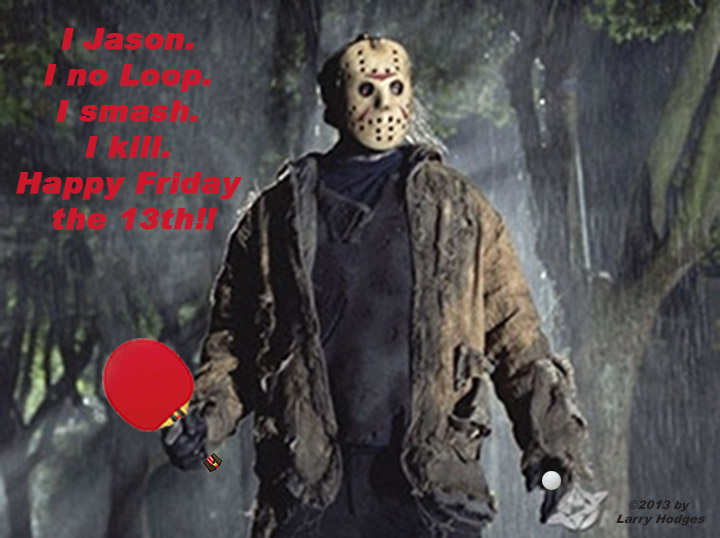
Happy Friday the 13th!
Jason Voorhees, table tennis player, says hi!
The Hobbit and Early-Morning Writing
I saw the midnight showing of The Hobbit Part 2, and didn't get to bed until after 4AM. (I still can't believe that Gollum is Gandalf's father!!!) And I still got up at 8AM to write this blog and do other table tennisy stuff. So if my mind wanders off I have a doggy and I start repeating myself or saying weird things or repeating myself Gollum Gollum loopsy please bear with me I said bear okay?
USA Nationals
I'm off to the USA Nationals in Las Vegas this Sunday for a week. I'm not playing, only coaching, but I'll be incredibly busy. How busy can a coach be since he's only working when one of his players is playing? Extremely! Because there's a lot more to it than just showing up for each match. (Plus I'm coaching two top juniors who are entered in numerous events.)
Before the tournament I have to make sure they are mentally and physically ready. The mental part could take up a book (and of course there are many good books on sports psychology). Suffice to say it's a coach's job to make sure the players go into the tournament with the right frame of mind, as well as well rested and fed. I also have to make sure their equipment is ready. Is the sponge on their rackets new? Do they have backup rackets? Did they remember their shoes? (You wouldn't believe how often junior players forget their playing shoes.) Do they have backup shirts for each day? Are the shirts all different colors than the ball?
Of course I have to prepare for the tournament as well, such as reviewing likely opponents so my players are ready to face them. Plus I did the all-important trip to the grocery store for trail mix, which is what I live on when I'm coaching at tournaments.
Once in Las Vegas I have to arrange practice sessions for the players. At tournaments players and coaches are constantly calling each other to make arrangements, or just to let the other know where they are. How did players survive before there were cell phones?
The tournament starts on Tuesday, but we're flying in on Sunday. That gives us Monday to practice, get used to the conditions, and to the three-hour time difference. When the kids aren't practicing, I want them to relax and have fun. Swimming pool and video games are musts.
When we check in I generally have to pay a few extra dollars for copies of my players' schedules. Once I have them, I sit down somewhere and plan out my schedule for the tournament. It can get complicated, since sometimes there are time conflicts. That's why I consider it important to arrange in advance the guidelines for who I'll coach when. I already know which of my players I'll favor in any given event, though there are judgment calls at any given time, based on the opponent. For example, I may decide that one match isn't as meaningful or competitive as another, and choose what match to coach based on that. However, each player has their priority events, and I'll coach them in every competitive match in that event.
Besides coaching, I'm hoping to attend the USATT Assembly on Wednesday night, and the Hall of Fame Banquet on Thursday night. It all depends on my players' schedules. I'll also spend some time hanging around the Paddle Palace booth, since they sponsor me, where I'll perhaps sign copies of my various table tennis books on sale there.
Coaching is a nerve-racking profession at tournaments. Players may be nervous before a match, but once the match begins most relax and just play. (If they don't, then there's some sports psychology sessions needed.) But coaches don't get to play, and watching is definitely more nerve-racking then playing. Who do you think is more nervous on Sunday night football when the game is on the line, the players or the fans watching? Or the coaches?
I've done this so many times it's all sort of second nature now. Even packing is easy as I have a standard "To Pack" list, which I update for individual tournaments.
This year I've given incentives to some of the Maryland players. Read about them on my Nov. 5 blog. My stomach is already growling in agony just thinking about it.
Tips of the Day
Below are the USATT Tips of the Day since last Friday. These are from the 171 Tips of the Week I did for them from 1999-2003 as “Dr. Ping-Pong.” (Click on link for complete tip.) Note that the Dec. 8 tip is by Carl Danner. The rest are by me.
Dec 13, 2013 Tip of the Day - Playing Dead Blockers
Dead blockers slow the ball down (throwing off your timing), and keep it shorter than you are used to.Dec 12, 2013 Tip of the Day - Practice Service Spin on a Rug!
It’s often difficult to judge how much spin you are putting on the ball when you practice serves. Without this feedback, it’s not easy to improve your serves. So try this find a large, carpeted room, and practice serving there!Dec 11, 2013 Tip of the Day - Think Strategy, Then Let the Shots Happen
Between points, think about what you want to do, especially at the start of the rally what serve to use, what type of receives.Dec 10, 2013 Tip of the Day - Shoe Grippiness "El Dente"
If your shoes aren’t grippy enough, you slide when you play, and so can’t move properly.Dec 09, 2013 Tip of the Day - Inside-Out Forehand Serve
Many players use the forehand "pendulum" serve. It’s the most popular serve in table tennis.Dec 08, 2013 Tip of the Day - Getting Run Off the Table by Carl Danner
Whoops, you're down a game and this one's going badly, too. How do you stop the bleeding in time -- assuming this is an opponent you might expect to beat?Dec 07, 2013 Tip of the Day - Backhand Serve Deception
The key to deception on the backhand serve is the elbow.Dec 06, 2013 Tip of the Day - Get the Back Foot Around when Stepping Around
When stepping around the backhand corner to play a forehand (usually a loop or smash), many players don’t get their back foot around enough.
Table Tennis Club Survey
Georgia State University PHD student Yi Zhang is doing a research project to study the reasons that players join and attend a table tennis club. The survey is a bit lengthy but goes pretty fast - it didn't take me very long. I'm sure she'd appreciate your help. Here's the survey.
ITTF Was Founded in 1926
And so I can write . . . Four score and seven years ago table tennis players brought forth on this world a new federation, conceived in ping-pong, and dedicated to the proposition that table tennis should dominate the world.
I could go on, but I'll let someone else pull up the Gettysburg Address and rewrite the rest of it in table tennis lingo. I just wish I'd thought of this on Nov. 19, the 150th Anniversary of the speech.
China Prepares for 2014 World Team Squad Trials
Win a Signed Blade from Fan Zhendong
Here's the contest page at Table Tennis Daily.
Reggie Miller vs. Nate Robinson
Here's video (37 sec) as the two NBA players prepare to have it out at ping-pong on the TV show NBA Inside Stuff.
***
Send us your own coaching news!
Developing Training Centers
The best thing that's happened to table tennis in recent years is the rise of full-time training centers. I predicted this for years, but most thought there simply weren't enough table tennis players to support more than a few of these. In December 2006, when there were no more than eight to ten full-time TT centers in the U.S. (including my club, the Maryland Table Tennis Center), I even gave a presentation to the USATT Board, urging them to get involved by using their resources to recruit and training coaches to set up these full-time centers and junior programs. I wanted them to set a goal of 100 full-time training centers in five years. The response was a room full of eyes staring back at me as if I were crazy, with two board members bluntly telling me that there simply aren't enough players in this country to support more than a few full-time centers. Others nodded in agreement. They also didn't like the idea of setting a specific number as a goal, since they thought they'd be considered failures if they didn't reach the goal. (This last was crazy, as if you have ten centers and make a goal of having 100, and get, say, 80, you are an incredible success, going from ten to 80 - and then you continue to strive for the 100.) I made a similar challenge at the 2009 USATT Strategic Meeting; same result.
In the seven years since the 2006 meeting, we've gone from ten to 64 full-time professional table tennis clubs in the U.S., with more popping up every month. (There's a new one opening up in Houston that'll soon join the list, and another here in Maryland that's opening soon, and others I probably don't know about.) The ones who thought there weren't enough players to support full-time centers simply did not have the vision, experience, or knowledge to understand why this is happening - that when you open these centers, you develop the players needed to support them. They were stuck in the old-fashioned thinking that you opened a club if there are already enough players to support it, which is backwards. Professional clubs develop their own player base.
The result has been mind-boggling to those who have been paying attention. The number and depth of junior players who are now training regularly is so far beyond where it was just seven years ago as to be incomparable. The players who lose in the semifinals of major junior events would have dominated the events back then, especially up to the cadet level (under 15). There used to be one or two kids who'd dominate their age group for a decade; now there are a dozen of them in each age group, all battling for supremacy and at levels that approach or match the best in the world outside China. It bodes well for the future of U.S. table tennis.
The huge weakness in the growth of these centers is there is no manual on putting together a full-time table tennis center. Every time someone wants to do it they have to reinvent the wheel, or go to current centers to learn how to do it. What's needed is such a manual to grease the wheels, not just to make it easier, but to encourage those considering setting up one to do so.
I already did half the job, with my Professional Table Tennis Coaches Handbook, which covers the professional side of coaching - recruiting and retaining students, setting up and running a junior program, etc. But more is needed on the specifics of opening an actual center, from the finances to the specifics of what's needed to open one. It's a rather long todo list.
So here's my offer to USATT: If they bring in someone or put together a committee to create such a manual (and I'm not volunteering, don't have time, though I might help out), they can incorporate my Handbook, and create a manual, which can tentatively be called "Professional Table Tennis Center Handbook." (Can you think of a better title?) We can then put it on sale at Amazon.com (created via createspace.com, which is how I now create my books), where it can be published "print on demand" at a cheap rate. And that will greatly encourage coaches and promoters to create even more of full-time table tennis centers.
The nice thing about this is that USATT doesn't really have to do much work. They just recruit the person or persons to create the manual, either from volunteers, with a small payment, or (my recommendation), whoever creates it gets the profits from sales, as well as the fame and prestige of being a published author.
Arm Problems
My first physical therapy session for my arm was scheduled on Tuesday. Someone also scheduled a snowstorm on that day. So the session was cancelled. Since I'm leaving for the Nationals this Sunday, I won't be able to get another session scheduled until afterwards. So I'll probably just rest it, and if all goes well, I'll be fine by January.
The Hobbit and Friday's Blog
I may see the midnight showing of "The Hobbit" tonight. If so, I won't get home until around 3AM, and probably not to bed until 4AM - which means tomorrow's blog will probably go up late, probably noonish or so. Brace yourselves!
Table Tennis Funding and the Lottery
For so many years people have wondered how to fund table tennis, when it was so obvious. The Meg-Millions lottery is now up to $400 million, with the drawing tomorrow, which is Friday the 13th. So I'm going to buy a few tickets, and use the winnings to fund table tennis. It's so obvious, why hasn't anyone thought of this before? What can possibly go wrong?
Nervousness and "Winning Ugly"
There's a great piece of advice for dealing with nervousness in the book "Winning Ugly" by Brad Gilbert and Steve Jamison. (I'm referring to the 1994 edition, which I have; there are newer editions.) Chapter 5 is titled, "Four "Nervebusters": Overcoming Pre-Match Nervousness." While he is talking about tennis specifically, all four relate to table tennis as well. The four items are:
- Breathe like you've got asthma (take smooth, rhythmic, deep breaths)
- Get happy feet (stay on your toes and bounce up and down between points)
- Read the label (watch the label on the ball to help you focus)
- Sing a song (hum a relaxing song under your breath).
USATT Assembly
In my blog yesterday I wrote, "Unlike past years, there doesn't seem to be time set aside for those who wish to address the assembly." Some seemed to think I was accusing USATT of breaking Article 15.1 of the Bylaws, which includes the statement, "Individual and organization members and other constituencies may be permitted to pose questions to the Board and Chief Executive Officer for response." Technically speaking, this is fulfilled by the 30 minutes set aside in the Assembly this year from 8:15-8:45PM for "Interaction with the Board and Staff." There's just one problem - I never accused USATT of breaking their bylaws. I said exactly what I meant, so I'll repeat it again: "Unlike past years, there doesn't seem to be time set aside for those who wish to address the assembly." I didn't say they didn't get to pose questions to the Board and CEO for response; I said they no longer seem to have time set aside to address the assembly, as had been done in past years.
Aerobic Table Tennis Official Launch
Here's the ITTF article. "After two years of detailed preparation, Aerobic Table Tennis will be launched in January 2014. Aerobic TT is an alternative way to keep fit. Music is played throughout the session to create a high energy zone. The session includes, warm up and stretching, table tennis movement to music, speed agility and quickness exercises plus of course table tennis."
Fan Zhendong Tribute
Here's video (6:16) of a tribute to the 16-year-old Chinese player, who's already winning ITTF Pro Tour events.
2036 U.S. Olympic Table Tennis Team
Here's video (1:23) of Fiona (3) and Kenzie (1) demonstrating the beginnings of the forehands that will totally dominate the world in 23 years, care of Coach Samson Dubina.
Non-Table Tennis - "Satan's Soul"
On Tuesday I sold my humorous fantasy story "Satan's Soul" to Stupefying Stories. A depressed Satan knows he's going to lose at Armageddon - until a superbeing appears and offers to have him win, in return for his soul! Satan negotiates seemingly favorable terms regarding his soul, and even gets to keep possession of it though he loses ownership. Jesus and the anti-Christ will soon go at it in a UN parking lot, with the Anti-Christ throwing modern military hardware at Jesus in a somewhat over-the-top scene, while Jesus fights back while listening on an iPod to Beatles music. Oh, and a penguin is central to the story! Sorry, no table tennis in this one.
***
Send us your own coaching news!
USATT Candidate Statements and Board of Directors
If you are a USATT member over the age of 18, by now you've received the candidate statements and supplementary campaign statements from the two candidates running for the USATT Board, Jim McQueen and Ross Brown. I've read over them, and let's just say I'm dismayed. I blogged about this a few weeks ago after receiving the initial candidate statements, and now we have the supplementary ones. (As I blogged there, I voted for McQueen because I disagree with Brown on most major issues. At the 2009 Strategic Meeting, Ross and I argued about just about everything, and he "won" the day - nothing I pushed for was adopted, while he was on the "winning" side of nearly every decision. I blogged about this several times, such as here, though I didn't mention names. A few of the links in the blog to USATT news items are no longer valid, alas.) I'm not sure why they have these supplementary statements, but they are more of the same. To be clear, what I have to write here is about what they wrote, not about the candidates themselves - but alas, the candidate statements are for many voters all they have to judge them by.
The statements have no vision, no goals, no plans. They are mostly about how well and fairly they'd judge the issues that come before them as board members. It's as if they are running for USATT judge. To me, this may qualify them to be on certain USATT committees, where fairness issues need to be judged. We need to separate "Fairness Issues" from "Progressive Issues. I blogged about this in March.
We don't need more judges on the USATT Board; we need leaders, both executives and legislators, who will take our sport from its current smallness and make it big. Leaders do not grow a sport by sitting back and judging the issues that come before them; they do so by actively taking the actions needed to grow the sport.
To do this takes vision. Once you have a vision of where you want to go, you set goals to reach that vision. Once you have goals, you create plans to reach those goals. I don't see this in the campaign statements.
Members regularly discuss what USATT needs to do. Why is it that as soon as a member decides to run for office, he so often forgets this? Why would anyone want to be on the Board if the goal was status quo? If the goal isn't status quo, then what are their plans for changing the status quo? There's nothing in the campaign statements that shows any plans or desire to change this status quo, where our membership of 8000 (compared to where we want to be) is no more than a roundoff error.
The membership is hungry for someone with vision, with goals, with plans. There are many out there. I even blogged about ten easy things USATT could do that could pay off big if they'd just take initiative. At one time I tried to take initiative on some of these issues, but USATT wouldn't get behind them. That's the primary reason I resigned as USATT editor and programs director in 2007.
My vision is one of regional leagues all over the country, with hundreds of thousands of members competing in them (from the amateur to the professional level), with many hundreds of training centers dotting the country around every population center, with large-scale junior programs. The goal at the start might be 100,000 USATT League members and 200 Training Centers; more later on. As to plans to reach these goals, they are included in the "ten easy things" I blogged about. I've given presentations to USATT on how to reach these goals, but there just doesn't seem to be any energy to take initiative, even on the "easy" stuff.
The sad thing is there were others who wanted to run for the board, who seem to want to take the initiative, but were not put on the ballot by the USATT Nominating and Election Committee. I already blogged my thoughts on that in the links given above. There's something really wrong with the governing process when a board of directors can set up a committee to decide who can and can't run for the board, regardless of who the membership might vote for. A recipe for status quo. USATT, prove me wrong. Start by leaving that 8000 membership figure in the dust by learning how other sports have done it and how table tennis has done it in other countries and in some regions of this country.
While you explore ways to grow the sport, please, for the love of Ping-Pong, remember this.
(Addendum: I do NOT plan on getting involved in USATT politics, other than the above. I've had my say, and now plan to go back to talking about coaching issues.)
Restrictions of a Drill Mindset
Here's the article. It's about not sticking to a drill when the rally changes unexpectedly.
Practical Advice on Rackets
Here's the article by Kagin Lee, which focuses on proper gluing and care of your racket.
Wang Liqin, Ma Lin, Others Retire from Chinese Team
Here's the article. Others retiring from team are Chen Qi, Qiu Yike, Zhang Chao, Zhai Chao, Zhai Yiming, and Xu Ruifeng.
USATT Annual Assembly
It's at the USA Nationals, as usual, on Wednesday, Dec. 18, from 7-9PM. Here's the agenda. If I'm not coaching I expect to be there. Unlike past years, there doesn't seem to be time set aside for those who wish to address the assembly.
What is Magnus Force?
Here's a video (3:47) that explains the Magnus force, which is what causes a spinning ball to curve. It's actually a pretty simple concept - a spinning ball causes high density air on one side, low density on the other, and the high density air pushes the ball to the low density side.
Ping-Ping Balls on Fire
Here's the video (2:08). The bonfire begins about one minute in. Below the video is an explanation for while ping-pong balls are so flammable.
SnowPongPlayer
Here's the picture! One of the few good things to come out of the snow deluge of the last few days.
***
Send us your own coaching news!
Physical Therapy
I'm supposed to start physical therapy on my arm at 11:30 this morning. However, it's snowing outside (again), and schools and most businesses closed for the second day in a row. I'm guessing it'll be postponed. Since I'm off for the USA Nationals this Sunday, and then will be coaching at our Christmas Camp, I might not be able to schedule anything else until January. We'll see. Meanwhile, the cortisone shot finally stopped hurting. Can't tell how my arm is without playing, and don't want to risk that. So I'll just keep resting it with the idea that I'll be healthy and ready to go by January. (I also have a dental appointment at 2PM, but I'm guessing that'll be cancelled too.)
Table Tennis Tips
Since I'll be stuck at home most of this week without any coaching (thanks to arm problems), I may start work getting my next table tennis book ready for print, tentatively titled "Table Tennis Tips." It'll be a compilation of all my Tips of the Week that have been going up each week the past three years. Sure, you can read them all online, but this puts them all together in one nice convenient package, organized by subject (strokes, footwork, tactics, sports psychology, etc.). It turns out that when I finish the year, I'll have exactly 150 Tips published since I started in January 2011. There are 148 already online, with two more to go, for Dec. 23 and 30. (No Tip on Dec. 16 while I'm at the Nationals.)
First task is the cover. Tentatively I'll go over all my coaching pictures and pick out something. Then I'll do fancy it up with the title and who knows what else.
Second is organizing them by subject, which shouldn't be a huge job. I've already got all of them in one long file. Each week, after putting the new Tip up, I've been cut and pasting it into the file, which (in 12-point Time Roman font) is about 85,000 words and 154 pages with 8.5x11 pages. It'll take a few hours to arrange them into the right order. With formatting, and perhaps adding a few pictures, the final book will be about 270 pages on 6x9 pages. (That's the dimensions of my previous TT book, Table Tennis Tactics for Thinkers.)
Third is the title. Should I go with the simple and to-the-point "Table Tennis Tips"? I've toyed with calling it "Table Tennis Tipalooza." Any suggestions?
Scorekeepers
At the North American Teams last weekend I saw that they were playing the final of Division 12 (average rating 1300) on one table without a scorekeeper, between two all-junior teams (ages 11-13), with dozens of parents and kids watching. I went to the officials table and they lent me a scoreboard. One of the kids, about 10, became the scorekeeper for all nine matches. (Disclosure: I had been coaching a team called "Jawbreakers," and had a bag of jawbreakers I'd been giving out. I paid the kid one jawbreaker per match, so nine in all. He was quite happy with the arrangement.)
One of the best things tournament directors can do to make their tournaments presentable to the public is to have plenty of scoreboards available, and try to have scorekeepers for the "big" matches. It's not hard to get people to scorekeep; just ask and you'll get volunteers. Kids love to do it. The key is that they are scorekeepers, not umpires. Their purpose is to keep score so that spectators can see the score. An exciting point at deuce isn't nearly so exciting if the players don't know it's deuce. In fact, an exciting point at 1-1 isn't so exciting when the spectators have no idea what's going on. They want to see what the situation is; otherwise, it's just two players playing points.
Every major distributor sells scoreboards. Why not buy a few for your next tournament? I own one which I used to bring to tournaments just for my matches, in case I could find a scorekeeper. It's a lot more fun playing with a scorekeeper! It's also easier to focus on your own game when you don't have to worry about keeping score.
Hao Shuai at the North American Teams
Where There is A Will, There is a Way, Bangladesh Overcomes Political Obstacles
Here's the article from the ITTF on USATT Coach Richard McAfee's latest coaching seminar, this time in Bangladesh.
World Class American Table Tennis Players - New Books!
Volumes 2 and 3 are now out of these table tennis history books by Dean Johnson and Tim Boggan. They are on sale at amazon.com. Here are the three volumes to date:
- World Class American Table Tennis Players of the Classic Age
- World Class American Table Tennis Players of the Classic Age Vol. II: Sol Schiff/Lou Pagliaro/Sally Green Prouty
- World Class American Table Tennis Players of the Classic Age Volume III: 1931 - 1966
My Note at the 2001 World Table Tennis Championships
I did coverage for USA Table Tennis of the 2001 Worlds in Osaka, Japan. This often meant long days taking notes and long nights of writing. I just got an email from Diego Schaaf (who was there as a USATT photographers), where he wrote:
I just ran across some notes from the World Championships in Osaka you might remember with amusement. One of them was the sign on your door: "If anyone disturbs me while this sign is up, I will hunt you down and pour speed glue down your throat." (Signed "Larry Hodges, Sleepless in Osaka.") And the other was you, responding to the question, how many hours you had worked between the beginning of the tournament and the final: "All of them. Except 6am to 8am on a couple of days."
Cat Sushi Ping Pong?
***
Send us your own coaching news!
Tip of the Week
Learn Tactics by Coaching Others.
Recap of Past Week
It's been a wild week. Let's recap the last five days:
- Wednesday: I reinjured my arm (or at least aggravated previous injury) and had to cancel four hours of coaching that night and the following night.
- Thursday: $458 in car repairs. (Car was vibrating and needed new tires.)
- Friday: Saw doctor, got a cortisone shot, no more playing for rest of month (i.e. no private coaching). Also spent an hour going over videos of Zhang Jike, Ma Long, and Ma Lin and their footwork, and one of our top juniors, and then sent him a selection to view and compare. Later we discussed it, going over what he needs to do to improve.
- Saturday: Ran a group junior session for 90 minutes, but then sent out emails to cancel the rest of my private coaching for the weekend and the rest of the month.
- Sunday: All my group sessions today (3.5 hours) were cancelled due to snow and sleet. So I sat in a lounge chair all day and night reading and watching TV. It was great!!!
Mentality in a Match and in Practice - Revisited
Someone doubted part of my Tip of the Week for Nov. 25 at the MyTabletennis.net forum, writing that he thought that "…the zone was still something people enter on occasion and that Larry was wrong when he said one could practice entering it." I think this is a common way of thinking for those who don't have the experience that top players and coaches have in sports psychology. Here is my response:
Why do you think you can't practice entering it? Of course you can; you use the same mental techniques in practice that allow you to get into the zone as you would in a tournament. The more you practice doing it, the easier it is to do so in tournaments. Or do you think it's a completely random thing that just sort of happens? That may be true of those who don't understand sports psychology, but the whole point of sports psychology is to allow one to get into the zone on a consistent basis. And you learn to do this with practice; there's no other way. That's why top players meet with sports psychologists so they can learn these mental techniques, and then they practice these techniques in practice sessions (including practice matches) - and then they can do it in serious competition. The idea that it just sort of happens is not how top players do it, which is why the top players can get into the zone and play their best nearly every major tournament. It comes from practice. I know I can get into the zone pretty much at will within a game of any match because I've practiced it for many years and know what mental rituals to go through to attain it. Read "The Inner Game of Tennis," or "Get Your Game Face On!" or "Finding Your Zone."
Here was the response to that: "Usually, it's easier to enter the zone when you aren't being frustrated by your opponent - the level of challenge usually matches the focus you bring. Most players get frustrated in TT when they are missing the ball. The question is whether you can be in the zone and not playing that well." Here's my response:
Half the point of sports psychology is so that things in a match do not frustrate you. If the opponent is frustrating you, then you need to apply the sports psychology techniques used by top players to overcome this. Once in the zone, you will play well, relative to how you would play if not in it. If the opponent does something that really messes you up, it'll mess you up less if you are in the zone.
I'm often in demand as a coach in tournaments. Those who believe coaching at tournaments is all about tactics are only doing half their job. At least half of it is psychological as you use various techniques to get your player into the zone. You can't always do this - a frustrated kid can be hard to get into the zone - but I've been doing this for many years, along with the tactical aspect. The two go together - once someone is thinking about the tactical aspects (which means 2-3 tactics out of zillions of possibilities), then they aren't thinking about losing or other distracting thoughts, and is a quick way to get into the zone.
World Junior Championships
They were held in Rabat, Morocco, Dec. 1-8, finishing yesterday. The big upset was a South Korean won Under 18 Boys over the Chinese juggernaut. Here is the ITTF home page for the event, which includes results, write-ups, pictures, and videos. You can also check how the U.S. team did. (There should be a write-up of that soon by someone else; I'll link to it when it's up.)
Shonie Aki, RIP
Hall of Famer Shonie Aki died last Monday. Here's his Hall of Fame profile. Strangely, while I've sort of known him for many years (mostly through USATT matters), he was always so quiet that I never really knew him except through his Hall of Fame profile.
Ma Long's Instructional
Here's a video (55:30) where world #1 Ma Long of China teaches table tennis, covering nearly all the major aspects. This is a "must watch" for coaches and players.
Chinese Footwork
Here are two videos of Coach Matt Hetherington feeding multiball to Yang Song Wei.
- Three Point Forehand (1:07)
- Full Table Free (1:08)
Table Tennis Player Oldest Olympic Torchbearer
Here's the article. "A 101-year-old table tennis player became the oldest torchbearer in Olympic history Saturday, carrying the flame for the Sochi 2014 Games through the Siberian city of Novosibirsk."
Great Rally at World Junior Championships
Here's video (1:02, parts in slow motion) of a rally between Morizono Masataka (Japan, near side) and Zhou Kai (China) at 2013 ITTF World Junior Table Tennis Championships. See how fast Zhou moves to cover his wide forehand!
Ma Long - Zhang Jike Show
Here's a video (6:06) of the two doing a hilarious exhibition!
***
Send us your own coaching news!
Re: December 9, 2013
Alexander Kaptarenko (that 101-yr old table tennis player who carried Olympic torch) still plays - watch this one around 6.15
https://www.youtube.com/watch?v=qoLnLSLqpyE
Says he was lucky to have been playing almost all his life, and his clubmates say that he is, for them, a constant inspiration.
Re: December 9, 2013
In reply to Re: December 9, 2013 by JimT
It's my first cortisone shot. But even though I might not feel any problems when I play now, it's still injured and needs a bit more rest. By taking the rest of this week off, I can essentially give it three weeks off since the next two weeks after that are the Nationals and our Christmas Camp, where I'll only be coaching in matches and doing multiball.
Seeing Doctor
I'm one of those people who hates seeing doctors. But alas, my arm not only didn't heal during the week I had off playing at the Teams, it somehow got worse. So I finally made an appointment with an orthopedist/sports medicine doctor, for 1PM today. I'll report on this on Monday. I'm pretty sure I have tendinitis.
I'm also considering possible scenarios if I can't do any serious playing for a while, which mostly affects private coaching. I already do a number of group coaching sessions, but I have a number of private students as well. One scenario is I group them in two-hour segments, and bring in one of our practice partners for the middle hour - the second half of the first one-hour session, the first half hour of the second one-hour session. Then I focus on multiball and serve & receive in my thirty minutes, and just coach (while practice partner does the playing) in the other thirty minutes. In an ideal world, I'd have the practice partner do all the hitting the entire hour, but I'd have to pay him for it. This 50-50 arrangements lowers that cost 50%, and should be workable as I can still feed multiball and do most serve & receive drills as long as we don't play out the point.
Jorg Rosskopf and Me
At the about.com forum, Jim Butler quotes German coach and former star Jorg Rosskopf as saying, "When I play with the German Team I only practice playing the first ball against them. After this I just let the ball go." This was because he's older and so not as fast as before, and so can't rally as fast as he used to. This is exactly what I sometimes do with the top juniors at my club. I don't play at the level I used to, but my serve and receive is still very strong, and so often I let them practice against just that, and don't continue the rally.
Returning Short Serves (and Playing Penholders)
Tuesday's USATT Tip of the Day was "Returning Serves Short." This was one of the 171 tips I wrote for USATT back in 1999-2003. Nearly all of them are still pertinent, as is this one, but the opening line says, "At the highest levels, the most common return of a short serve is a short push..." While it is still important to learn the short push if you want to reach a very high level, and you will be handicapping yourself at even a moderately high level if you don't develop it, it is no longer the "most common return of a short serve." In the last ten years we've seen the rise of the backhand banana flip, and that is now the most common return of a short serve.
The best players all have excellent short pushes, but these days more and more top players look to return many or most short serves by attacking with their backhands with a banana flip.
When I coach high-level players, much of the receive tactics against short serves is the proportion of flipping, pushing short, and pushing long. Against some players it's best to mostly push long to the backhand over and over, a nice safe return if they can't attack it effectively. Against others you have to find ways to stop their attack, or to take the attack, and that's where pushing short and flipping come in. Most often a player should choose two of these three returns as the main two, and the third as an occasional variation.
At lower levels it's all about consistency and placement. It's also about reading the serve as many players at the beginning/intermediate levels still find themselves pushing topspin serves.
And yet, the foundation of a good receive is good fundamentals, i.e. good technique and footwork. If you have those, then it gets a lot easier. Many players think they are misreading the spin when they push topspin serves high or off the end, but often they have actually read the spin, but don't have confidence in driving or flipping the ball, whether forehand or backhand, and so fall back on "safe" pushing - which, against a topspin serve, isn't so safe.
So develop those fundamentals and they'll greatly help your receive.
NOTE - today's Tip of the Day, "General Rules of Ball Placement When Attacking," also has one thing I might want to expand on now. Against penholders, it says, "They are less vulnerable in the middle, but still have to choose between forehand and backhand, and so are still weak there. Most penholders tend to be weak on one corner." This was aimed more at conventional penholders, but since that time we've seen the rise of the reverse penhold backhand, which plays pretty much like a shakehander, and is typically as strong in the corners and weak in the middle as a shakehander.
USATT Tips of the Day
Below are the USATT Tips of the Day since last Wednesday, when I left for the North American Teams. These are from the 171 Tips of the Week I did for them from 1999-2003 as “Dr. Ping-Pong.” (Click on link for complete tip.)
Dec 05, 2013 General Rules of Ball Placement When Attacking
Key places to land the ball to win your next match!Dec 04, 2013 Should You Stick With Your Best Shot If It Is Missing?
The situation: Your best shot is missing, and you are losing because of this. Should you keep using it, or abandon it?Dec 03, 2013 Returning Serves Short
At the highest levels, the most common return of a short serve is a short push, even against a sidespin serve. At the lower levels, most players just push them deep, giving opponents the chance to loop.Dec 02, 2013 Playing Against Seemiller Style Players
No two players play alike, and this applies to those with the Seemiller grip as well.Dec 01, 2013 Tournament Experience vs. Practice
Many players practice for many months, not playing in any tournaments until they feel they are completely ready. They then enter a tournament … and flop.Nov 30, 2013 Power Player Control Shots
There’s nothing an experienced and tactical player likes better than facing a player with big shots but little else. On the other hand, there’s little more scary than an opponent with big shots and ball control to set the big shots up and withstand opponent’s attacks.Nov 29, 2013 In a Lopsided Match, What Should the Higher-Rated Player Do?
Many players have difficulty generating great speed on their regular smashes (i.e. off a relatively low ball, not a lob, which uses a different stroke).Nov 28, 2013 Increase Forearm Snap to Increase Smashing Speed
Many players have difficulty generating great speed on their regular smashes (i.e. off a relatively low ball, not a lob, which uses a different stroke).Nov 27, 2013 Flat Flip vs. Topspin Flip
Suppose you face an opponent who serves short, and loops your long returns, even if you flip them.
Nominations for USATT Coaches of the Year
What is the Effect of Sponge Thickness in Table Tennis Rubber?
Here's a series of answers to this question by top coaches, including Stellan Bengtsson, Massimo Constantini, Jasna Rather, Samson Dubina, Tahl Leibovitz, Scott Lurty, and Sara Fu.
ITTF Monthly Podcast
Here's the new video (12:24), covering November.
Kanak Jha Interview
Here's the article and video interview (2:28) with USA's Kanak Jha at the World Junior Championships.
Erica Wu Interview
Here's the article and video interview (1:45) with USA's Erica Wu at the World Junior Championships. She had just upset Laura Pfefer of France.
Liu Shiwen is Technically Flawed
"Ping Pong Summer" to Premiere at Sundance
Here's the article. The movie stars Susan Sarandon as well as Judah Friedlander.
Mike Mezyan's Newest Table Tennis Artwork
Here's "Be Bruce," as in Bruce Lee. It's a "…huge 8 foot by 11 foot wall mural at the new Bruce Lee lounge in Chicago. (Here are other table tennis artworks by Mike.)
More of Yao Ming Playing Table Tennis
Yesterday I posted a short video of basketball star Yao Ming playing table tennis with the Chinese National Team in China. Here's a better and longer video (4:23).
Table Tennis Jokes
***
Send us your own coaching news!
Post Teams Coaching
Now that the North American Teams are over my coaching changes focus. The last few weeks before the Teams I was preparing players for the tournament. Now comes the long period where we focus on developing their games for the longer haul. In particular, I have several players who I'll be working on topspinning their backhands more. I also want to greatly improve serve and receive. And as noted yesterday, we're going to work more on sports psychology. But in general there's going to be a lot more work on fundamentals while setting and aiming to achieve long-term goals.
Arm Problems
HERE WE GO AGAIN!!! But it makes no sense. None. Nada.
I think it was a couple of months ago that I had serious arm problems and had to take two weeks off. I've had minor problems since then, but nothing serious. Then, last week, just before the North American Teams, the arm started hurting again. Part of it might have been the extra coaching hours getting players ready for the Teams. But it wasn't that bad, and I knew I'd be able to take a week off to rest the arm during and just after the Teams. (I coached at the Teams, but except for one session warming up a player for ten minutes didn't play any.) So I rested the arm for exactly one week, from last Wednesday until yesterday.
About five minutes into the session I was grabbing my arm. At first it just seemed tight. Then it began to hurt - badly - especially when I hit backhands. It was the same injury as two months ago, and the same one I'd had as a recurring problem in the 1980s, but not in between. HOW DID MY ARM INJURY GET WORSE WHILE RESTING IT FOR A WEEK???
I finished the session, doing lots of multiball and avoiding hitting backhands. I started my next session - I only had two hours scheduled fortunately - but could barely continue. "Fortunately" (in quotes) my student (Doug) was also having some shoulder problems, and we agreed it'd be best to take the rest of the night off.
I iced the arm last night and again this morning. I've already cancelled my session today. Tomorrow I'm a practice partner from 5-6PM, and have a private session afterwards. I'll skip the 5-6 session, but I think I'll try to do the 6-7PM one - but no backhands. When needed, I'll play forehands from the backhand side. Hitting backhands is what really causes the problems, but once I hit backhands repetitively for even a few minutes the arm swells up and I can't do much of anything. Fortunately, most of my weekend coaching is group sessions, where I don't have to use my arm except for multiball. But I have a few sessions in there.
I'm also going to (finally) make an appointment to see a doctor or trainer.
The good news? My knees seem totally healed from the problems I've had there this past month. The week off really helped. Also, with the Teams over, and with the Nationals and Christmas coming up, my coaching schedule isn't very heavy right now. (I leave for the Nationals Sunday, Dec. 15, returning the morning of Sunday, Dec. 22.)
New World Rankings
The new World Rankings are out. On the men's side, the big change is Fan Zhendong of China jumping from 11 to 5. Chinese men now hold the #1-5, 7, 11, 12, 14, 18, 22, 43, 58, 61, 91, and 100 spots. Germany has #6, 8, 24, 25, 49, 60, and 78. Taiwan has #9, 23, and 88. South Korea has #19, 26, 27, 35, 36, 39, 46, 56, 65, 68, and 83. Hong Kong has #21, 31, 96, and 98. USA's top three are #352 (Yuan Xiaojie), 367 (Timothy Wang) and 393 (Wang Qingliang).
On the women's side, the only major change near the top is Ai Fukuhara of Japan jumping from 14 to 9. Chinese women now hold the #1-3, 5-8, 11, 15, 22, 29, 34, 36, 51, 52, 65, 66, 83, 88, 89, and 97-99 spots. Singapore has #4, 20, 69, and 74. Japan has #9, 10, 26, 37, 50, 57, 63, 64, 75, 76, 78-80, 90, and 94. South Korea has #12, 17, 21, 24, 25, 35, 47, 66, 72, 73, 85, and 91. USA's top three are #80 (Ariel Hsing), 110 (Lily Zhang), and 171 (Zheng Jiaqi).
World Junior Championships
They are going on right now in Rabat, Morocco, Dec. 1-8. You can follow all the action at the ITTF World Junior Championships page. USA players are: Boys - Kanak Jha, Theodore Tran, Kunal Chodri, and Allen Wang; Girls - Prachi Jha, Tina Lin, Ariel Hsing, and Erica Wu
Yao Ming Playing Table Tennis
Here's the article, interview, picture, and link to a video (1:48) of the basketball star hitting with members of the Chinese Team, with commentary in Chinese. He's a penholder.
Table Tennis Doll
Head Table Tennis
Here’s the bizarre video (5:05, with the “table tennis” starting about one minute in) of a new version of table tennis, where players head mini-volleyballs back and forth.
***
Send us your own coaching news!
Sports Psychology and Sport Psychology Books
After watching and coaching at the Teams, I'm upping the sports psychology training. In fact, I just got out to review my copies of "Get Your Game Face On" by Dora Kurimay, "The Inner Game of Tennis" by Timothy Gallwey, and "Finding Your Zone" by Michael Lardon. I also discovered that my copy of "Winning Ugly" by Brad Gilbert is missing, and realized I lent it to someone a long time ago and never got it back - so I just ordered a new copy. (A new version came out in May this year anyway.) I also discovered a new book, "Coaches Guide to Sport Psychology" by Rainer Martens which I just ordered. (Dora Kurimay and Michael Lardon are both sports psychologists and top table tennis players. Dora ran a sports psychology session at MDTTC I think in early 2012. "The Inner Game of Tennis" and "Winning Ugly" both use tennis as examples, but the principles apply to all sports, and they are both considered classics that are read by top athletes from every sport.)
I've undergone a lot of sports psychology training, and long ago incorporated much of it into both my game and my coaching. During the four years I was (at different times) manager, director, and/or assistant coach at the Resident Training Program for Table Tennis at the Olympic Training Center in Colorado Springs (1985-89), the players often had weekly group sessions with the sports psychologists there, which I normally attended. Many had private sessions as well. But I think it'd be valuable for me to go back and review all the stuff I learned so long ago.
At the Teams it was interesting watching the different responses to tournament pressure by different players. Here are four of them, all ages 12 or 13. All four of them read my blog (at least sometimes), as do some of their parents, so I'm guessing they'll recognize themselves!
Player A was a vintage case of nervousness under pressure. He had difficulty throughout matches overcoming this, and especially when it got close. I'm going to be working with him on this as it really hampers his play as he tends to stand up straight, freeze up, and miss shots over and over that he makes pretty consistently in practice games at the club.
Player B seemed on edge much of the time, but was able to play well in spite of this - but it affected his tactics as he often was afraid to attack. Especially against weaker players he'd just push, chop, fish, and lob, even if he was losing. When he'd fall behind, he'd finally work up the nerve to attack, and then he'd start winning again - and then he'd stop attacking again. He needs to gain confidence in his game, which includes attacking.
Player C seemed to guide his shots early in games rather than just let them go, especially with his forehand loop, his best shot. But in contrast to most players, as it got close, he seemed to get looser, and his shots more fluid. He needs to work on relaxing early on, perhaps by pretending it's already deuce.
Player D wasn't really nervous, but he kept having slow starts as if he couldn't quite get up for the match. Then he'd turn it on and play really well for several games. But late in matches, especially in fifth games, he seemed to lose focus and get careless with his shots. He also is too easily distracted by outside things, which affects his play and leads to some matches where he's mentally not there. I have a few focus drills I want to try on him - one of which is where he practices serves while I try to distract him with "trash talk," and he has to just tune me out. (This is based on the famous Tiger Woods drill where he'd practice at the driving range while his dad would try to distract him.)
I'm working out plans for these players so they can overcome these problems, and ideally turn them into strengths. There's a reason why so many top players say the game is mostly mental. I'll likely be assigning some reading to these players.
While pulling out my sports psychology books, I also pulled out my copy of "Successful Coaching" by Rainer Martens, the best-selling coaching book in America. It also covers sports psychology. The five sections are:
- Developing a Coaching philosophy
- Sport Psychology
- Sport Pedagogy
- Sport Physiology
- Sport Management
So I'll be reviewing this book as well. (And I still have to read "The Next Step," so I've got some busy reading coming up.)
Difficulty Level of Table Tennis Techniques
Here’s an article that judges the relative difficulty level of various table tennis techniques, and puts them in five categories, from easiest (the counter-hit) to most difficult (topspin against topspin, i.e. counterlooping, and chopping against topspin).
Random Thoughts of a Table Tennis Nut from a Basketball-Crazy Nation
Here’s the essay from fellow TT nut Lorenzo Antonio Angel.
Ma Long for Super League’s Most Valuable Player
Ma Long and Yan An Backhand Topspin Training
Here’s the video (1:56).
Snoopy
Here’s a new picture of Snoopy playing table tennis. Here’s another one where he looks like Mr. Cool.
Never Underestimate Your Opponents
Here’s a hilarious new video (2:14) of two guys who underestimate the level of play of the two girls who ask to play. The two women are Austrian stars Amelie and Petrissa Solja.
***
Send us your own coaching news!




Re: December 24, 2013
This "satisfied" rule is an incredibly bad rule - more or less any rule is somewhat subjective because its enforcement and decision on when to invoke it in the hands of umpires/referees - but this one takes the cake because it incorporates the subjectivity directly and formally into the language of the rule. Whoever came up with that language should be barred from ITTF Rules Committee for life.